2014issue C0110-14
Ideal trader hindsight as a pretrade filter
A discretionary path keeps scan, sizing, management, and exit as live choices, while a finished system encodes those same choices in advance. The archive scores a planned stop, entry lag, and target against a hypothetical ideal trader, then reads a decision matrix of win chances before capital is committed.
- An ideal trader is a hypothetical path that buys every low and sells every high after ignoring noise-threshold swings, and it is used only to score a planned trade.
- Qualifying ideal-path profits are described with a profit distribution in which the smallest wins are the most frequent and larger wins are rarer.
- A decision matrix turns target multiple and entry lag into a pre-entry win chance, and a trailing-stop map rereads that matrix when the first target is missed.
- Low matrix win chances are presented as typical of trend-following setups and are judged against payoff size and competing opportunities. The same matrix scores nontrending swings after a mean-reversion swap.
Discretionary choices and encoded systems
A discretionary path requires continuous choices from scan through sizing, management, and exit. A finished system encodes those choices in advance.
The ideal trader as a scoring path
The evaluation construct is a hypothetical actor allowed to place orders in the past at turning points. That actor extracts the largest available move after ignoring swings smaller than a chosen minimum target.
The archive calls this path the ideal trader. The chosen minimum target is the control parameter, which also sets the stop distance and the unit of profit measurement. Any price swing smaller than the control parameter is a noise threshold. It is treated as untradeable and ignored.
The profit distribution
On that construct, qualifying profits are described as exponentially distributed, with standard deviation equal to the control parameter and mean equal to twice that parameter. The smallest qualifying wins are therefore the most frequent. That claimed shape is the profit distribution: larger wins are rarer.
The accompanying probability chart is read as about a 60 percent chance that an ideal-path profit is no larger than twice the control parameter, and about a 40 percent chance that it exceeds the control parameter.
Matching a planned trade to the path
A planned trade is scored by matching its stop, entry lag, and target to the ideal path. Entry lag is how far the planned entry sits from the matching ideal turning point, measured in units of the control parameter. Target multiple is the planned profit distance expressed as a multiple of the same control parameter used for the stop.
When the target equals the stop and the entry sits two stops from the ideal turn, the implied chance of reaching that target is 14 percent. That reading follows because the matching ideal profit must be at least three control units.
The decision matrix
A pre-entry decision matrix lists win chances for combinations of target multiple and entry lag. A trailing-stop entry one control unit from the ideal turn is assigned a 61 percent chance of a half-stop win and a 37 percent chance of a one-stop win.
When the first target is missed
If a trade misses its target, remaining smaller profits are scored by mapping the realized profit onto a larger ideal-path profit and rereading the same matrix with the target-plus-one substitution. That remapping is the trailing-stop map, so an unfinished trade still has a probability estimate.
How the archive frames low win chances
The relatively low win chances in that matrix are presented as typical of trend-following setups. They are meant to be judged against payoff size and competing opportunities, not as a reason to reject every such trade.
Scoring nontrending swings
The same matrix can score nontrending swings by swapping roles. The control-parameter stop becomes the profit target and the former target becomes a fixed stop. That mean-reversion swap keeps nontrending swings on the identical scale.
Ideal-trader cumulative profit probability
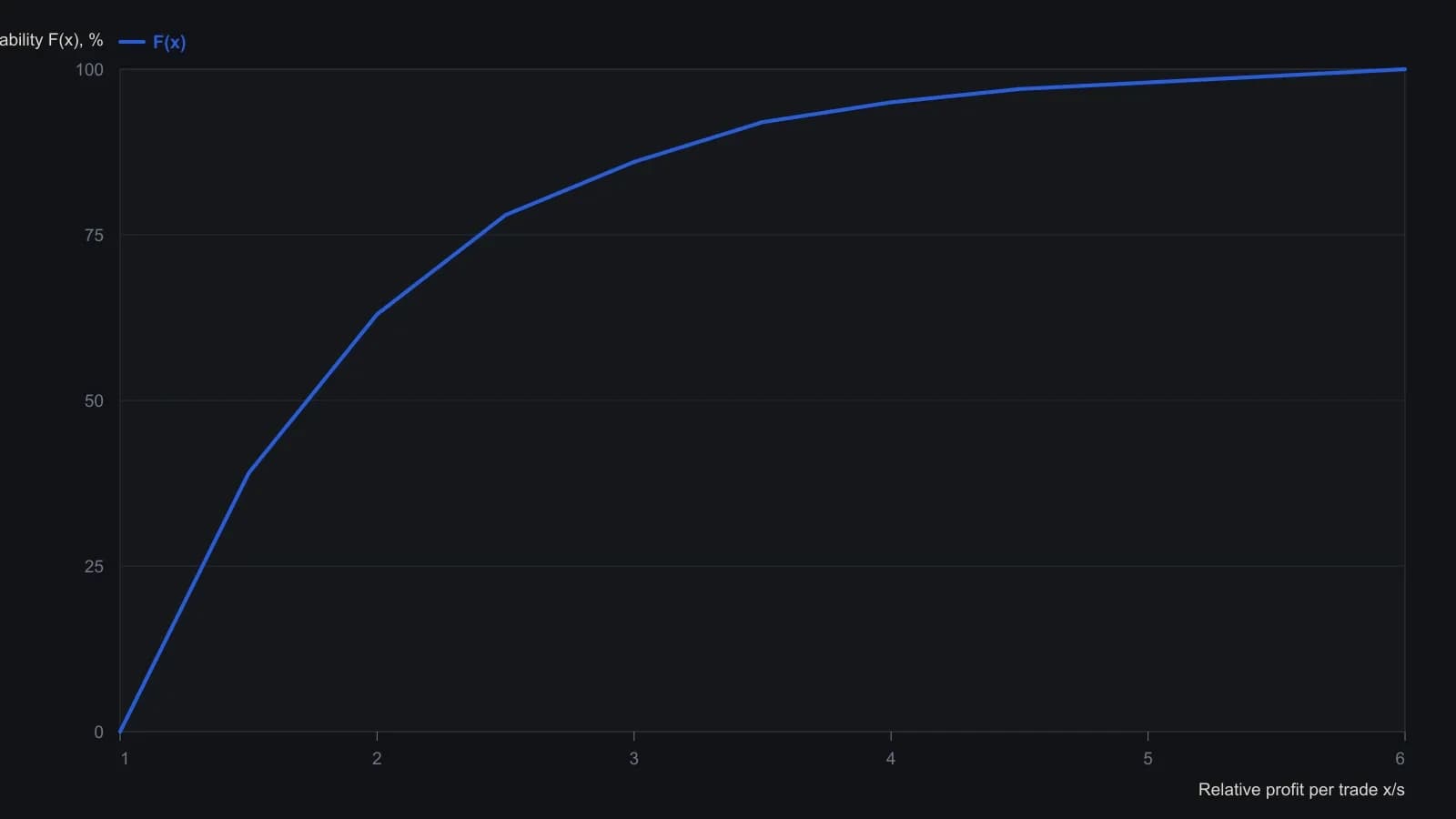
The source treats captured profits as exponential with mean 2s and standard deviation equal to the stop s, so the smallest counted move is one stop. Matrix cells are whole percents, and F(x) is the chance the ideal-trader profit is at most x.
All readings on this track · 22 readings
- 1995A pre-trade checklist that bounds loss before the order
- 1998Ledger audit of exits, payoff, and overlap
- 1998A return-to-loss filter for drawdown-aware evaluation
- 2000Pair historical volatility with return-to-loss filters
- 2001Credit-spread construction that can fail before any order is sent
- 2002Evaluating mechanical systems in a traders market
- 2002Profitability as a bound implied by RWL and commission
- 2004A day-trading breakeven matrix for size and win rate
- 2006Sit out, size and expectancy as one procedure
- 2006A testable intraday procedure from setup to stand-down
- 2007A planned liquidity offer at the inflection point
- 2011A style-neutral expectancy filter for system evaluation
- 2011Separate buying power from posted risk capital
- 2012Design before you trade: testing mechanical systems
- 2014Ideal trader hindsight as a pretrade filter
- 2014When expectancy and drawdown limits disagree
- 2015Signal, confirm, and invalidate before the trade
- 2015Price the win, stall, and loss before a stock entry
- 2016Construct expectancy by bounding losses and winner size
- 2017Estimate expectancy before you accept the trade
- 2017Size ladder tests for drawdown caps and expected value
- 2017Evaluate a high-yield correlation break as one locked procedure