2007issue C081-11
A system-management template that sets the stop and the required reward before entry
A system-management template applies the same money-management and trade-management checks to mechanical and non-mechanical strategies. Trade size, a volatility-based stop-loss, and a dynamic risk-reward ratio are named so the allowed loss is set before and during the position.
- Money management calculates trade size and the loss allowed if the trade fails, while trade management covers the rules applied before and after a position is open.
- A system-management template applies both checks to mechanical and non-mechanical strategies.
- One trend-following procedure sized each futures trade so a volatility-based initial stop would lose no more than a fixed 2 percent of a notional account, reset that account each year, and kept add-on clusters inside the same 2 percent bound.
- A software implementation accepted initial equity, a nominal risk percent, and a volatility-risk percent, allowed only long positions, and used a dynamic risk-reward check with a default minimum ratio of 3 plus a stops barrier to judge whether a trade still merited capital.
Money management and trade management
Money management is defined as calculating trade size and the loss allowed if the trade fails. Trade management covers the rules applied before and after a position is open.
A system-management template is a reusable worksheet designed to apply both money-management and trade-management checks to mechanical and non-mechanical strategies, before and during a position.
A stop-loss is a pre-set invalidation price that caps the loss if the trade is stopped out. A risk-reward ratio compares planned reward to planned loss and is used as a go or no-go filter before entry.
A mechanical trading system is a fully specified procedure for entries, exits, and abstention that can be coded and reviewed as one set of rules. The template is designed to apply the same checks to that kind of procedure and to non-mechanical strategies.
A notional account and a volatility stop
A notional account is a theoretical account used to size risk so each trade is treated as an equal unit of allowed loss. A volatility stop is an initial stop placed from a volatility measure rather than from an arbitrary dollar amount.
One referenced trend-following procedure sized each futures trade so that a volatility-based initial stop would lose no more than a fixed 2 percent of a notional account.
That same procedure reset the notional account at the start of each year from the prior year's system results and treated every trade as an equal unit of allowed loss.
When add-on trades followed a successful breakout, stops were reset so that the whole cluster still risked no more than 2 percent of the notional account.
Software inputs and the stops barrier
A software implementation of the template accepted initial equity, a nominal risk percent, and a volatility-risk percent as inputs and allowed only long positions.
A dynamic risk-reward check was specified as a template input, with a default minimum ratio of 3, and was used to monitor whether a trade still merited capital.
The stops barrier is a price line derived from a target and a minimum risk-reward requirement that the stop must stay beyond. The stops-barrier calculation placed that line at close minus the distance from close to target divided by the minimum dynamic risk-reward ratio.
AAPL daily close versus the rising stop barrier
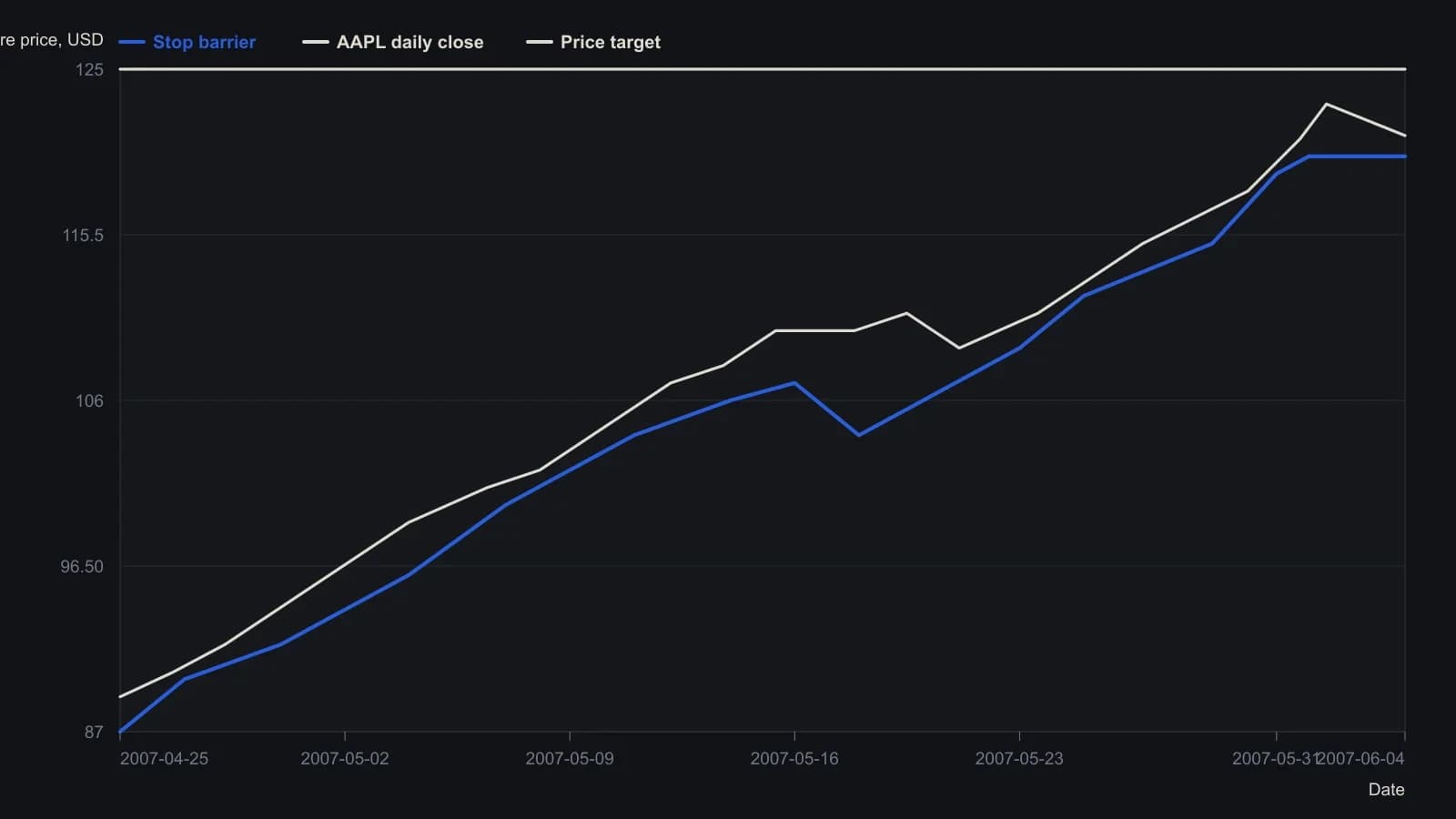
Barrier is SB = close − (target − close) / minDRR with target $125 and minDRR = 3. Digitised prices are rounded to about a dollar, the resolution of the raster, except the on-chart last close of 121.191. The line is plotted only once it is inside the visible 86–126 window.
All readings on this track · 27 readings
- 1987Precommit the stop and require a surplus payoff
- 1987When open losses overwrite precommitted exit rules
- 1991Ranking month-end holds with risk-reward and stops
- 1994Evaluating percentage profit exits on trend-following averages
- 2001Construct reward to risk before entry
- 2003A pre-trade readiness checklist for entry, abstention, and risk
- 2003Evaluating out-of-the-money strikes with saddle premiums and implied volatility
- 2004A critique of one-procedure trading decisions
- 2004Mechanical stops leak intent and misprice losses
- 2004Implied-volatility premium on rate indexes
- 2006Keep the stop that authorized the entry
- 2006Bound the loss with a risk-to-reward filter before entry
- 2007Audit the operator before abandoning a system
- 2007Failed-break slingshot reversal rules
- 2007A system-management template that sets the stop and the required reward before entry
- 2007Construct a pre-trade style envelope for entries and skips
- 2008Systems that skip the three decision gates
- 2010Four-gate veto before trend entries
- 2012Construct a trading plan as one written procedure
- 2012Forex stops and reward targets by quote increment
- 2013The average directional index as a lookback cluster and a risk-reward bound
- 2014A three-step worksheet for VIX futures tick value and low-vol risk-reward
- 2014Binary option premia, fees, and pre-expiry risk-reward
- 2015Selling far out-of-the-money commodity option premium as a forgiving timing case
- 2016Prepaid option spreads that bound range-day risk and reward
- 2016Pre-trade risk-reward versus instinctive exits
- 2020Bounding a short-dated option spread with a stop, a gap remainder, and a credit exit