2014issue C0937
A three-step worksheet for VIX futures tick value and low-vol risk-reward
TradersWeek editorial: keep implied-volatility, futures-contract-selection, and a risk-reward-ratio filter on one page. Pick the listed VIX expiry rather than the cash index, convert every volatility-point distance into dollars with that contract’s increment, and reject the long unless the loss to a documented floor stays inside a preset bound versus the dollar distance to rebound zones.
- Futures-contract-selection uses a specific VIX expiry plus that listing’s session hours, 0.01 tick increment, and $10 multiplier instead of the informational cash index.
- Implied-volatility is expected S&P 500 volatility as priced in the VIX complex, and a depressed futures print is a market-regime input rather than a cash-index quote.
- The risk-reward-ratio filter turns the gap from the working price to a cited floor or rebound into dollars with the contract multiplier, then compares the two sides before size is taken.
- A long VIX futures stance is treated as subject to erosion if implied volatility does not rise, while upside moves are characterized as abrupt rather than gradual.
Keep the three checks on one page
The archive workflow started from implied-volatility: expected S&P 500 volatility as priced in the VIX complex. A depressed futures print was treated as a market-regime input, not as a cash-index quote.
Futures-contract-selection then replaced that informational index with one listed expiry, so session hours, the 0.01 tick increment, and the $10 multiplier sat beside the regime read. The risk-reward-ratio filter used those same dollars to compare a cited floor with rebound zones before size was taken.
Step one: choose the listed expiry
Futures-contract-selection means choosing a specific VIX futures expiry and applying that listing’s session hours, 0.01 increment, and $10 multiplier instead of the informational cash index.
Listed VIX futures use a 0.01 minimum increment valued at $10, so a one-point move from 13.00 to 14.00 equals $1,000 per contract. That 0.01 minimum price change is the tick increment.
The usual bid-ask width is about five ticks, or $50, and quoted prices often step in those five-tick increments even when daily volume reaches tens of thousands of contracts.
Weekday trading ran from 3:30 p.m. Central to 3:15 p.m. the next day, with a 15-minute pause aligned to e-mini S&P 500 futures hours.
Step two: convert point distances into dollars
Every volatility-point distance is converted with the selected contract’s increment, not with the cash index.
Dollar results are computed from the absolute gap between the higher and lower prices multiplied by $10, then labeled as a gain or a loss according to whether the position was long or short.
Step three: compare the dollar sides before size
The risk-reward-ratio is a pre-entry filter that turns the gap from the working price to a cited floor or rebound into dollars with the contract multiplier, then compares the two sides before size is taken.
TradersWeek editorial note: the archive records those dollar gaps. It does not record a numerical bound that had to be met before a long could be accepted. The filter taught here is the on-page comparison of the two sides.
A mid-June 2014 pass through the worksheet
In mid-June 2014 the July 15, 2014 VIX futures were near 12.50, near a contract low and close to the lowest futures prints since March 2004, which sat in the mid-11s.
With the $10 multiplier, a drop from 12.50 to about 11.50 implied roughly $1,000 of adverse variation, and a drop toward a cash-index floor near 9.50 implied roughly $3,000.
The same multiplier mapped a rebound from 12.50 to about 13.80 as roughly $1,300 and a move to about 15.50 as roughly $3,000. A faster recovery into the 18 to 20 area mapped to more than $7,000 per contract before costs.
The cash-index floor is the informational VIX low used only as a more distant historical reference, not as a tradable futures price.
July 2014 VIX long: dollar risk versus rebound targets
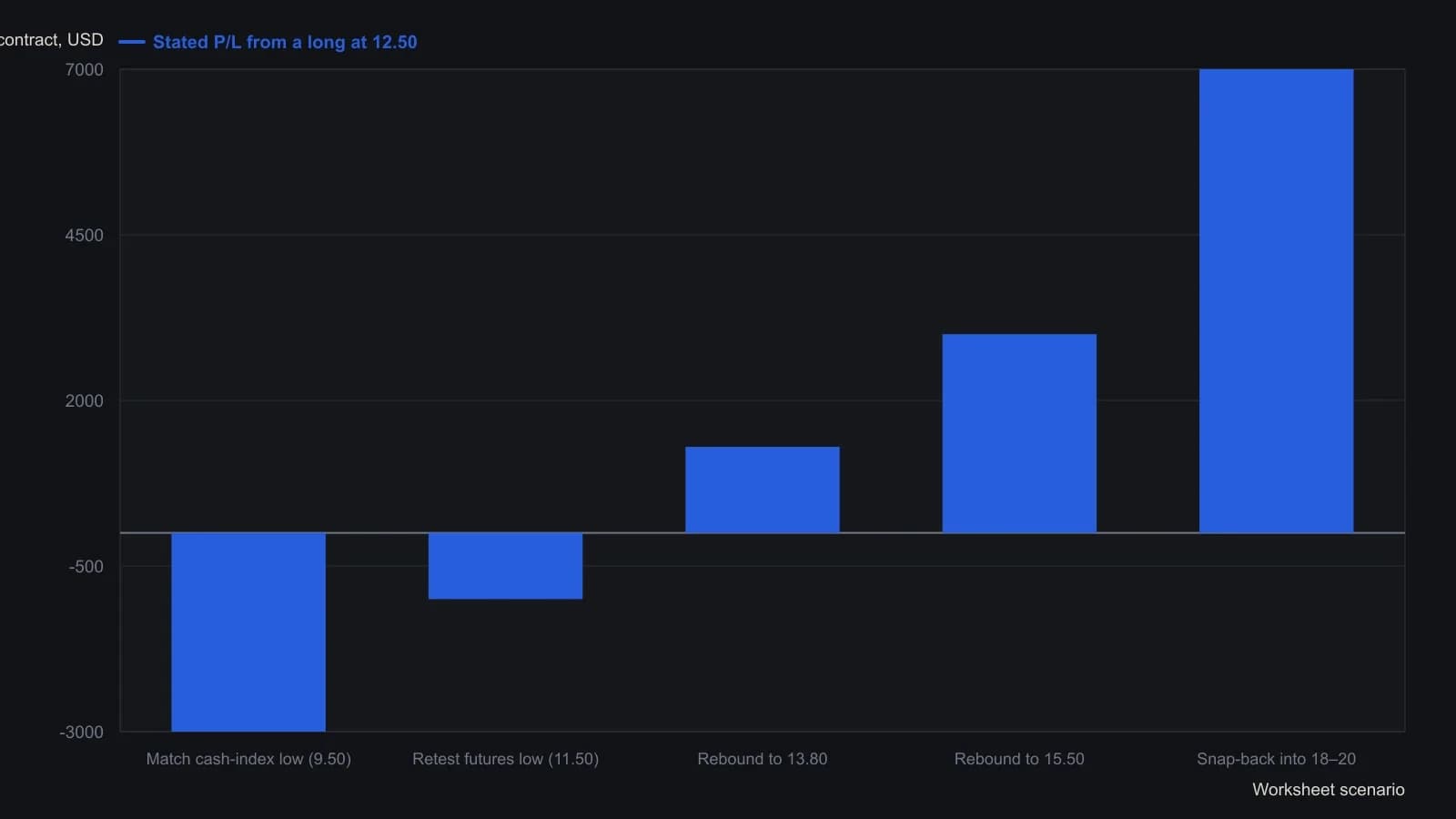
The column prices a 0.01 increment at $10, so one full VIX point is $1,000. Mid-11s, mid-9s and mid-15s appear in the worked sums as 11.50, 9.50 and 15.50. The $7,000 recovery figure is stated as a lower bound for a move into the 18–20 area, not an exact print.
Erosion if implied volatility does not rise
A long VIX futures stance is treated as subject to erosion if implied volatility does not rise, while upside moves are characterized as abrupt rather than gradual.
All readings on this track · 27 readings
- 1987Precommit the stop and require a surplus payoff
- 1987When open losses overwrite precommitted exit rules
- 1991Ranking month-end holds with risk-reward and stops
- 1994Evaluating percentage profit exits on trend-following averages
- 2001Construct reward to risk before entry
- 2003A pre-trade readiness checklist for entry, abstention, and risk
- 2003Evaluating out-of-the-money strikes with saddle premiums and implied volatility
- 2004A critique of one-procedure trading decisions
- 2004Mechanical stops leak intent and misprice losses
- 2004Implied-volatility premium on rate indexes
- 2006Keep the stop that authorized the entry
- 2006Bound the loss with a risk-to-reward filter before entry
- 2007Audit the operator before abandoning a system
- 2007Failed-break slingshot reversal rules
- 2007A system-management template that sets the stop and the required reward before entry
- 2007Construct a pre-trade style envelope for entries and skips
- 2008Systems that skip the three decision gates
- 2010Four-gate veto before trend entries
- 2012Construct a trading plan as one written procedure
- 2012Forex stops and reward targets by quote increment
- 2013The average directional index as a lookback cluster and a risk-reward bound
- 2014A three-step worksheet for VIX futures tick value and low-vol risk-reward
- 2014Binary option premia, fees, and pre-expiry risk-reward
- 2015Selling far out-of-the-money commodity option premium as a forgiving timing case
- 2016Prepaid option spreads that bound range-day risk and reward
- 2016Pre-trade risk-reward versus instinctive exits
- 2020Bounding a short-dated option spread with a stop, a gap remainder, and a credit exit