2004issue C071-5
A critique of one-procedure trading decisions
This archive article reads a historical decision workflow in which entry, exit and abstention are meant to be one testable procedure, then asks how stop-loss and risk-reward filters bound that procedure before a trade is placed.
- The registered process turns rule inputs, market state and execution constraints into a signal meant to make entry, exit and abstention testable as one procedure.
- A stop-loss and a risk-reward ratio are filters that bound a loss or exposure decision before entry and throughout the position.
- Those filters read account equity, volatility, stop distance and exposure rather than generating the signal themselves.
- Editorial reading: the critique is whether the filters sit inside that procedure or cut it off before the procedure can be tested as a whole.
What the process is for
The registered trading psychology process takes rule inputs, market state and execution constraints and holds them for the system holding period. Its stated use is to make entry, exit and abstention rules testable as one procedure. The output is a signal, not a separate price forecast.
The archive facts describe that historical workflow. They do not, on their own, say how the parts should be ordered when a live decision is made.
Monthly principal and interest on a 30-year mortgage
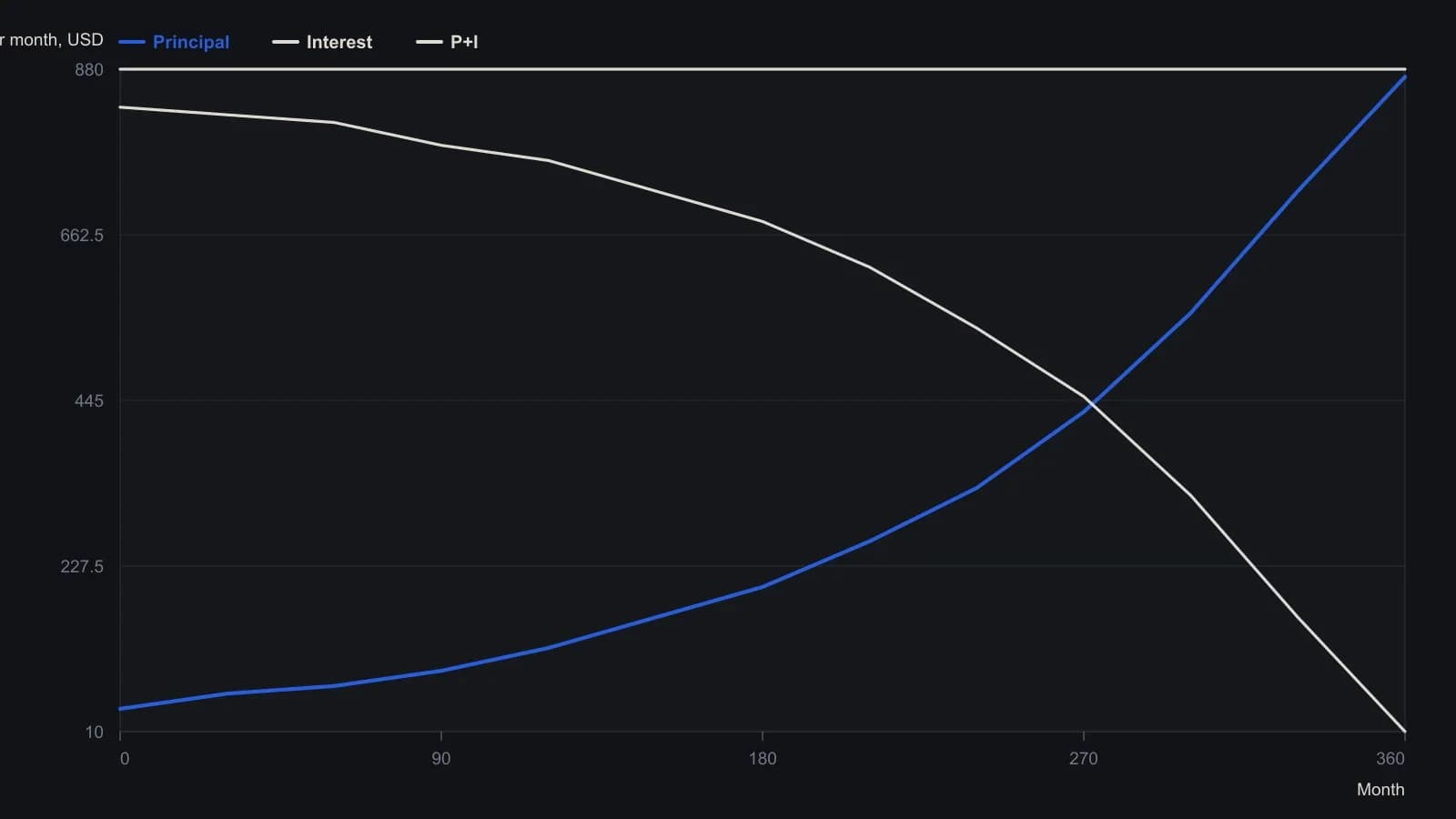
Interview terms are a $100,000 balance at 10 percent with a stated $877.57 monthly payment. The magazine raster is coarse, so plotted amounts are rounded to the nearest $10 and are not an amortization table.
Where the filters sit
A stop-loss and a risk-reward ratio are registered as filters, not as the signal. Both use account equity, volatility, stop distance and exposure. Both are meant to keep a loss or exposure decision bounded before a trade is placed, and to remain in force throughout the position.
The filters therefore sit beside the procedure rather than replacing it. They can accept or reject exposure. They do not rewrite the entry, exit and abstention rules into a different method.
The tension in the decision process
The topic is the decision process inside a trading system. Entry, exit and abstention are supposed to be one procedure. The filters are supposed to bound loss and exposure before that procedure becomes an open position.
Editorial reading: a system can apply each registered rule and still fail as a decision process if the signal and the filters are not used in a fixed order. The critique is about whether the procedure stays testable once the filters can halt it, not about whether any one rule is missing.
All readings on this track · 27 readings
- 1987Precommit the stop and require a surplus payoff
- 1987When open losses overwrite precommitted exit rules
- 1991Ranking month-end holds with risk-reward and stops
- 1994Evaluating percentage profit exits on trend-following averages
- 2001Construct reward to risk before entry
- 2003A pre-trade readiness checklist for entry, abstention, and risk
- 2003Evaluating out-of-the-money strikes with saddle premiums and implied volatility
- 2004A critique of one-procedure trading decisions
- 2004Mechanical stops leak intent and misprice losses
- 2004Implied-volatility premium on rate indexes
- 2006Keep the stop that authorized the entry
- 2006Bound the loss with a risk-to-reward filter before entry
- 2007Audit the operator before abandoning a system
- 2007Failed-break slingshot reversal rules
- 2007A system-management template that sets the stop and the required reward before entry
- 2007Construct a pre-trade style envelope for entries and skips
- 2008Systems that skip the three decision gates
- 2010Four-gate veto before trend entries
- 2012Construct a trading plan as one written procedure
- 2012Forex stops and reward targets by quote increment
- 2013The average directional index as a lookback cluster and a risk-reward bound
- 2014A three-step worksheet for VIX futures tick value and low-vol risk-reward
- 2014Binary option premia, fees, and pre-expiry risk-reward
- 2015Selling far out-of-the-money commodity option premium as a forgiving timing case
- 2016Prepaid option spreads that bound range-day risk and reward
- 2016Pre-trade risk-reward versus instinctive exits
- 2020Bounding a short-dated option spread with a stop, a gap remainder, and a credit exit