2020issue C1216-19
Bounding a short-dated option spread with a stop, a gap remainder, and a credit exit
In a historical worked example, a short-dated option spread was read from underlying price and days remaining before entry. The same stop price implied different dollar losses by time left, a gap through the stop could exceed those losses, and some holders used a stated fraction of maximum credit as an early exit.
- In the worked example, a stop at 73.50 implied a loss of roughly 62 if hit immediately and roughly 19 if hit on expiration day.
- A gap through the stop could exceed either stop-path loss, up to a stated maximum of 169 per one-lot. The worst-case remainder required a gap below 72, past the 73.50 stop.
- If the underlying stayed above 74 through expiration, the stated credit on the example spread was 31.
- Some holders planned to stay until expiration, while others treated 50 percent to 80 percent of maximum credit as an early exit. In one path, two sessions before expiration the open credit was 25, equal to 80 percent of the 31 maximum.
A pre-trade reading of the spread
An option spread is a defined set of option legs whose dollar outcome can be read from underlying price and days remaining before the trade is placed. The archive example used that reading as the working picture of the position.
The example risk diagram plotted dollar outcome against both underlying price and days remaining, with one curve for the first day and another for expiration.
The same stop price, two dollar losses
A stop-loss is a precommitted underlying price used to close the spread so a planned loss is bounded when that price trades without a gap. In the worked example, a stop at 73.50 implied a loss of roughly 62 if hit immediately and roughly 19 if hit on expiration day.
When a gap consumes more than the stop
Gap-through-risk is the extra loss that appears when the underlying jumps past the stop and the close occurs only after a worse fill, up to the spread’s maximum debit. A gap through the stop could exceed either stop-path loss, up to a stated maximum of 169 per one-lot.
The worst-case remainder in the example required a gap below 72, past the 73.50 stop.
Stated credit against both loss figures
Risk-reward-ratio is the comparison of stated credit if a favorable price holds through expiration against the stop-path loss and the larger gap-through remainder. If the underlying stayed above 74 through expiration, the stated credit on the example spread was 31.
Credit-harvest is an optional early close once a stated fraction of maximum credit is already in hand, used to drop remaining time risk before expiration. Some holders planned to stay until expiration, while others treated 50 percent to 80 percent of maximum credit as an early exit.
In one path, two sessions before expiration the open credit was 25, equal to 80 percent of the 31 maximum.
AMD $73.50 stop: dollar loss by time left, plus gap remainder
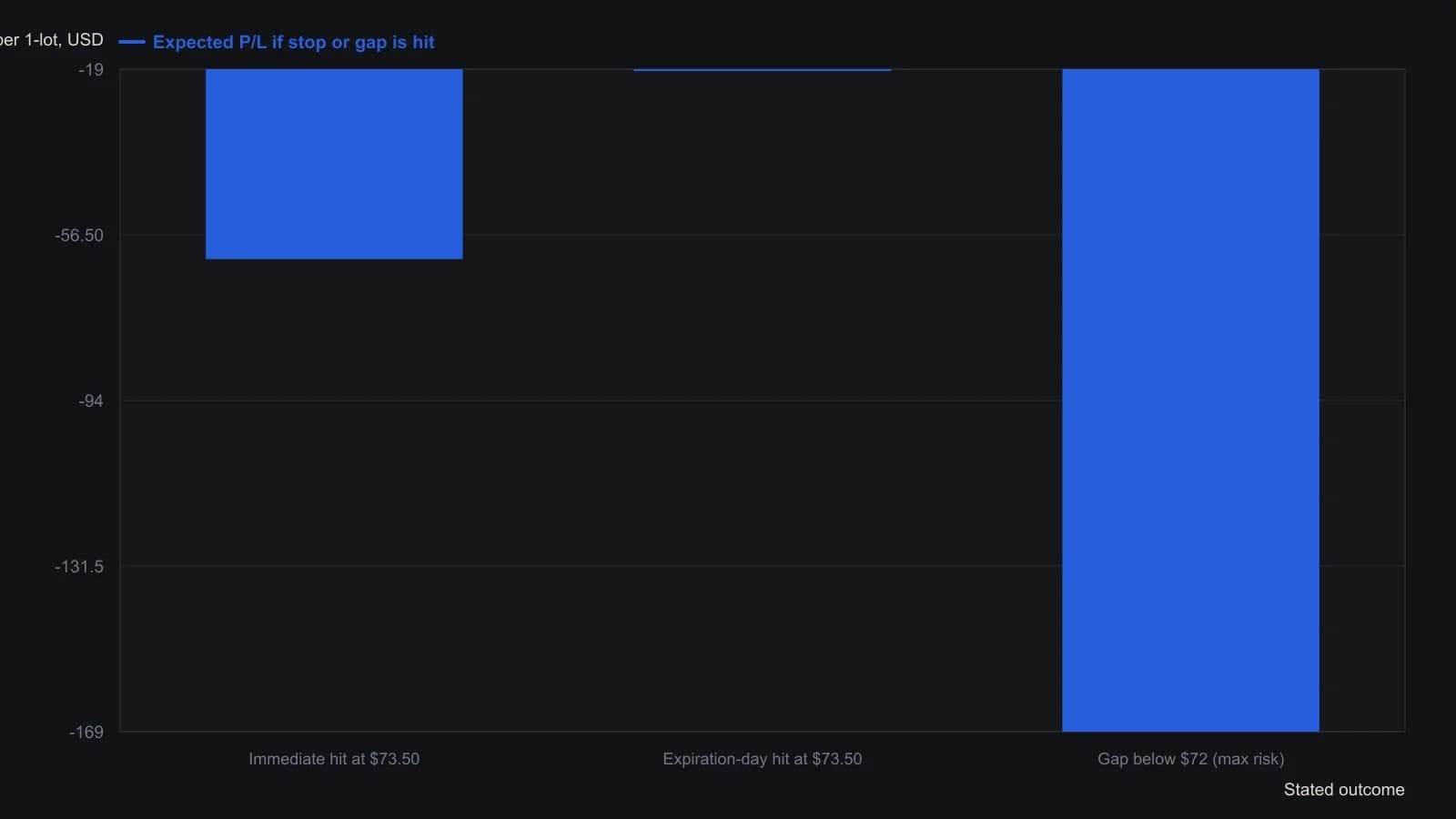
Barring a gap, the stop at $73.50 is the planned exit. The −$169 figure is the stated maximum if AMD gaps below $72. Profit-side example: $25 open profit equals 80% of the $31 maximum credit.
All readings on this track · 27 readings
- 1987Precommit the stop and require a surplus payoff
- 1987When open losses overwrite precommitted exit rules
- 1991Ranking month-end holds with risk-reward and stops
- 1994Evaluating percentage profit exits on trend-following averages
- 2001Construct reward to risk before entry
- 2003A pre-trade readiness checklist for entry, abstention, and risk
- 2003Evaluating out-of-the-money strikes with saddle premiums and implied volatility
- 2004A critique of one-procedure trading decisions
- 2004Mechanical stops leak intent and misprice losses
- 2004Implied-volatility premium on rate indexes
- 2006Keep the stop that authorized the entry
- 2006Bound the loss with a risk-to-reward filter before entry
- 2007Audit the operator before abandoning a system
- 2007Failed-break slingshot reversal rules
- 2007A system-management template that sets the stop and the required reward before entry
- 2007Construct a pre-trade style envelope for entries and skips
- 2008Systems that skip the three decision gates
- 2010Four-gate veto before trend entries
- 2012Construct a trading plan as one written procedure
- 2012Forex stops and reward targets by quote increment
- 2013The average directional index as a lookback cluster and a risk-reward bound
- 2014A three-step worksheet for VIX futures tick value and low-vol risk-reward
- 2014Binary option premia, fees, and pre-expiry risk-reward
- 2015Selling far out-of-the-money commodity option premium as a forgiving timing case
- 2016Prepaid option spreads that bound range-day risk and reward
- 2016Pre-trade risk-reward versus instinctive exits
- 2020Bounding a short-dated option spread with a stop, a gap remainder, and a credit exit