2007issue C011-3
Audit the operator before abandoning a system
Expectancy is the average r-multiple of a large enough sample, and it counts as a system result only when written rules ran entry, exit, and abstention as one procedure. Editorial: audit the live operator before discarding the system.
- A worst-case exit is set before entry so per-unit risk is known, position size is derived from a fixed cash-risk amount, and expectancy is the mean r-multiple only when the sample is large enough.
- A mistake is a failure to follow written rules; if no written rules exist, every action is counted as a mistake.
- Unidentified rule breaks tend to be repeated, including impulse purchases that later crowd out system signals and refused stops that turn a planned loss into a much larger r-multiple loss.
- A brief end-of-day review ends with no further work when written rules were followed, including on a losing day; after a break, the conditions are listed, a purchase checklist is installed, and the correction is rehearsed until it is automatic.
Bound the loss before the fill
A worst-case exit is set before entry so per-unit risk is known and position size can be derived from a fixed cash-risk amount. Trade results are recorded as multiples of that initial risk. An r-multiple is a trade profit or loss divided by the cash amount defined as worst-case risk at entry. The mean of those multiples is used as system expectancy only when the sample is large enough.
Stops and outcomes are expressed against that predetermined initial risk so a loss or exposure decision is bounded before the trade is placed.
Hypothetical book: R-multiple by closed trade
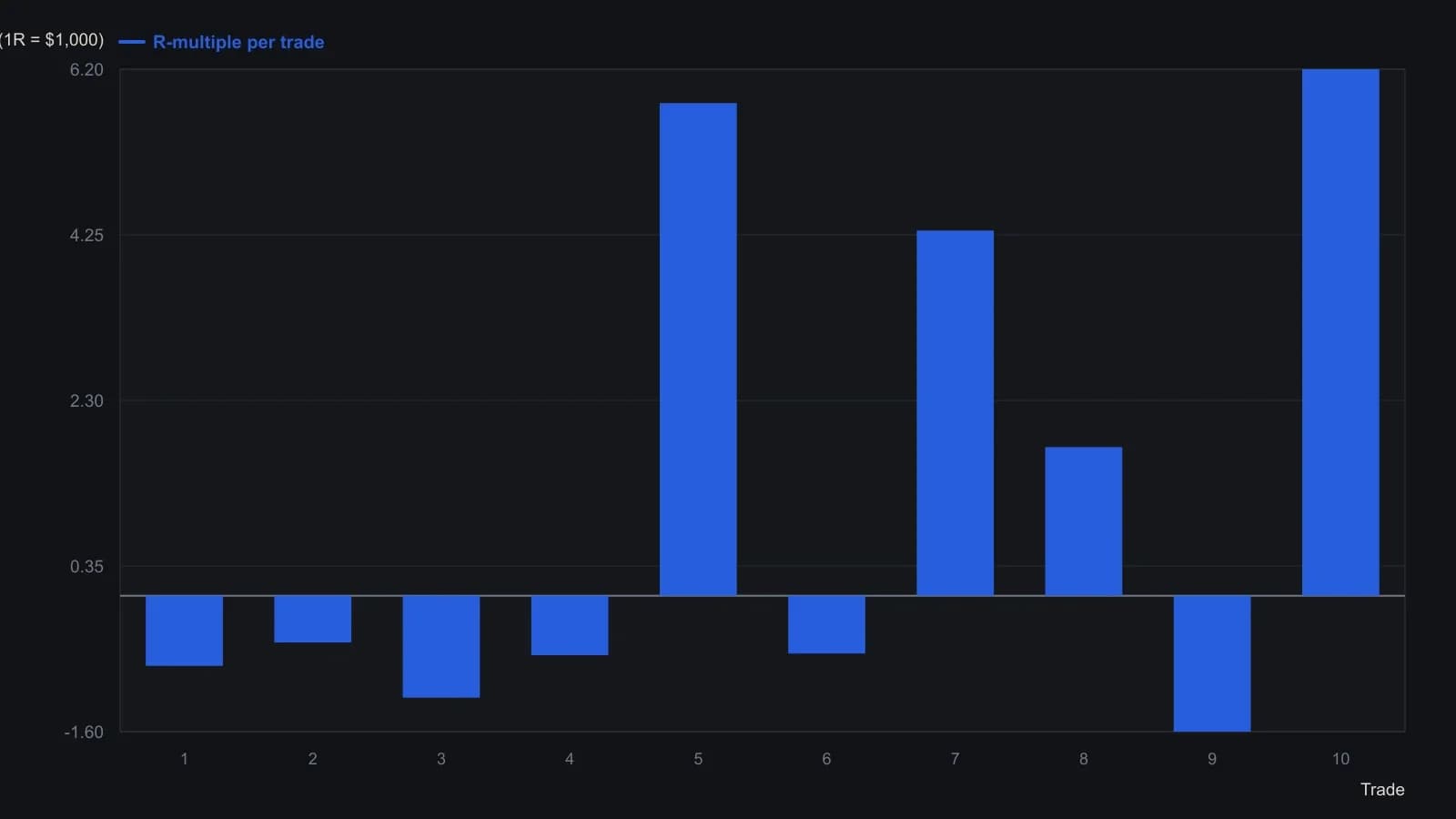
The author states that ten trades are not a large enough sample for the 1.2495R average to stand as a stable expectancy.
Written rules define a mistake
A mistake is defined as failing to follow written trading rules. If no written rules exist, every action is counted as a mistake. Written rules are documented entry, exit, sizing, and abstention instructions that define correct execution of the system.
Listed rule breaks include taking an unsignaled impulse trade, skipping a signaled trade, not honoring a stop, risking more than the planned equity fraction, and mixing several systems in one account.
An unnamed break tends to repeat
A rule break that is not identified tends to be repeated, including holding an impulse purchase that later crowds out later system signals. After a common run of consecutive losses, declining later signals can omit a large favorable multiple of initial risk, and self-blame without naming the rule break does not correct it.
Refusing a stop can turn a planned loss into a much larger r-multiple loss if the position is then kept as a long-term holding.
End-of-day review and rehearsal
A brief end-of-day review asks whether written rules were followed. If they were, including on a losing day, the review ends with no further correction work. That daily debriefing is a short post-session check of whether written rules were followed and, if not, which conditions must be blocked next time.
After a rule break, the conditions that produced it are listed, a purchase checklist of system criteria is installed, and the correction is rehearsed until it is automatic. The checklist is a written pre-trade list of system criteria that must be complete before an entry is allowed, so entry, exit, and abstention can be tested as one procedure. The psychology process is an end-of-day rule audit plus rehearsal of corrections so recognized operator errors are not repeated.
All readings on this track · 27 readings
- 1987Precommit the stop and require a surplus payoff
- 1987When open losses overwrite precommitted exit rules
- 1991Ranking month-end holds with risk-reward and stops
- 1994Evaluating percentage profit exits on trend-following averages
- 2001Construct reward to risk before entry
- 2003A pre-trade readiness checklist for entry, abstention, and risk
- 2003Evaluating out-of-the-money strikes with saddle premiums and implied volatility
- 2004A critique of one-procedure trading decisions
- 2004Mechanical stops leak intent and misprice losses
- 2004Implied-volatility premium on rate indexes
- 2006Keep the stop that authorized the entry
- 2006Bound the loss with a risk-to-reward filter before entry
- 2007Audit the operator before abandoning a system
- 2007Failed-break slingshot reversal rules
- 2007A system-management template that sets the stop and the required reward before entry
- 2007Construct a pre-trade style envelope for entries and skips
- 2008Systems that skip the three decision gates
- 2010Four-gate veto before trend entries
- 2012Construct a trading plan as one written procedure
- 2012Forex stops and reward targets by quote increment
- 2013The average directional index as a lookback cluster and a risk-reward bound
- 2014A three-step worksheet for VIX futures tick value and low-vol risk-reward
- 2014Binary option premia, fees, and pre-expiry risk-reward
- 2015Selling far out-of-the-money commodity option premium as a forgiving timing case
- 2016Prepaid option spreads that bound range-day risk and reward
- 2016Pre-trade risk-reward versus instinctive exits
- 2020Bounding a short-dated option spread with a stop, a gap remainder, and a credit exit