2007issue C131-4
Construct a pre-trade style envelope for entries and skips
A tradingStyle is a written parameter set applied to every order and kept separate from any one tradingSystem. Capital, lot size, supportHorizon, and available time are fixed first so a preTradeChecklist and riskRewardScreen can reject a candidate before an order.
- Write the tradingStyle first. It is a reusable set of capital, time, risk, chart, and signal rules, not a tradingSystem.
- Give each named style its own parameter set, including lot size, capital base, and a supportHorizon matched to the intended hold.
- Treat styleMixing as a cause of premature stop-outs or of costs overwhelming a small lot.
- Run a preTradeChecklist that checks risk tolerance, budget, present market condition, and a riskRewardScreen before any order.
Separate the tradingStyle from the tradingSystem
A tradingStyle is a written, reusable set of capital, time, risk, chart, and signal rules applied to every order. The archive treats that object as independent of any one strategy and independent of a tradingSystem.
A tradingSystem is a conditional entry-and-exit procedure designed to operate in a stated market condition. Applying a trend-oriented procedure in a consolidating or choppy market is described as producing repeated premature exits.
What the style parameter set includes
Style construction specifies capital, lot size, price range, entries and exits, support used for stops, indicator settings, holding period, risk tolerance, available time, sectors, and the data and chart types required.
Named style labels include intraday, day, momentum or velocity, swing, position, intermediate-term, and long-term investing. Each is said to need its own parameter set.
Capital and lot constraints travel with the style
Worked examples pair styles with different capital and lot constraints. Intraday examples use blocks of 5,000 to 10,000 shares held for minutes, with a capital base usually above 100,000. Position examples can be as small as 100 shares on a few thousand dollars and use weekly charts. Momentum examples use lots of 1,000 to 5,000, with a capital base usually at least 50,000.
styleMixing is treated as a cause of early exits
Mixing style rules is presented as a cause of premature stop-outs or of costs overwhelming a small lot. The archive describes a position trader using a tight, weak-support stop on a name outside that style's risk tolerance, and a momentum trader using 100-share lots on a brief burst.
Match the supportHorizon to the hold
Stop-loss support is matched to style horizon. The archive assigns 15-minute to one-hour levels for intraday, end-of-day intraday support for day and momentum, multi-day weak support for swing, several weeks to one quarter for position, quarterly to several quarters for intermediate-term, and yearly support for long-term.
CDC Corp weekly price, October 2000–August 2006
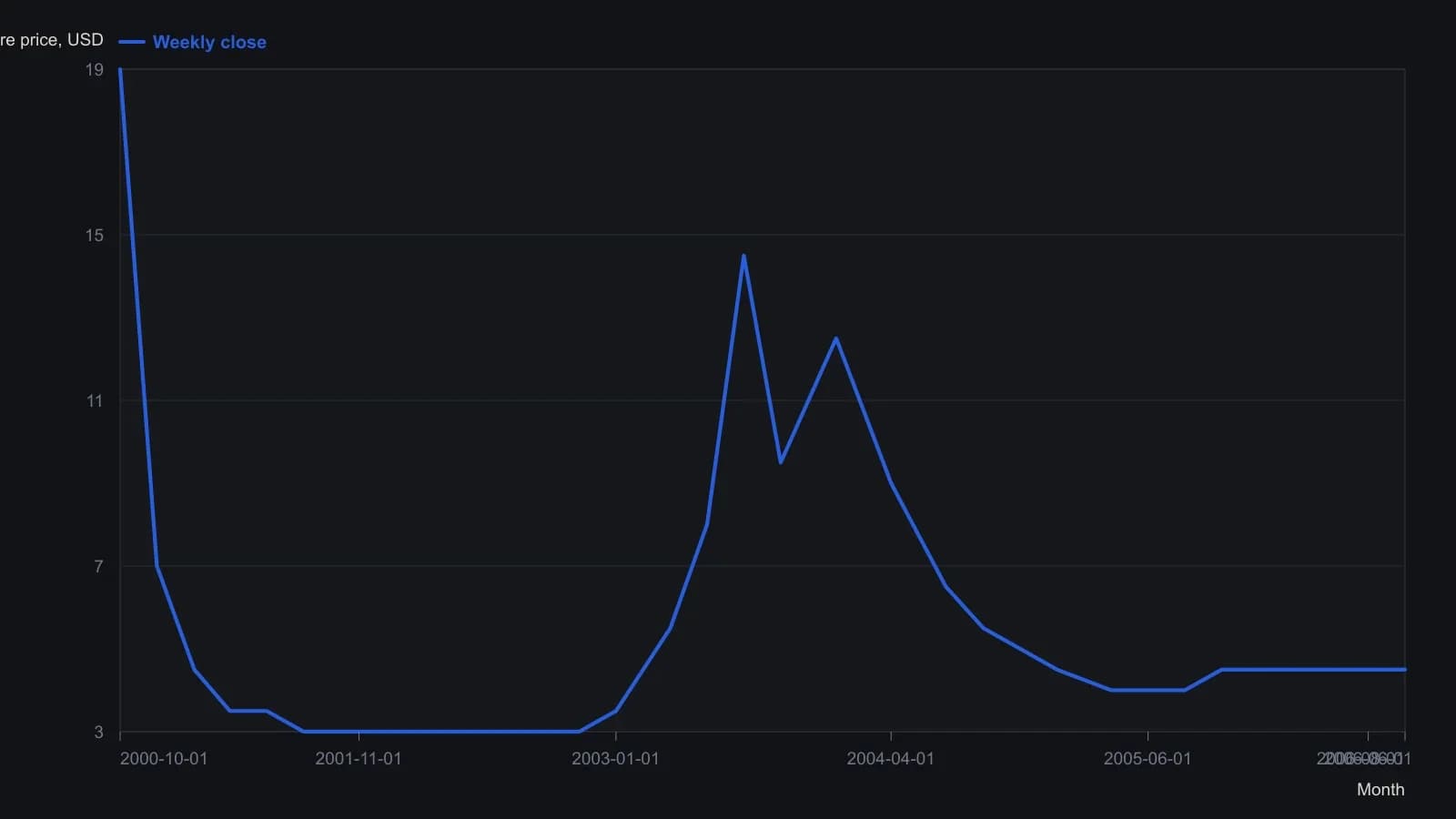
Two moving-average overlays on the source pane were not digitized. Prices are rounded to the nearest half-dollar; the printed scale runs from 0 to 30 and cannot support tighter reading. Month labels follow the printed x-axis.
holdingPeriodEnvelope sets how much entry error a trade can absorb
Risk and time demand scale with style. Intraday is described as highest risk and a full-time activity. Swing still requires daily review because holds are short. Position holds last several weeks, need less daily scanning, and are described as more forgiving of entry error. That pairing of intended duration, review cadence, and stop scale is the holdingPeriodEnvelope.
Ask the preTradeChecklist before the order
A written style plus a repeatable pre-trade routine is used to reject weak candidates. The preTradeChecklist asks whether prospective loss sits inside tolerance, whether price sits inside budget, whether the setup still fits the present market condition, and whether the loss-to-gain relationship is acceptable before an order.
The riskRewardScreen is that last filter: it asks whether prospective loss versus prospective gain is acceptable inside the style's risk limits.
All readings on this track · 27 readings
- 1987Precommit the stop and require a surplus payoff
- 1987When open losses overwrite precommitted exit rules
- 1991Ranking month-end holds with risk-reward and stops
- 1994Evaluating percentage profit exits on trend-following averages
- 2001Construct reward to risk before entry
- 2003A pre-trade readiness checklist for entry, abstention, and risk
- 2003Evaluating out-of-the-money strikes with saddle premiums and implied volatility
- 2004A critique of one-procedure trading decisions
- 2004Mechanical stops leak intent and misprice losses
- 2004Implied-volatility premium on rate indexes
- 2006Keep the stop that authorized the entry
- 2006Bound the loss with a risk-to-reward filter before entry
- 2007Audit the operator before abandoning a system
- 2007Failed-break slingshot reversal rules
- 2007A system-management template that sets the stop and the required reward before entry
- 2007Construct a pre-trade style envelope for entries and skips
- 2008Systems that skip the three decision gates
- 2010Four-gate veto before trend entries
- 2012Construct a trading plan as one written procedure
- 2012Forex stops and reward targets by quote increment
- 2013The average directional index as a lookback cluster and a risk-reward bound
- 2014A three-step worksheet for VIX futures tick value and low-vol risk-reward
- 2014Binary option premia, fees, and pre-expiry risk-reward
- 2015Selling far out-of-the-money commodity option premium as a forgiving timing case
- 2016Prepaid option spreads that bound range-day risk and reward
- 2016Pre-trade risk-reward versus instinctive exits
- 2020Bounding a short-dated option spread with a stop, a gap remainder, and a credit exit