2003issue C051-3
Evaluating out-of-the-money strikes with saddle premiums and implied volatility
Out-of-the-money premiums can stall or fall even when the underlying rises. This archive article follows a chain-wide screen that flags neighboring premium gaps, keeps enough remaining life for implied volatility, and ranks strikes by expected P/L versus premium at risk.
- Out-of-the-money calls can stay unchanged or lose value even when the underlying rises, especially in the nearest series as expiration nears and implied volatility declines.
- A neighboring-strike-premium-gap in last, bid, and ask quotes flags a contract for further evaluation instead of selecting the cheapest strike.
- An expiration-horizon-filter drops series with less than three weeks left so an implied-volatility-overlay has enough remaining life to work with the position.
- After a modeled-strike-shift, candidates are ranked by p-to-r-ratio, and the saddle-point is the strike whose reading exceeds both neighbors.
Out-of-the-money premiums can fall as the underlying rises
An out-of-the-money-option is a call struck above the underlying or a put struck below it, and it expires at zero if it remains out of the money. Out-of-the-money calls can stay unchanged or lose value even when the underlying rises. That drag is strongest in the nearest series as expiration nears and implied volatility declines.
Cheap deep out-of-the-money front-month calls are framed as needing both a large move in the underlying and a rise in implied volatility. That combination is treated as uncommon.
Flag a strike by its neighboring premium gap
A candidate strike is flagged when last, bid, and ask quotes show a sharp premium gap versus the neighboring strike. That neighboring-strike-premium-gap is used to mark a contract for further evaluation, not to complete the choice on its own.
Keep enough life for implied volatility
Series with less than three weeks to expiration are excluded from this speculative screen. If the front month has only 10 to 15 days left, the next series with about 40 to 50 days is preferred.
This expiration-horizon-filter leaves room for an implied-volatility-overlay: judging an out-of-the-money premium by how implied volatility typically fades into expiration or expands on a large move in the underlying.
Rank expected P/L against premium at risk
A rapid rally can be screened with a modeled-strike-shift. Each call’s price is moved to the current market of the next-lower strike so expected outcomes can be compared across the chain.
After a 100-share multiplier and a 5-dollar commission, candidates are ranked by expected P/L divided by maximum-risk. Maximum-risk is the capital exposed on a long option, taken as today’s premium scaled by contract count. The ranking statistic is the p-to-r-ratio: expected profit and loss after charges, divided by that maximum-risk figure.
The saddle-point is the strike whose risk-reward reading exceeds both neighboring strikes after that modeled one-strike premium shift.
A historical listed-chain illustration
In the 12 November 2002 IBM chain, with the stock near 78.51, the December 90 call’s p-to-r-ratio exceeded both adjacent strikes and was treated as the saddle-point. The April 95 call’s higher p-to-r-ratio was set aside because of larger time value.
The same screen on puts
A sudden drop in the underlying is described as arriving with higher implied volatility, which may let an out-of-the-money long be closed without a loss even if the asset is below the entry level. The same neighboring-premium and risk-reward screen is stated to apply to out-of-the-money puts as well as calls.
IBM call P to R by strike after a $5 rise
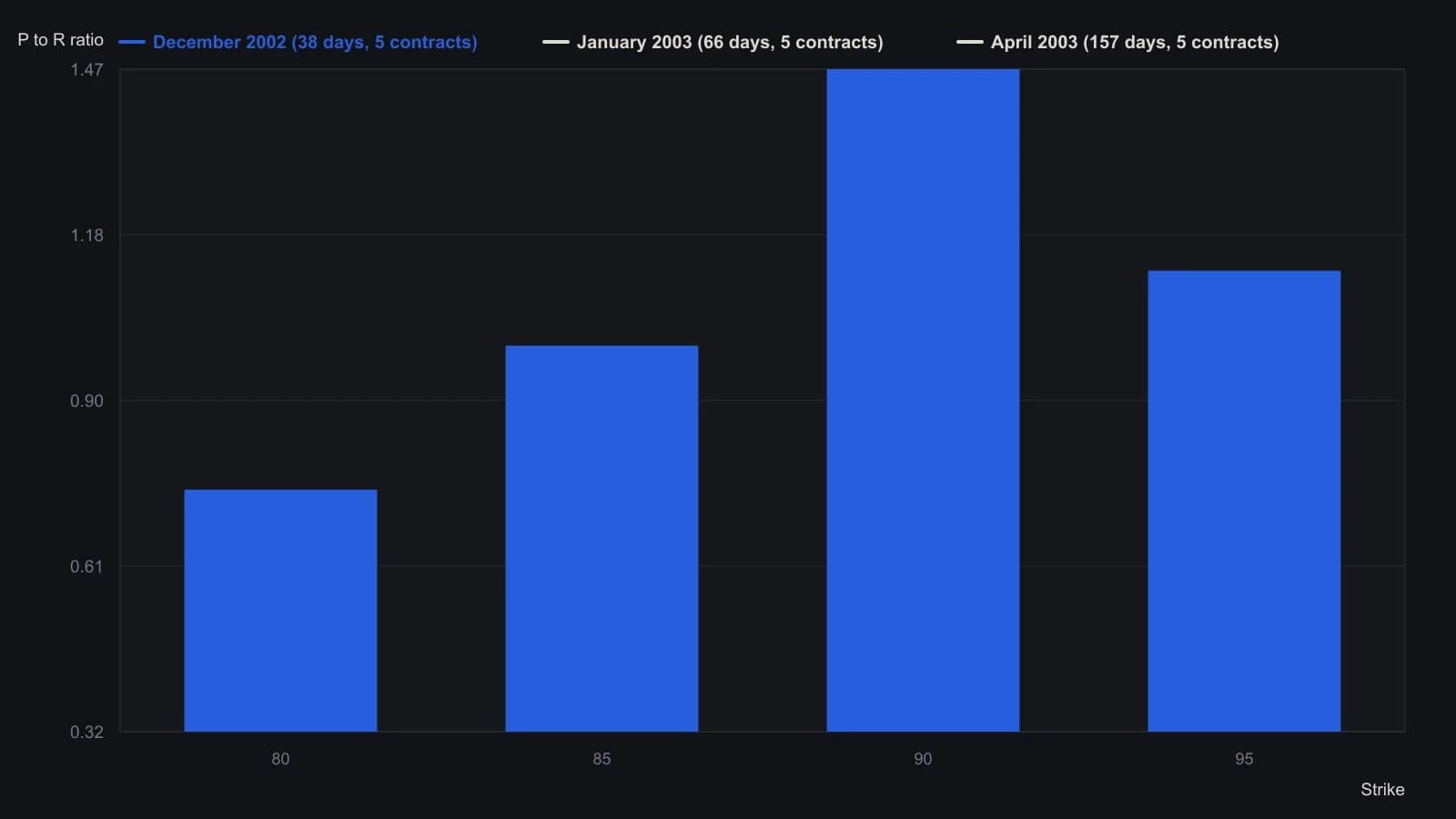
Snapshot assumes a $5 underlying rise that reprices each strike to the next-lower strike’s bid; $5 commission per side. November 2002 is omitted (three days to expiry). P to R is five-contract P/L over five-contract max risk (100 times today’s ask).
All readings on this track · 27 readings
- 1987Precommit the stop and require a surplus payoff
- 1987When open losses overwrite precommitted exit rules
- 1991Ranking month-end holds with risk-reward and stops
- 1994Evaluating percentage profit exits on trend-following averages
- 2001Construct reward to risk before entry
- 2003A pre-trade readiness checklist for entry, abstention, and risk
- 2003Evaluating out-of-the-money strikes with saddle premiums and implied volatility
- 2004A critique of one-procedure trading decisions
- 2004Mechanical stops leak intent and misprice losses
- 2004Implied-volatility premium on rate indexes
- 2006Keep the stop that authorized the entry
- 2006Bound the loss with a risk-to-reward filter before entry
- 2007Audit the operator before abandoning a system
- 2007Failed-break slingshot reversal rules
- 2007A system-management template that sets the stop and the required reward before entry
- 2007Construct a pre-trade style envelope for entries and skips
- 2008Systems that skip the three decision gates
- 2010Four-gate veto before trend entries
- 2012Construct a trading plan as one written procedure
- 2012Forex stops and reward targets by quote increment
- 2013The average directional index as a lookback cluster and a risk-reward bound
- 2014A three-step worksheet for VIX futures tick value and low-vol risk-reward
- 2014Binary option premia, fees, and pre-expiry risk-reward
- 2015Selling far out-of-the-money commodity option premium as a forgiving timing case
- 2016Prepaid option spreads that bound range-day risk and reward
- 2016Pre-trade risk-reward versus instinctive exits
- 2020Bounding a short-dated option spread with a stop, a gap remainder, and a credit exit