2014issue C0331
Elliott-wave target versus the option bid-ask
A historical case treated a 65 wave-4-hold on CND as support for a 68.55 objective, then asked whether that remaining impulse still existed after the April 60 call’s 1.60 quoted-spread.
- A wave-4-hold can keep a cash-chart impulse intact while the quoted-spread on the listed option consumes the wave-remainder.
- The April 60 in-the-money-call implied 670 of defined cost per contract, a theoretical 1.85-point gain at 68.55, and a 1.60 quoted-spread.
- A limit-fill-rule and an exercise-to-cash exit were the stated controls, with hard fills near expiration and possible overnight share exposure.
- A penny-quoted-class narrows the increment on designated liquid series; ordinary and multi-leg books can still erase most of an unfinished wave.
The wave-4-hold and the remaining impulse
The case applied Elliott-wave structure to CND near 66. It treated a recent 65 low as a wave-4-hold, a prior corrective low used as support after Wave 4 so the remaining upside-impulse hypothesis stayed intact. The next upside objective was 68.55. The wave-remainder is the distance from the current price to that wave-derived objective.
Expressing the target in an in-the-money-call
The shortest listed expiration that still matched that wave horizon was 96 days away. The April 60 call was the contract priced against the target. It was used as an in-the-money-call because it carried less time value and was expected to track the underlying more like shares. A 6.70 debit on that April 60 call implied 670 of defined cost and risk per contract.
The quoted-spread against the wave-remainder
At an underlying price of 68.55, the same calls were marked at a theoretical 8.55, a 1.85-point gain, against a 1.60 quoted-spread. The case framed that 1.60 gap as large enough to erase most or all of the remaining wave distance, especially on illiquid series and multi-leg spreads. The wave-remainder is the quantity a quoted option spread can consume.
Stated controls on entry and exit
One stated control was a limit-fill-rule: enter and exit with limits so the wave trade does not pay the full quoted gap. Limits can be hard to fill near expiration. Another stated control was exercise-to-cash, converting the option into stock and exiting in the shares market to bypass a wide options book. That path notes overnight exposure unless the shares were shorted first, and only if the name could be shorted.
Smaller increments on a penny-quoted-class
A 2007 exchange pilot quoted designated liquid classes in 0.01 increments below a 3 premium and 0.05 at or above 3, with one index product quoted in 0.01 across all series. A penny-quoted-class is that designated liquid options class, quoted in smaller increments so the minimum spread is tighter than on ordinary series.
Church & Dwight call bid and ask by strike
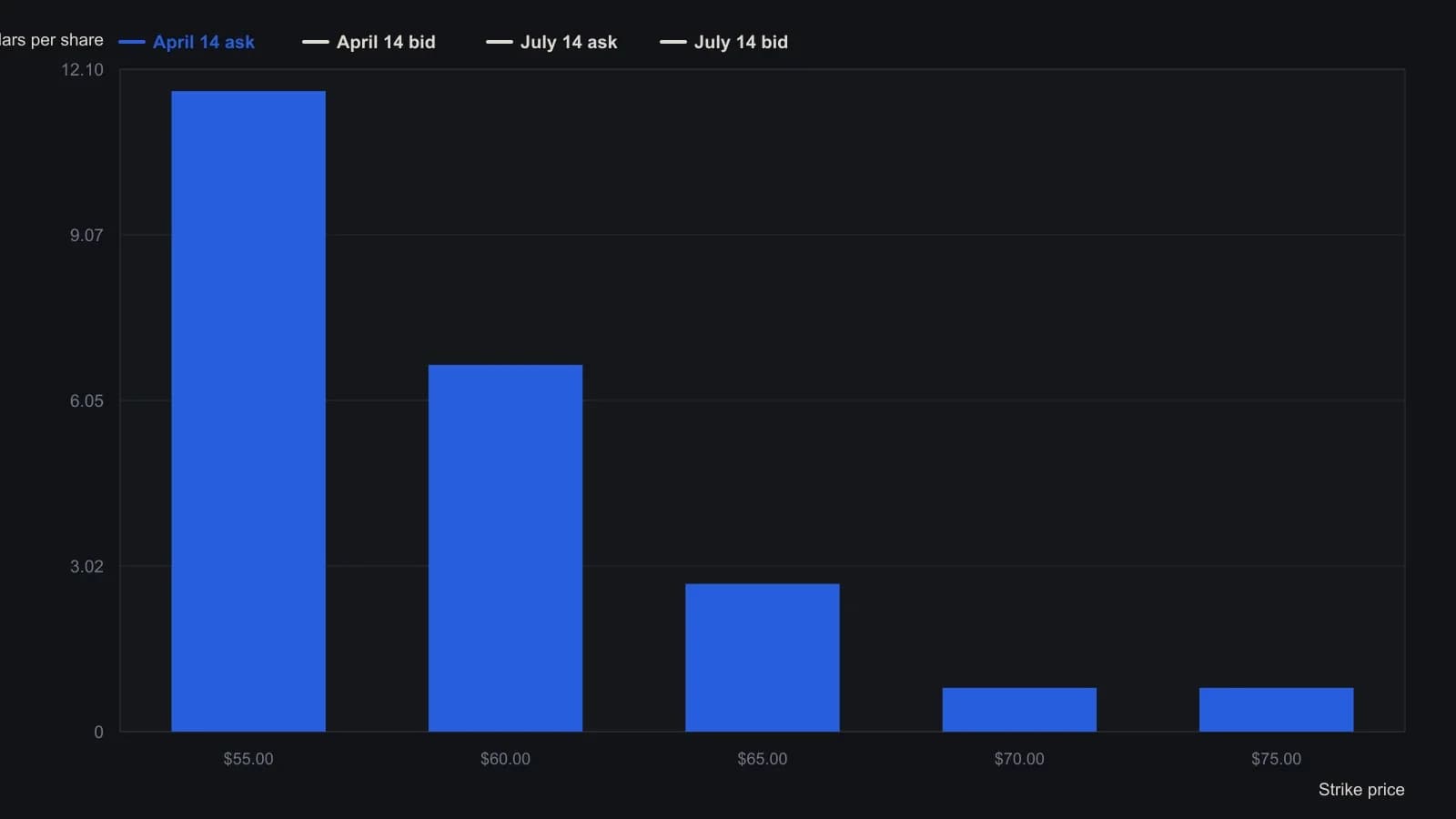
The April 60 bid printed as a dash on the quote board and is omitted; the column text states a $1.60 spread on that contract. Mid-implied-volatility percentages shown under each market are not plotted.
All readings on this track · 26 readings
- 1984Three-gate confirmation for wave, ratio, and cycle turns
- 1988Triaging Elliott wave counts with weekly stochastic divergences
- 1989Dominant-cycle phase flips as regime tests
- 1989Audit signals against elasticity regimes
- 1990When wave counts fail the exclusion test
- 1991Evaluating hourly DJIA growth-rate and velocity attractors
- 1996If a terminal fifth is rewritten, fail the first count
- 1998Mapping industrial-average swings with Fibonacci growth and retracements
- 1999Define the stop before the wave or the divergence
- 2001Form-first Elliott wave construction with phi
- 2006Wave count, channel floor, and Fibonacci bands after a correction
- 2007Impulse and correction as a recursive fractal recipe
- 2008Gold-silver ratio as a shoreline wave
- 2008A daily chart trend filter with Elliott wave abstention
- 2010Revising Elliott wave counts with RSI and stochastic guides
- 2010Constructing corrective-wave hypotheses with Fibonacci retracements
- 2011Pre-commit the wave-and-ratio stop before entry
- 2012Dated wave and ratio cases need a later-sample test
- 2013Keep a 1-2-3 count only while zigzag, Fibonacci depth, and divergence still agree
- 2014Elliott-wave target versus the option bid-ask
- 2014A three-layer classroom on one daily futures chart
- 2015Elliott wave classifies the swing; trend following holds the trade
- 2016Constructing wave labels and retracement zones from chart structure
- 2017Sector ETF pairs in quiet regimes
- 2017A policy-shift case that tested a delayed long-cycle wave count
- 2018One role each for wave, Fibonacci, and stochastic