2011issue C0531-38
Pre-commit the wave-and-ratio stop before entry
The historical workflow sets a hard-stop at entry and later raises or trails it. Editorial teaching is to locate that exit on the elliott-wave invalidation and the fibonacci-retracement depth first, then let the same structure follow the trade.
- Pre-commit the elliott-wave invalidation and the fibonacci-retracement depth so the first stop is already a falsifiable chart hypothesis.
- A hard-stop is set at entry from a percentage, dollar-risk, or structure offset and can later be raised to entry plus commission.
- A volatility-stop sits outside daily noise using average true range and is frequently triggered in directionless conditions.
- Drawdown-recovery is larger than the posted loss, which is why the exit belongs in the construction rather than after the fact.
The historical workflow treats a protective exit as part of how the order is built. A static stop is set at entry. If price then moves in favor, that stop can be raised or trailed. Editorial teaching: locate the exit on the elliott-wave invalidation and the fibonacci-retracement depth before entry, then let that same structure trail the trade so the stop stays a falsifiable hypothesis rather than a last-minute reaction.
Pre-commit the invalidation
An elliott-wave count of impulse and corrective swings locates the chart condition that invalidates the trade hypothesis. Fibonacci-retracement levels are ratio-based pullback and extension marks used to place and trail a stop outside expected corrective depth. Editorial teaching: write both down before the order so the first hard-stop already sits on that structure.
Hard-stop and the first raise
A hard-stop is a static protective exit placed at entry from a fixed percentage, dollar-risk, or structure offset. The historical practice is to set that static protective stop at entry as a percentage price offset or as a dollar-loss amount from portfolio risk. If price moves favorably enough, the stop can be raised to entry plus commission so the remaining risk is designed not to lose money on that trade.
Support, resistance, and reward to risk
A support-resistance-stop is a protective exit set just beyond recent support for longs or resistance for shorts after a pre-entry risk-reward check. Placing a long stop just below recent support, or a short stop just above recent resistance, requires a pre-entry comparison of potential reward to the risk defined by those levels.
Volatility-stop and ordinary noise
A volatility-stop is a trailing exit sized from average true range or price-deviation so the stop sits outside ordinary noise. Average true range is computed from the greatest of the current high-low range, the current high versus the prior close, or the current low versus the prior close, then averaged. A 14-period ATR updates as prior ATR times 13 plus current true range, divided by 14.
Volatility and trailing stops are intended to sit outside daily noise and work best in trending markets identified with a moving average or trendline. They are frequently triggered in highly volatile, directionless conditions.
Horizon, slippage, and time
Shorter-horizon traders typically use tighter percentage or volatility offsets, while longer-horizon holders use looser offsets and accept larger potential drawdowns. Manual stop execution adds delay slippage versus pre-entered protective orders. In a sideways stretch a trailing stop can keep a position open unless a time limit is also imposed.
Drawdown-recovery after a posted loss
Drawdown-recovery is the larger percentage gain required to restore account value after a percentage loss. A posted 10% loss requires an 11.1% gain to restore original account value. A posted 30% loss requires a 43% recovery to restore original account value. An 80% loss requires a 400% price move to restore original holdings. Editorial reading: those recovery gaps are the reason to pre-commit the invalidation instead of waiting until a large loss is already posted.
Gain required to recover a posted loss
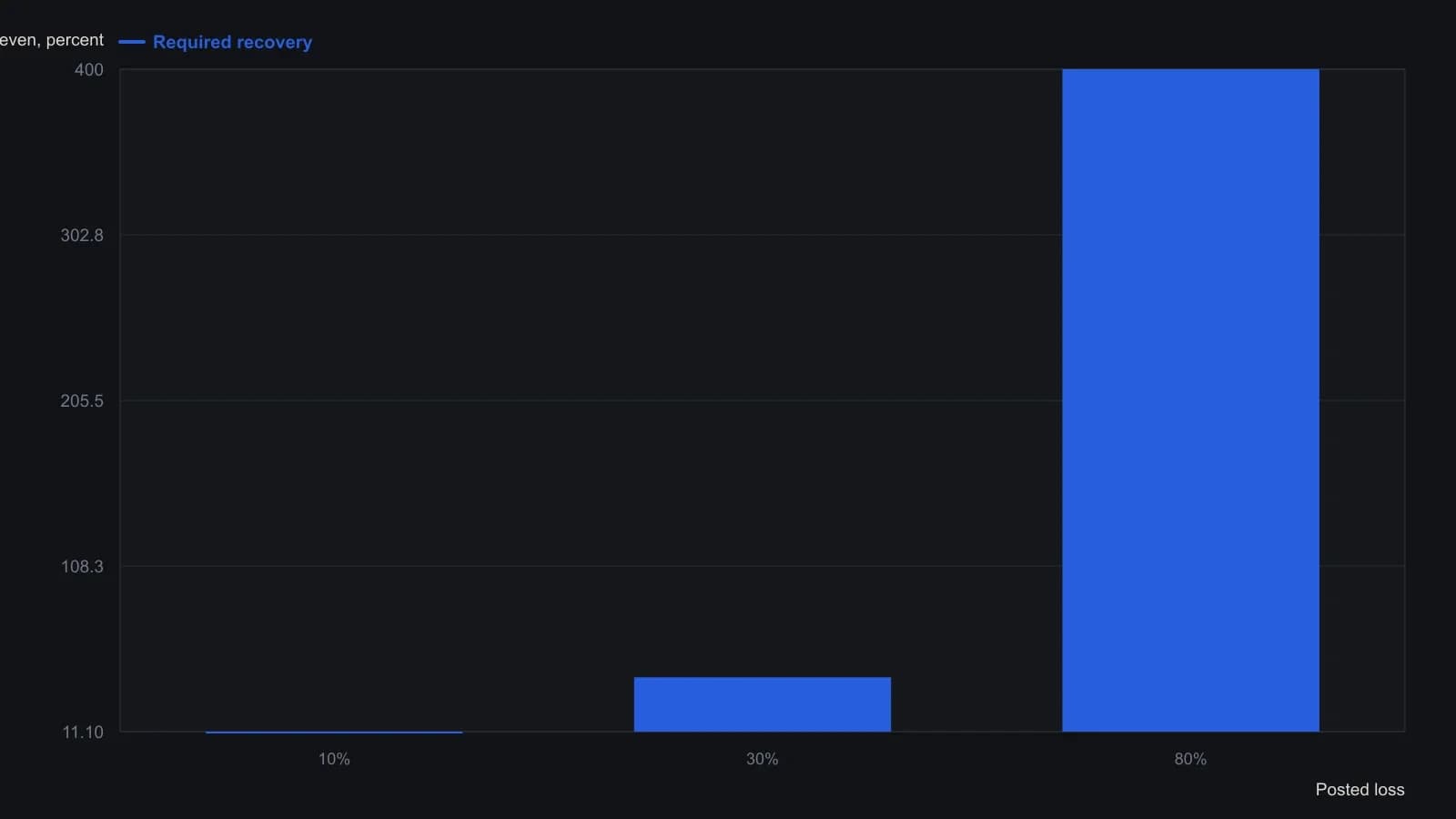
The magazine figure is a continuous recovery curve; only these three callout pairs appear in the article body, so the bars are those stated examples rather than a digitized plot.
All readings on this track · 26 readings
- 1984Three-gate confirmation for wave, ratio, and cycle turns
- 1988Triaging Elliott wave counts with weekly stochastic divergences
- 1989Dominant-cycle phase flips as regime tests
- 1989Audit signals against elasticity regimes
- 1990When wave counts fail the exclusion test
- 1991Evaluating hourly DJIA growth-rate and velocity attractors
- 1996If a terminal fifth is rewritten, fail the first count
- 1998Mapping industrial-average swings with Fibonacci growth and retracements
- 1999Define the stop before the wave or the divergence
- 2001Form-first Elliott wave construction with phi
- 2006Wave count, channel floor, and Fibonacci bands after a correction
- 2007Impulse and correction as a recursive fractal recipe
- 2008Gold-silver ratio as a shoreline wave
- 2008A daily chart trend filter with Elliott wave abstention
- 2010Revising Elliott wave counts with RSI and stochastic guides
- 2010Constructing corrective-wave hypotheses with Fibonacci retracements
- 2011Pre-commit the wave-and-ratio stop before entry
- 2012Dated wave and ratio cases need a later-sample test
- 2013Keep a 1-2-3 count only while zigzag, Fibonacci depth, and divergence still agree
- 2014Elliott-wave target versus the option bid-ask
- 2014A three-layer classroom on one daily futures chart
- 2015Elliott wave classifies the swing; trend following holds the trade
- 2016Constructing wave labels and retracement zones from chart structure
- 2017Sector ETF pairs in quiet regimes
- 2017A policy-shift case that tested a delayed long-cycle wave count
- 2018One role each for wave, Fibonacci, and stochastic