2007issue C041-4
Impulse and correction as a recursive fractal recipe
The archive constructs market structure from one impulse and correction pair, (3, -1), written as the recursive fractal (3, -1)F. Larger five-and-three counts and fractal retracements are the same pair inverted and nested, with calendar time left out of the recipe.
- The construction seed is the impulse and correction pair (3, -1): an impulse of +3 and a correction of -1, written as the recursive fractal (3, -1)F.
- The first generation is (3, -1) or (1, 2, 3, -1). The second generation is three copies of (3, -1) plus the inverse pair (1, -3), which is required for the pattern to keep generating itself.
- The same two-number recursion is drawn as a five-and-three count and is fixed by geometry. A (4, -1) seed makes constructed retracements too shallow; a (2, -1) seed makes them too deep.
- Because calendar time is omitted, the model can sequence fractal retracements but cannot say when they occur, and a margin of error remains between idealized and observed retracements.
The impulse and correction seed
The construction seed is the impulse and correction pair (3, -1): an impulse of +3 and a correction of -1, written as the recursive fractal (3, -1)F.
A recursive fractal is a self-similar wave generated by repeating and inverting that seed pair at each generation, so a completed sequence becomes one leg of the next larger sequence.
How each generation expands
The first generation is (3, -1), which can also be written as (1, 2, 3, -1). The second generation is three copies of (3, -1) plus the inverse pair (1, -3).
The inverse pair is the sign-and-order flip of (3, -1) into (1, -3). That inversion is required for the pattern to keep generating itself at the next degree.
The same recipe as a five-and-three count
The same two-number recursion is drawn as an idealized Elliott count. Under the five-and-three count used here, an impulse is counted as five waves and a correction as three waves, nested inside the next higher degree.
Price over time, not a time window
Construction uses only price displacement and retracement. Calendar time is omitted from the wave recipe. That price-over-time choice measures how far price moves and how far it retraces, not how long the move lasts.
Changing the seed to (4, -1) makes constructed retracements too shallow. Changing it to (2, -1) makes them too deep. The pair is therefore fixed by the geometry rather than by a time-window setting.
Three construction assumptions
The archive states three construction assumptions: market data may contain fractals, no movement is pre-labeled noise, and price outranks time.
The no-noise assumption is the rule that every price movement belongs in the model. Nothing is discarded as a statistical outlier before the wave is built.
Fractal retracements and the margin of error
A fractal retracement is the ratio of a corrective leg to the preceding impulse, read off the recursive (3, -1) geometry rather than from a separate overlay. Idealized fractal retracement ratios on the constructed series include values such as 0.496, 0.244, 0.195, 0.330, 0.162, and 0.498.
Because time is stripped out, the model can sequence retracements but cannot say when they occur. The archive lists that limit as a construction weakness.
The archive treats a finished description of past structure as having some forward use. It also states a residual error band, the margin of error, between idealized fractal retracements and observed index retracements. That band is treated as the band around any later target.
S&P 500 price versus fractal-implied retracement levels
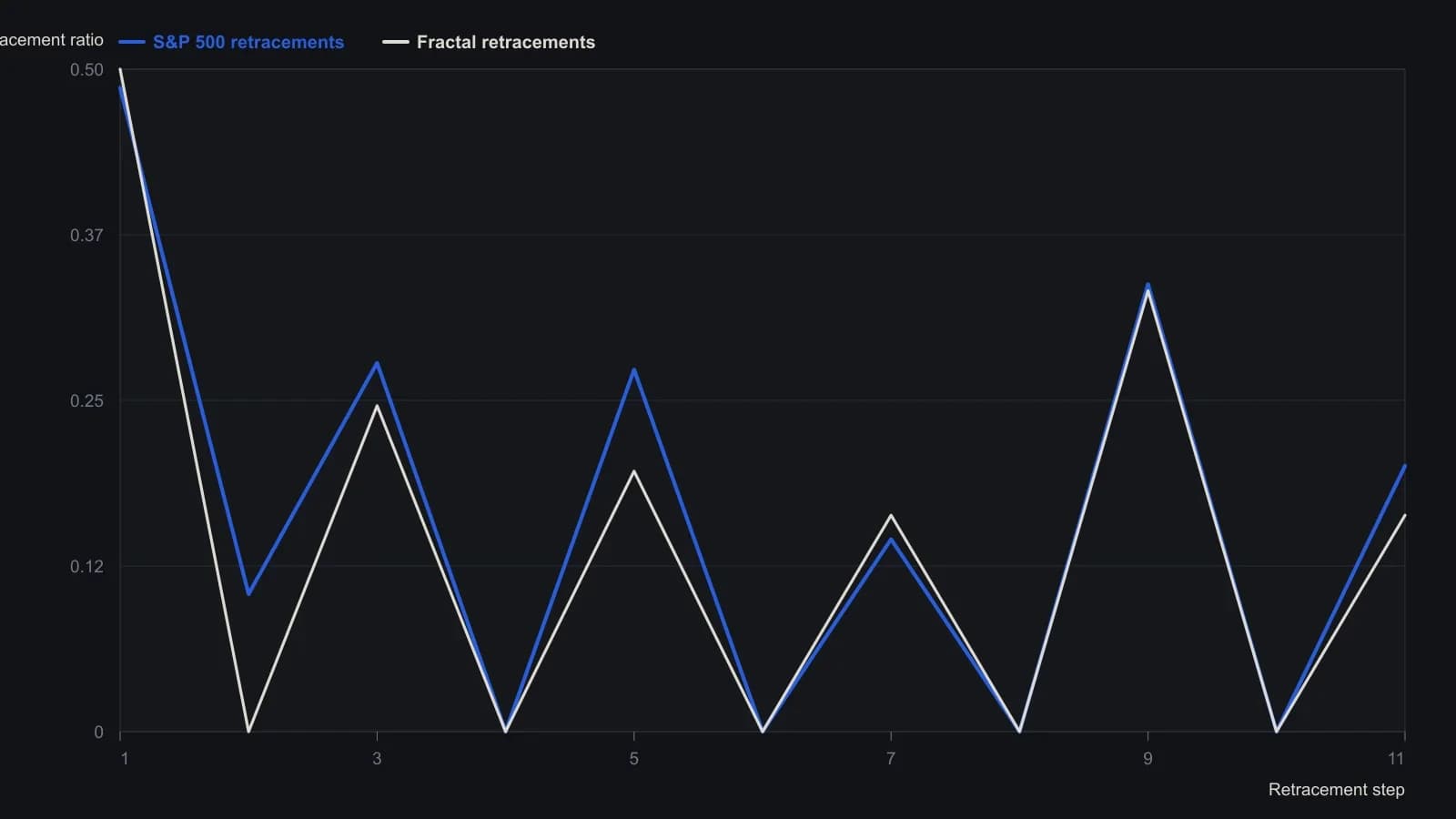
Ratios are those printed in the source table of S&P 500 versus fractal retracements; they are dimensionless fractions of the prior impulse, not prices. Calendar time is excluded from the construction.
All readings on this track · 26 readings
- 1984Three-gate confirmation for wave, ratio, and cycle turns
- 1988Triaging Elliott wave counts with weekly stochastic divergences
- 1989Dominant-cycle phase flips as regime tests
- 1989Audit signals against elasticity regimes
- 1990When wave counts fail the exclusion test
- 1991Evaluating hourly DJIA growth-rate and velocity attractors
- 1996If a terminal fifth is rewritten, fail the first count
- 1998Mapping industrial-average swings with Fibonacci growth and retracements
- 1999Define the stop before the wave or the divergence
- 2001Form-first Elliott wave construction with phi
- 2006Wave count, channel floor, and Fibonacci bands after a correction
- 2007Impulse and correction as a recursive fractal recipe
- 2008Gold-silver ratio as a shoreline wave
- 2008A daily chart trend filter with Elliott wave abstention
- 2010Revising Elliott wave counts with RSI and stochastic guides
- 2010Constructing corrective-wave hypotheses with Fibonacci retracements
- 2011Pre-commit the wave-and-ratio stop before entry
- 2012Dated wave and ratio cases need a later-sample test
- 2013Keep a 1-2-3 count only while zigzag, Fibonacci depth, and divergence still agree
- 2014Elliott-wave target versus the option bid-ask
- 2014A three-layer classroom on one daily futures chart
- 2015Elliott wave classifies the swing; trend following holds the trade
- 2016Constructing wave labels and retracement zones from chart structure
- 2017Sector ETF pairs in quiet regimes
- 2017A policy-shift case that tested a delayed long-cycle wave count
- 2018One role each for wave, Fibonacci, and stochastic