1998issue C031-5
Low relative P/E plus a trendline reversal for regime-aware stock selection
Historical P/E rankings are used here as a regime tilt for a low-P/E portfolio, not as a stand-alone buy list. The construction sequence then withholds each name until a defined downtrend line breaks and a retest of old lows can confirm that the psychological crowd has flipped.
- Several historical samples found that books built from the cheapest P/E quintile outpaced books built from the most expensive quintile.
- Relative P/E is a name versus its own historical multiple range, not versus the market or a high-visibility growth peer.
- Absolute cheapness is not a complete admission rule, because some cyclicals and impaired names stay cheap until a catalyst of change appears.
- The second filter waits for a defined downtrend-line break, a retest of old lows, and a consensus-shifting event before treating the psychological crowd as reversed.
Construction as two filters
Portfolio construction in this archive workflow is a sequence, not a single cheapness screen. The first filter builds a low-P/E portfolio by ranking names into P/E quintiles and overweighting the cheapest group rather than chasing the highest-multiple growers.
That screen uses relative P/E: a stock’s current price-to-earnings multiple compared with that same stock’s own historical range, not with the market or a growth-stock peer group. TradersWeek editorial reading: the first filter is there to tilt the whole sleeve toward a mean-reverting market regime before any single name is discussed.
The second filter is a chart and psychology rule. A historically cheap name is still withheld until a downtrend line has broken and a retest of old lows has failed. TradersWeek editorial reading: the lesson is not to buy cheap stocks. It is how to keep a value sleeve from becoming a permanent low-multiple trap by pairing a historically cheap relative-P/E tilt with a chart-based entry rule and a contrarian abstention rule.
What the quintile rankings showed
A 1948-1964 industrial sample ranked by P/E quintile showed average yearly price increases rising from 7.7% in the highest-P/E group to 18.4% in the lowest-P/E group.
An April 1957-March 1971 ranking of New York-listed names found the lowest-P/E quintile returned 16.3% a year versus 9.3% for the highest-P/E quintile, with the cheaper group also showing a lower beta.
In a 1937-1962 industry sample split into five P/E groups, the cheapest portfolios averaged about 16% versus about 3% for the most expensive group over holding windows of one to seven years.
A March 1977-March 1997 large-cap study that sorted 500 names into five P/E groups found average annual results about 6% better in the cheapest quintile than in the most expensive quintile.
Annual gains by historical P/E quintile
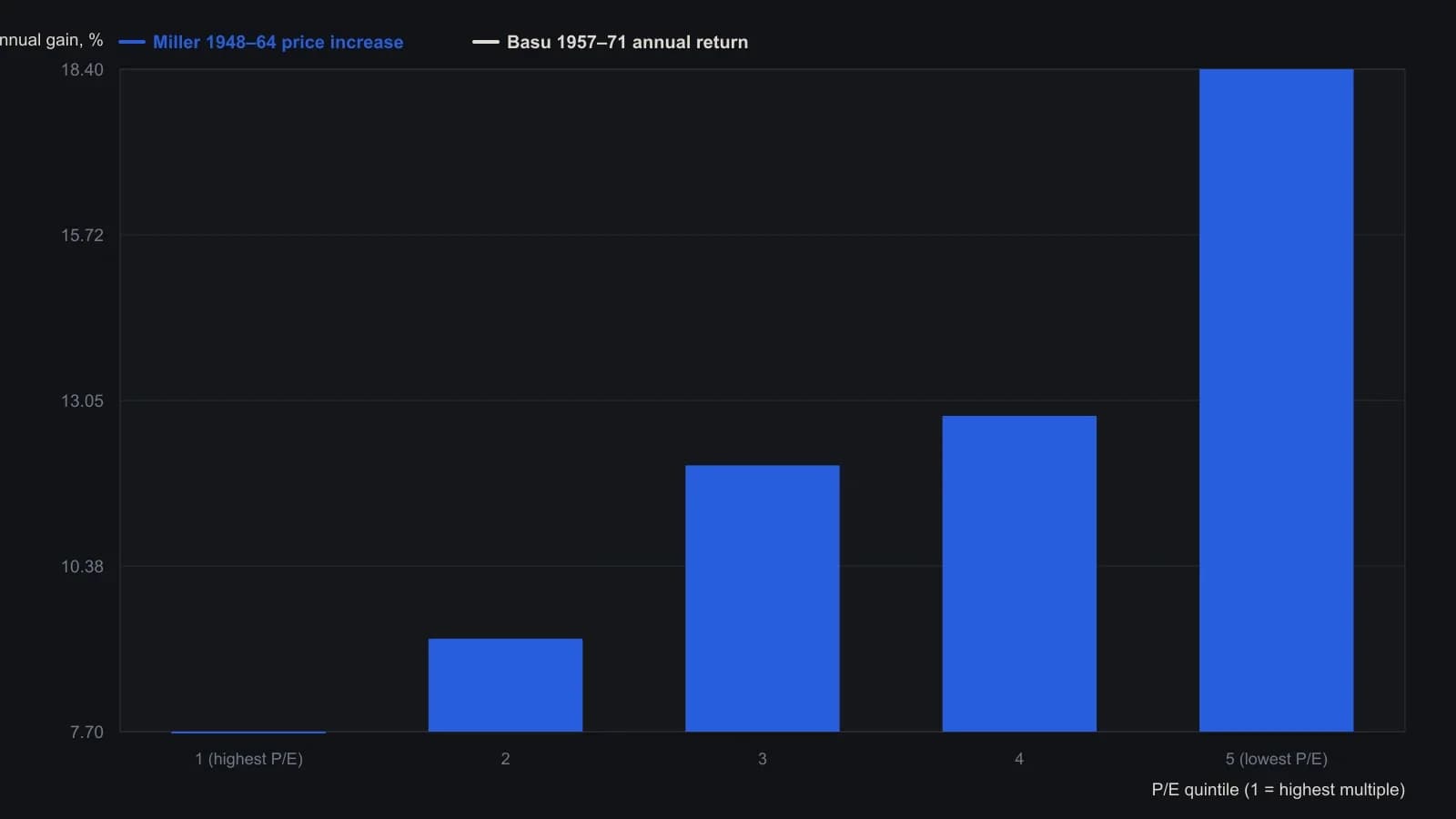
Miller’s 1948–64 CompuStat industrials required sales above $150 million and report average annual price increase. Basu’s April 1957–March 1971 NYSE sample reports annual return; that study also found lower beta in the cheap quintiles, omitted here because beta is not a return figure.
The earnings-visibility premium
A 1997 snapshot showed one favored growth name priced at more than three times the earnings multiple of a slower-growth communications name, 55 versus 16. That gap illustrates how large the earnings-visibility premium can become: the extra multiple investors pay for smoother, more forecastable earnings growth.
The quintile rankings above associate that premium with weaker subsequent returns. TradersWeek editorial reading: this is why the first filter ranks against a name’s own history instead of paying up for forecastable growth.
When cheapness is not a catalyst
Absolute cheapness is not enough for portfolio construction. Some cyclicals and structurally impaired names stay in a low-P/E regime. A candidate also needs a historically low relative multiple plus a catalyst of change that can alter the crowd’s view.
A catalyst of change, in this workflow, is a visible shift: a broken downtrend, a failed retest of old lows, or a sentiment-altering event. Without that shift, a cheap multiple remains a description of the name, not a reason to add it.
A falsifiable downtrend line
The chart filter defines a downtrend as a straight line from the first peak of a decline to a later lower peak at least one month later. That downtrend line is drawn only after price has already fallen through a short moving-average screen.
TradersWeek editorial reading: the delay is what makes the chart condition falsifiable. The line is not sketched on the first decline. It is drawn after a short moving-average filter has already marked the name as being in a fall, so a later break can be checked against a pre-stated structure.
The confirmation sequence
Worked examples treat a trendline break, a subsequent drift back toward old lows, and an event that changes consensus as the sequence that confirms a psychology shift. The first bounce off a cheap multiple is not treated as confirmation.
The retest of old lows is that drift back toward the prior trough after the trendline break. TradersWeek editorial reading: this is the point where a psychological crowd can be judged to have flipped, rather than the point where a cheap name is chased.
Four premises, including abstention
The selection procedure is framed as four testable premises: cheap-P/E books have historically beaten rich-P/E books, earnings forecasts are unreliable inputs, crowd selling can create oversold candidates, and a specific event can reverse a prevailing downtrend.
TradersWeek editorial reading: the fourth premise is also an abstention rule. If the downtrend line is intact, the retest of old lows has not failed, or no catalyst of change is visible, the name stays off the book even when the relative P/E already looks historically cheap.
All readings on this track · 16 readings
- 1988A two-rule classroom book of cheapness and new highs
- 1995A supermarket-chain case for yield, trendline, and a written checklist
- 1996Annual normalized-yield rank rotation for cyclical sleeves
- 1996Value filter then rank-rotate as one procedure
- 1997Dow high-yield rank rotation as a testable portfolio procedure
- 1998Low relative P/E plus a trendline reversal for regime-aware stock selection
- 1998Rank rotation, value screens, and ten-stock diversification
- 2001Earnback period ranking for growth-adjusted screens
- 2003Stress-testing calendar yield rotation in a declining tape
- 2003A value overlay and strangle hedge during a growth-led regime
- 2005Unfashionable value versus momentum in the book
- 2007Why premove fundamentals rarely flag tenfold-price moves
- 2012Year-end yield rank rotation with a collapse veto
- 2015A five-name January book from yield and price ranks
- 2017Screening value traps with regime-aware overlays
- 2017A pre-trade fail test for the cheap-looking name