2019issue C1027
Starting account size as a survival filter
Starting account size is the cash allocated before the first live order. The archive workflow chooses it from the strategy's own drawdown and ruin profile, not from initial margin. Editorial view: treat that choice as a pre-trade survival filter so a later drawdown and a rising risk of ruin stay inside a bound set from the strategy itself.
- Exchange initial margin, and simple multiples of it, is a poor basis for starting account size because it is set for venue participation and self-protection, not for a strategy's risk characteristics.
- A drawdown-limit floor uses the strategy's own history: scale the backtested maximum drawdown by a drawdown multiplier between 1.5 and 3, then add required margin.
- That padded historical peak still leaves a gap, because a later worst drawdown is expected to exceed the backtest decline.
- Monte Carlo resampling of closed trades can generate thousands of equity paths and shows risk of ruin rising sharply as starting account size becomes smaller.
Starting account size is the cash allocated before the first live order. In the archive workflow that cash is chosen from the strategy's own drawdown and ruin profile rather than from a venue minimum.
Why initial margin is a poor size rule
Initial margin is the venue-set deposit required to hold a contract. It measures capital lockup, not a strategy's loss path. Exchange initial-margin requirements, and simple multiples of those requirements, are a poor basis for starting account size because they are set for venue participation and self-protection and are not tied to a given strategy's risk characteristics.
In an illustrative gold-futures case, an initial margin of 4950, or three times that figure at 14850, is presented as an inadequate account-size rule.
A drawdown-limit floor from strategy history
A drawdown limit is a bound on loss relative to equity, stop distance, volatility and exposure, set so a stretch of losses cannot force an unplanned exit. A drawdown-limit approach uses the strategy's own history and treats the backtested maximum drawdown plus required margin as a starting-capital floor.
Because a later worst drawdown is expected to exceed the backtest peak, that historical maximum is scaled by a drawdown multiplier between 1.5 and 3 before it is added to margin. The drawdown multiplier is a conservative scale applied to the largest historical equity decline so later losses can exceed the backtest peak.
In the worked example, a historical maximum drawdown of 10000 implies a padded buffer of 15000 to 30000 plus initial margin when that 1.5-to-3 multiple is applied.
How starting size changes risk of ruin
Relying on a backtest peak drawdown still leaves a gap, because that past decline may not represent later losses.
Risk of ruin is the chance that equity is driven so low the strategy cannot continue. It is used as a filter on account size and exposure before entry and while a position is open.
Monte Carlo simulation is repeated random resampling of a strategy's historical trades to build many equity paths and compare how starting capital changes ruin outcomes. Resampling a system's closed trades can generate thousands of alternative equity curves and show how risk of ruin changes with starting account size. Under that simulation view, risk of ruin rises sharply as the starting account becomes smaller.
Simulated risk of ruin at ten starting account sizes
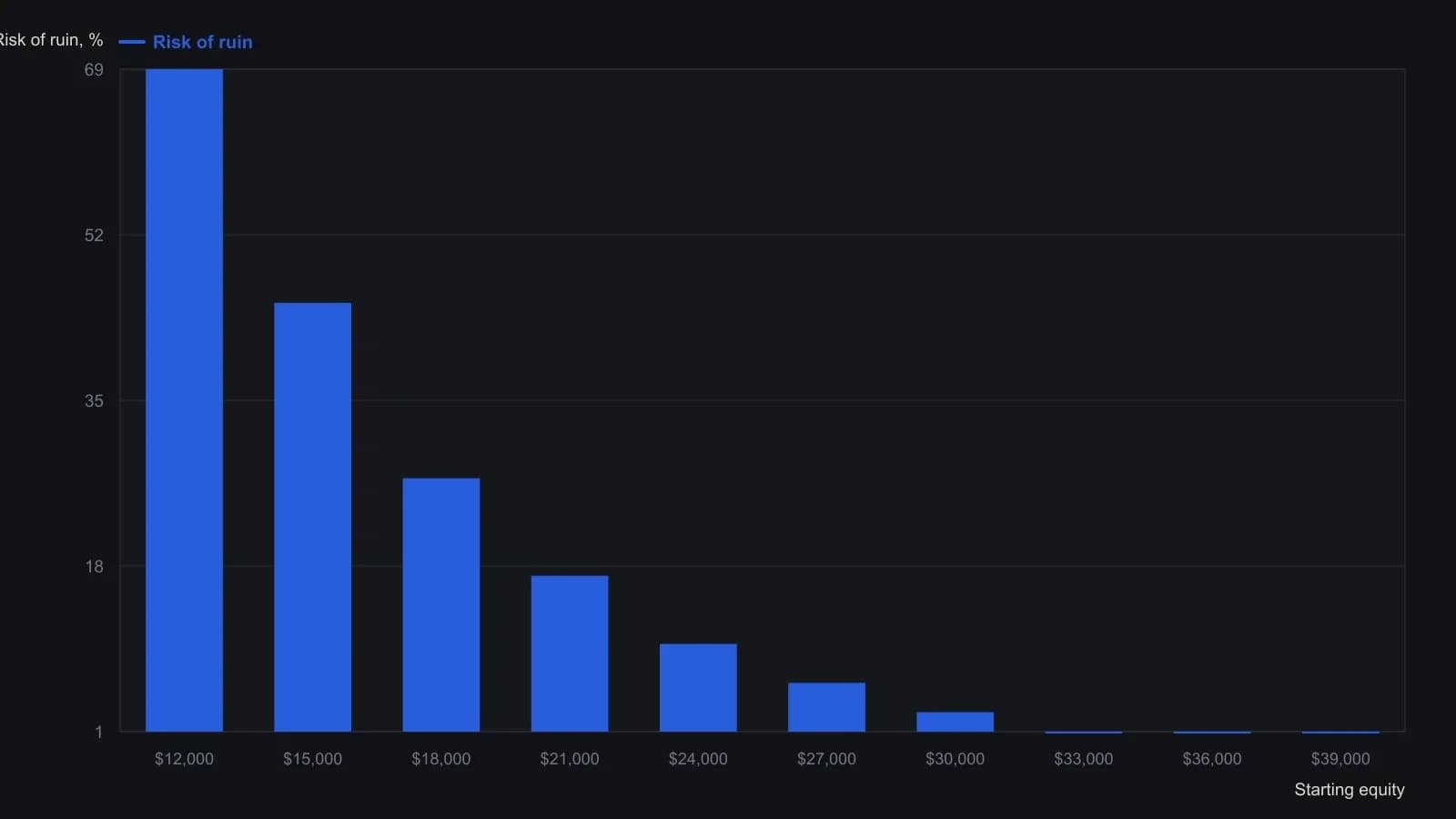
The source built the bars by resampling the system’s historical trades into thousands of shuffled equity paths. It did not publish the trade list, the ruin threshold, or the number of paths.
All readings on this track · 24 readings
- 1985Forced-close odds from monthly edge and leverage
- 1986Constructing a pre-entry risk filter on price-ratio grids
- 1991Ratchet the halt floor and stage exposure against cash
- 1992Sizing capital from degraded records and volatility
- 1992Filter size by expected value and ruin
- 1995Risk of ruin as a pre-entry position filter
- 1995Filter leverage by sequence-loss odds
- 1996Grading track records by drawdown, expected value, and ruin
- 1998When quieter returns lose their survival edge
- 1999Loss response versus a precommitted trading process
- 1999Reauthorize ruin and drawdown filters after a winning stretch
- 2000Sold premium, survivorship, and ruin bounds
- 2001Monte Carlo drawdown risk and volatility position sizing
- 2001Alertness is a size filter, not a mood
- 2002A constant percent risk bound beats a higher win rate
- 2010Risk of ruin with fractional and reserve betting
- 2014Payout identity, expectancy, and path-dependent ruin
- 2015Spreading names is not a substitute for a ruin bound
- 2015Prestige labels versus one testable trade procedure
- 2015Closed-trade quality screens before sizing risk
- 2019Size mini futures from drawdown and leftover margin
- 2019Starting account size as a survival filter
- 2019Pre-entry ruin and volatility caps for short options
- 2020Forced margin, stop-loss, and ruin risk in 2020