2011issue C0324-29
Dollar travel, afternoon sessions, and a 1:2 first-loss bound in equity-index futures
An eight-year comparison of five equity-index emini contracts ranked names by dollar movement rather than volume. Afternoon session travel then set a ten-percent-bound and a 1:2 risk-reward ratio on the Russell 2000 emini.
- Across an eight-year comparison of five equity-index emini contracts, the highest-volume contract ranked last in average annual tick movement.
- On average annual dollar movement the Russell 2000 emini ranked first, while the Dow emini ranked first in ticks, because tick values differed, including $5 on the Dow emini and $10 on the Russell 2000 emini.
- U.S. equity-index sessions showed more average tick travel and higher average volume in the afternoon than in the morning, while scheduled reports clustered between 8:00 and 10:30 a.m. Eastern.
- A ten-percent-bound on the Russell 2000 emini’s average afternoon tick travel was 16 ticks; a 1:2 risk-reward ratio placed the stop at 8 ticks, equal to $160 on that contract.
Rank the contract by dollar travel
The archive compared five equity-index emini contracts over eight years. Futures contract selection was framed by how much each name moved, not by which name printed the most volume. The highest-volume contract ranked last in average annual tick movement.
On average annual dollar movement the Russell 2000 emini ranked first among those indexes, while the Dow emini ranked first in ticks. Editorial comment: TradersWeek treats that split as a reason to put a single index futures trade into a cash-travel context before liquidity headlines decide the book.
Tick value changes the ranking
Dollar rankings diverged from tick rankings because tick values differed, including $5 on the Dow emini and $10 on the Russell 2000 emini. Tick value is the cash amount attached to one minimum price increment of a futures contract. Dollar movement is price travel converted into currency with that contract’s tick value.
A one-point S&P 500 emini move was valued at $50 per contract, so a 100-contract clip with a one-point target and one-point stop implied a $5,000 gain or $5,000 loss if that bound was hit.
Keep a session after the morning report window
Session analysis in the archive split U.S. equity-index hours into morning and afternoon. Those sessions showed more average tick travel in the afternoon than in the morning, while scheduled reports clustered between 8:00 and 10:30 a.m. Eastern.
Average volume for all five compared contracts was higher in the U.S. afternoon session than in the morning session. In the afternoon dollar comparison, the Russell 2000 emini showed the largest move, followed by the S&P MidCap 400 emini.
Editorial comment: TradersWeek reads the afternoon window as the session that remains executable after that morning report cluster, not as a claim that afternoon prices are easier to trade now.
Afternoon dollar travel by emini index
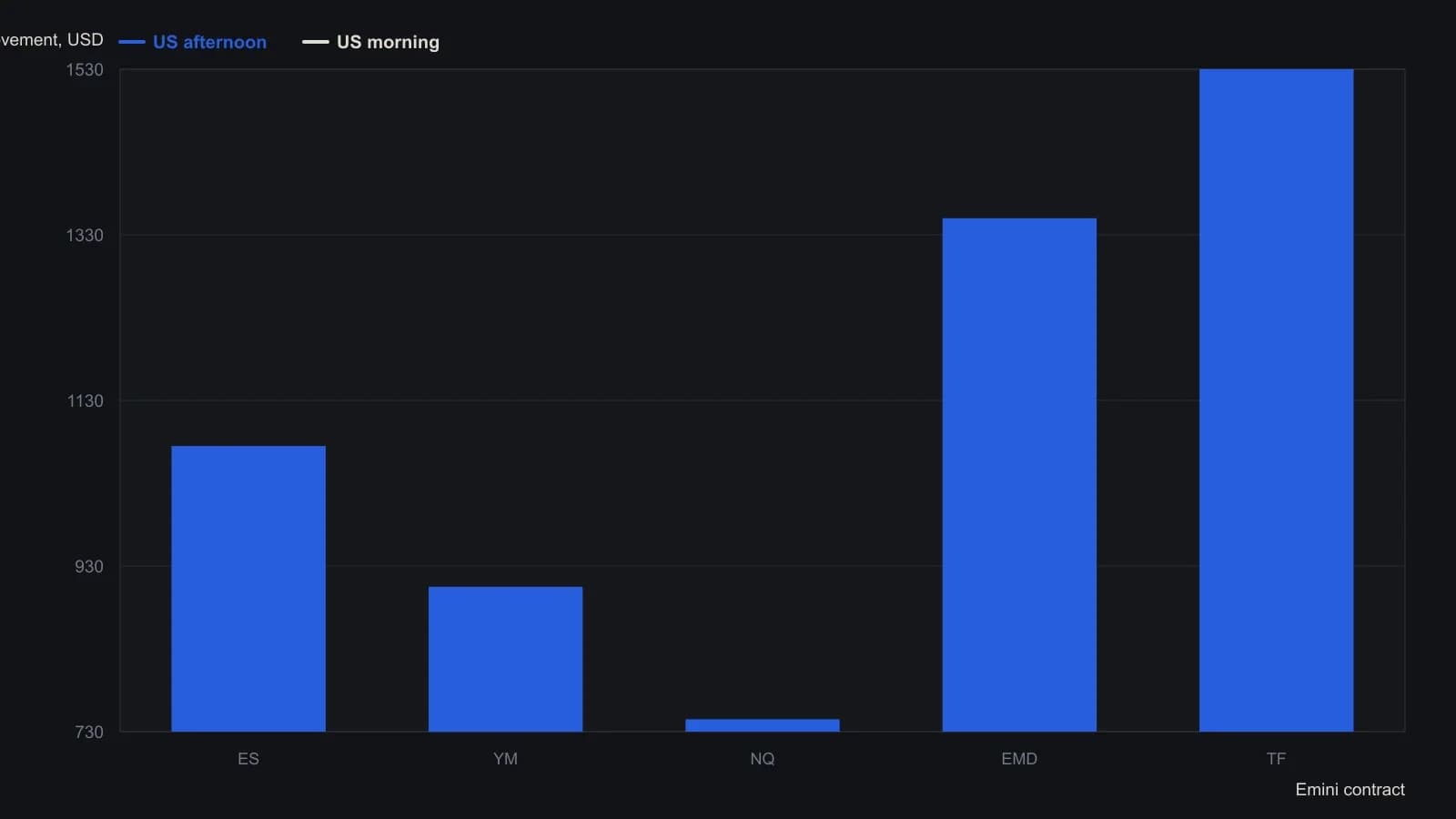
Printed dollar amounts equal average session ticks times the listed tick value: 12.50 dollars on ES, 5 dollars on YM and NQ, 10 dollars on EMD and TF. Afternoon travel is larger even though fewer scheduled US reports hit that window.
Bound the first loss from the session range
A first target set at 10% of the Russell 2000 emini’s average afternoon tick travel was stated as 16 ticks. That ten-percent-bound is a first target set at one-tenth of a contract’s average session tick travel. A 1:2 risk-reward ratio placed the stop at 8 ticks, equal to $160 on that contract.
Editorial comment: TradersWeek reads the risk-reward ratio as a first-loss bound sized from that contract’s typical afternoon range, so the cash exposure is known before the trade is placed.
All readings on this track · 18 readings
- 1990Constructing a second-hour session residual exponential index
- 2000Treat an open limit book as an execution filter
- 2002Constructing a long, short, or flat pre-trade checklist
- 2003Session-window trims for mechanical day-system evaluation
- 2004Overnight session entry rules after regular hours
- 2005Overnight and regular session execution in Nasdaq 100 names
- 2006The intraday workspace as a combined decision procedure
- 2006Same-session trading needs presence and next-signal rules
- 2007Session filters for moving-average entry rules
- 2008Related-market checklist, session filter, and ATR-scaled stop
- 2008After-hours session regimes and the next-day close
- 2008Evaluating a next-open entry after one-day corrections
- 2010Session range share: currency futures versus the mini index
- 2011Dollar travel, afternoon sessions, and a 1:2 first-loss bound in equity-index futures
- 2012Last-hour volume breaks with a first-hour exit
- 2013Same-session and multi-session trades as one rule-based procedure
- 2015Session clock bars from public quote feeds
- 2016Session-gated moving-average entry construction