2015issue C1260-64
Refuse mixed-horizon entries until the checklist locks one persona
A hold window that stretches from a few days to a few weeks cannot define trend or reversal. TradersWeek editorial reading: a pre-trade checklist must lock one trading persona, its bar length, and its drawdown envelope before a simple moving average or a channel breakout may authorize an entry, an exit, or a sit-out.
- A verbal hold that stretches from about three or four days to 15-20 days is not a holding-period band, because typical reversal size enlarges with that stretch.
- Four trading personas, from core through short-term, each pair a review frequency with a stated risk-tolerance envelope and a matching data time period.
- A simple moving average or channel-breakout confirmation is assigned only after the pre-trade checklist has locked persona, bar length, and envelope.
- Reading a shorter-horizon condition inside a longer-horizon structure is a defined review, not a mixed signal that can authorize an entry, an exit, or a sit-out.
An elastic hold window is not a rule
A trading persona is specified by a narrow holding-period band. A rule that holds for a few days or a few weeks so long as trend does not reverse is not implementable. Stretching the same wording from about three or four days to 15-20 days also enlarges typical reversal size.
If the verbal hold window stretches toward 10 days or weeks, average reversal amplitude can widen from under 1% toward 10%. An elastic horizon cannot support a consistent definition of trend or reversal.
A comfort zone must match the analysis method
A complete comfort-zone definition states expected return, drawdown depth, and drawdown length together and then requires the analysis method to match that envelope.
Four personas are distinguished by how often positions change and how long they are held. Core work changes one to five times in a lifetime and is held for decades. Long-term work changes one to five times a decade and is held for years. Medium-term work changes one to five times a year and is held for months. Short-term work changes one to five times a month and is held for days.
Each persona keeps its own risk envelope
Guideline risk envelopes paired with those personas run up to about -60% on yearly core data, -30% on monthly or weekly long-term data, -20% on daily or weekly medium-term data, and -5% on daily or intraday short-term data. Those levels are labeled arbitrary rough guides.
Multiple personas may occupy one book only if each keeps a separate review process, analytical toolkit, and risk envelope. A core sleeve is required to sit through declines of 50% or more and multi-year gaps between new highs.
A three-day air pocket can deliver index and style-vehicle losses of about 10% to 45%, so a persona's risk rule must cover compressed as well as drawn-out drawdowns.
Three-day ETF drops in the August 2015 mini-crash
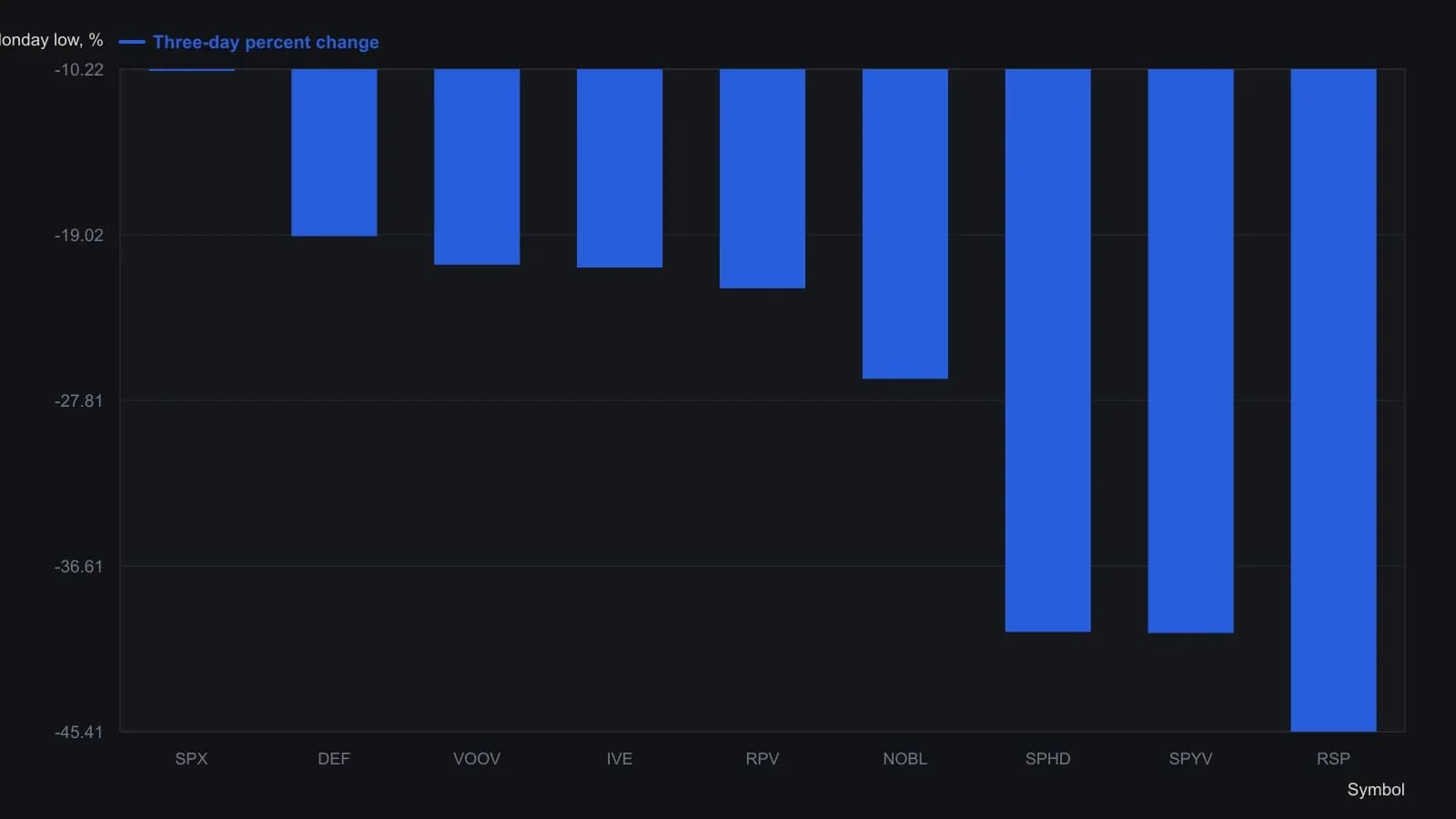
Each print is the change from the 19 August 2015 Wednesday close to the 24 August 2015 Monday low. The source contrasts that three-session window with losses that usually accumulate over many months.
Bar length and confirmation tool follow the persona
For a core persona sampled on yearly bars, a simple moving average is assigned as the baseline reader of the underlying series. Long-term monthly or weekly bars are assigned a simple moving average or a channel-breakout confirmation.
Medium-term work on daily or weekly bars is assigned channel-breakout confirmation. Short-term work on daily or intraday bars is assigned overbought/oversold oscillators or channel breakouts to locate extremes inside the longer-term trend.
Recombination is a checklist review, not a mixed signal
Once tools and sampling intervals are split by persona, they can be recombined as checklist conditions. A short-term decline inside a long-term advance, or a monthly overbought state inside a multi-decade core position, is a defined review rather than a mixed signal.
TradersWeek editorial reading: persona recombination is allowed only after each horizon has been analyzed with its own tool set. Until the pre-trade checklist has locked one trading persona, one data time period, and one risk-tolerance envelope, neither a simple moving average nor a channel breakout may authorize an entry, an exit, or a sit-out.
All readings on this track · 20 readings
- 1982Constructing a funnel from converging support and resistance
- 1990Bond trends as auction tests at prior highs
- 1995Constructing mechanical trendline breakout entries
- 2000Crowd balance points before a range-breakout
- 2000Breakout rules fail without tested exits
- 2002Waiting for setups instead of forcing trades
- 2003The 20-day channel high as a support test after breakout
- 2004Intermediate-term breakout rules and fifty-day exits
- 2004A three-check drill for support and resistance
- 2004Weekly exponential averages turn from breakout rails to resistance
- 2005Constructing a three-state moving-average breakout histogram
- 2005A three-state directional breakout on a moving-average midline
- 2005A range-market breakout watchlist with 50-day pullbacks and stops
- 2009Optimism bias, breakout adds, and predefined loss limits
- 2015Refuse mixed-horizon entries until the checklist locks one persona
- 2017Intraday breakouts planned from whole-number support and resistance
- 2017A fractal-dimension regime-gate for mechanical breakout entries
- 2018Trend-first FX walls stay a hypothesis until a second touch, RSI recross, or failed break
- 2019Constructing a sell-relative-strength-index from the intrabar range ratio
- 2020Decluttered charts for breakout, support, and stop rules