2017issue C097
Intraday breakouts planned from whole-number support and resistance
This archive case study plans an intraday long when a two-day high prints within $0.20 above a whole number, using a buy-stop at that offset, a stop-loss at the integer, and a target near $0.80 above it, short of the next whole-number resistance.
- Intraday entries and exits are planned from whole-number support and resistance rather than from stacked discretionary signals.
- A long is considered only when a two-day high prints within $0.20 above a whole number, which is the breakout confirmation used in the case study.
- The order plan places a buy-stop $0.20 above the whole number and a stop-loss at that same integer, with the planned exit near $0.80 above it and short of the next whole-number resistance.
- The scan looks for names in the $15 to $50 range and treats choppy names under $10, plus weak breakout signals, as conditions to avoid.
Entries planned from whole numbers
The case study plans intraday entries and exits from whole-number support and resistance instead of from stacked discretionary signals. A whole number is an integer price level used as the reference for the entry offset, stop placement, and target.
The write-up pairs a momentum price-action breakout with a tight, predefined stop-loss distance.
The two-day-high long
The long setup requires a two-day high that occurs within $0.20 above a whole number. That two-day high is the highest print over the prior two sessions, and it is used as the breakout confirmation to attempt a long day trade.
Round integer prices serve as nearby support under the breakout and as the next resistance that frames the exit. The planned exit sits near $0.80 above the same whole number, short of the next whole-number resistance.
TWTR long planned on the $17 whole-number rail
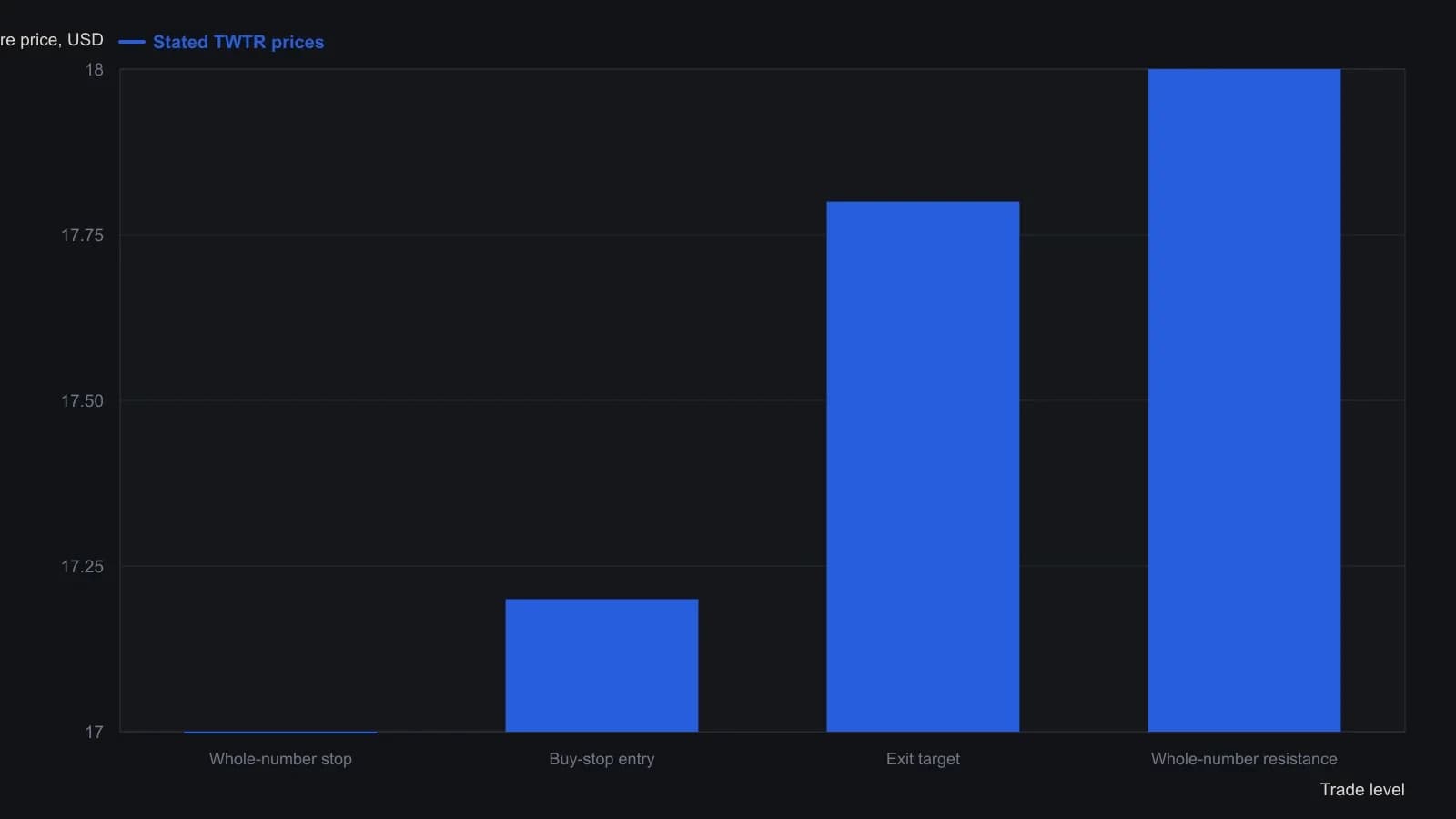
The 17.80 target is twenty cents below the next integer, matching the figure callout. One-minute candles on the screenshot were not sampled; the 20 August session is too compressed to read as discrete prints.
Buy-stop and stop-loss on the same integer
The illustrated order plan uses a buy-stop $0.20 above the whole number and an initial stop-loss at the whole number. The buy-stop is a resting buy that is intended to fill only after price trades that fixed offset above the whole number.
The stop-loss is a pre-placed protective exit at the whole number that bounds loss if the breakout fails immediately.
Scan range and names to avoid
The scan described looks for names in the $15 to $50 range. Choppy names under $10, plus weak breakout signals, are treated as conditions to avoid.
All readings on this track · 20 readings
- 1982Constructing a funnel from converging support and resistance
- 1990Bond trends as auction tests at prior highs
- 1995Constructing mechanical trendline breakout entries
- 2000Crowd balance points before a range-breakout
- 2000Breakout rules fail without tested exits
- 2002Waiting for setups instead of forcing trades
- 2003The 20-day channel high as a support test after breakout
- 2004Intermediate-term breakout rules and fifty-day exits
- 2004A three-check drill for support and resistance
- 2004Weekly exponential averages turn from breakout rails to resistance
- 2005Constructing a three-state moving-average breakout histogram
- 2005A three-state directional breakout on a moving-average midline
- 2005A range-market breakout watchlist with 50-day pullbacks and stops
- 2009Optimism bias, breakout adds, and predefined loss limits
- 2015Refuse mixed-horizon entries until the checklist locks one persona
- 2017Intraday breakouts planned from whole-number support and resistance
- 2017A fractal-dimension regime-gate for mechanical breakout entries
- 2018Trend-first FX walls stay a hypothesis until a second touch, RSI recross, or failed break
- 2019Constructing a sell-relative-strength-index from the intrabar range ratio
- 2020Decluttered charts for breakout, support, and stop rules