1989issue C091-3
One add option sizing with a scale-out and a trail
A decaying option can show a temporary loss even when the later direction is correct. The archive procedure ring-fences a dedicated-risk-stake, limits each idea with a dollars-per-trade-cap, adds once after a probe-fill, then uses a scale-out-position and a trailing-stop on the remainder.
- Ring-fence option losses in a dedicated-risk-stake inside a larger account used as collateral, and stop option activity if that earmarked cash is lost.
- Take a probe-fill first and place a mechanical-add immediately, with scale-in price and size fixed in advance so the second purchase is not re-decided.
- Recut the stop after the scale-in-position so remaining risk stays inside the dollars-per-trade-cap. If that stop is hit, accept the capped cash loss rather than hold a decaying contract into expiration.
- After a favorable move, a scale-out-position plus a trailing-stop banks some gain and keeps the remainder from reversing into a loss.
A decaying option can lose money first
Buying a decaying call or put before a trend is fully underway can produce a temporary loss even when the later direction is correct.
Keep option losses inside a dedicated stake
An option-risk stake can be ring-fenced inside a larger account used as collateral, with option activity intended to stop if that earmarked cash is lost.
A predetermined dollars-per-trade-cap is used so one position cannot consume a large fraction of the dedicated-risk-stake. The illustration uses 1500 at risk per idea against a 15000 option-risk budget.
Start with a probe-fill and one mechanical-add
Scale-in price and size are fixed in advance and the add order is placed immediately after the first fill so the second purchase is not re-decided. The probe-fill is the first, partial entry, and its purpose is to leave cash available for that one later add.
In the worked add, a six-contract long at 5 becomes twelve contracts at an average of 4.5 after a scale-in-position at 4, and a stop at 3.25 is set so remaining risk stays 1500.
Buying the full intended size at the first price can leave no cash reserve for a later add and, with a two-point stop on twelve contracts from 5, produces a 2400 cash loss, above the 1500 dollars-per-trade-cap.
Accept the cap if the recut stop is hit
If the post-add stop is triggered, the procedure accepts the capped cash loss rather than holding a decaying contract in hope of recovery into expiration.
Cash results of one add and a recut stop versus buying the full size
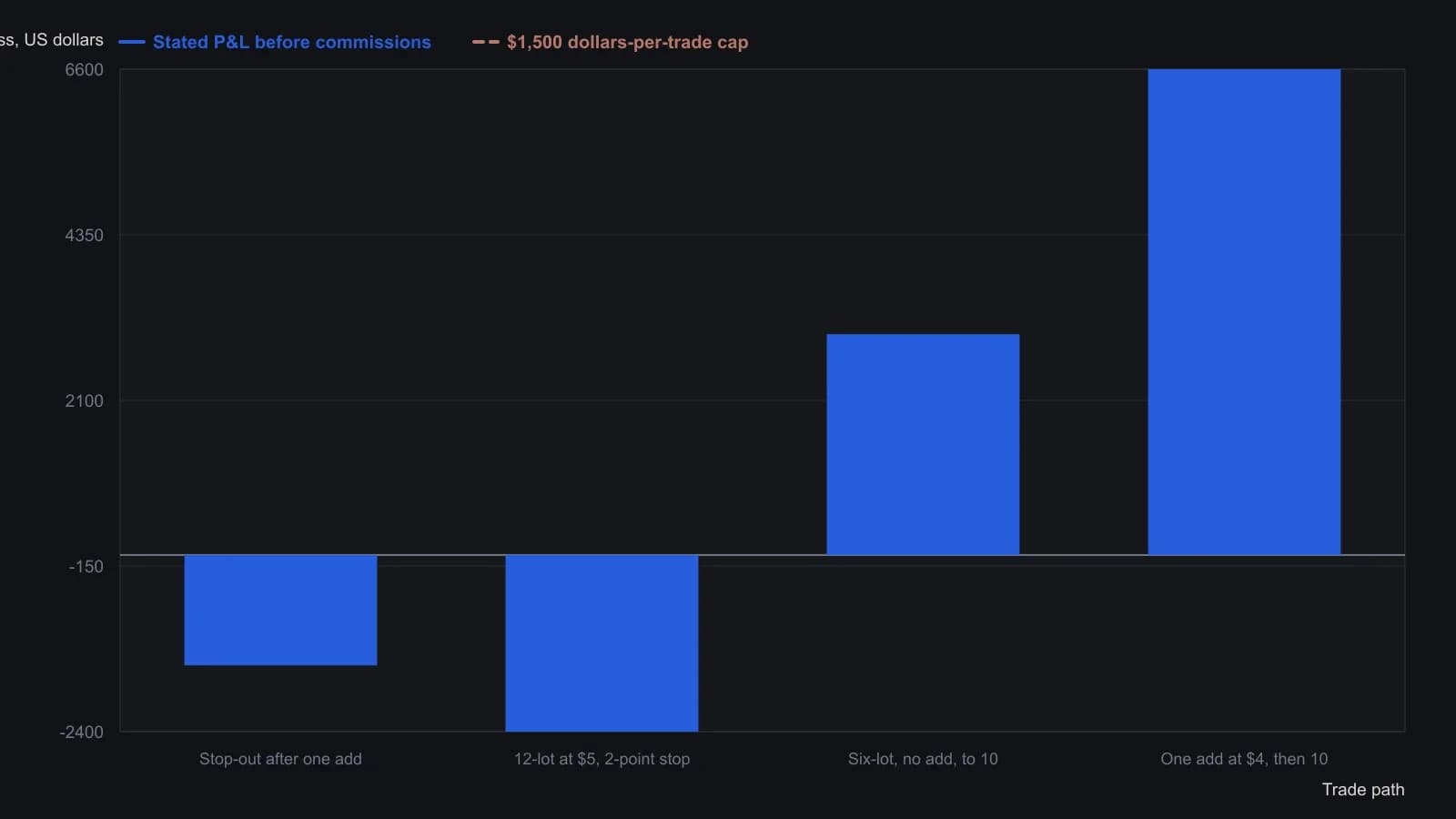
The source states each result plus or minus commissions, which it does not quantify. Dollar amounts use the standard $100-per-point option multiplier implied by 1-1/4 points times 12 lots equaling $1,500.
Scale out of a gain and trail the rest
After a favorable move, a scale-out-position uses a limit sale of half the position plus a stop on the remainder to bank some gain and keep an open profit from reversing into a loss.
A trailing-stop on the remaining size is raised as the contract advances so a later reversal exits the position after an open profit has already been established.
Liquidating the entire position at the first modest advance is described as leaving no remaining size if a much larger later move develops, while small realized gains are said to be offset by losses.
All readings on this track · 18 readings
- 1989One add option sizing with a scale-out and a trail
- 1991Precommit scale-outs and puts to replace impulse
- 1991A written game plan for checklist, scale-out and staggered stops
- 2004Name the stop, require a 1:3 reward, then scale out half
- 2005Why pre-target scale-outs lower expected value
- 2008Preplanned butterfly exits with stops and scale-outs
- 2010Qualified trend, volume breaks, and a staged scale-out
- 2011Gated entry and scale-out after a climactic selloff
- 2011First-target review: scale out or flatten
- 2012Tiny scale-out as a systems decision test
- 2014Written size and exit scripts for scaling and risk
- 2017Constructing livable scale-out exit rules
- 2017Why the simpler looking system is harder to run
- 2018Prewritten scale-out and exponential moving-average exit procedure
- 2019A dual-career swing procedure that must output entry, scale-out, or abstention
- 2019A same-session opening-range breakout with a whole-number stop and scale-out
- 2019Grade the first seasonal long-put gain as a maintenance exam
- 2019Failed candlestick fades with breakout permission and scale-out