1989issue C091-4
Evaluating channel breakout with intraday and close-only stops
A channel-breakout system can remain continuously positioned by reversing at the highest high or lowest low of the most recent n trading days. The same channel map can reverse on an intraday touch or only when the close is at or beyond that extreme.
- A channel-breakout system can stay continuously positioned by reversing at the highest high or lowest low of the most recent n trading days.
- The same n-day-channel can be run with an intraday-touch-stop or a close-only-stop, so the stop convention is a separate design choice.
- A close-only-stop can miss same-day movement and leave a signal unresolved until it is too late to trade that session, while it is described as theoretically avoiding some false signals an intraday touch can generate.
- Editorial: change only the stop convention when judging lag, giveback, and same-day uncertainty, and do that before inspecting a results table.
An always-in-market n-day channel
A channel-breakout system can be specified as a trend-following procedure that remains continuously positioned by reversing at an n-day price extreme. The always-in-market posture never stands aside. Each exit is also an entry in the opposite direction.
Reversal levels are the highest high and the lowest low observed over the most recent n trading days. That band is the n-day-channel. A breakout-system keeps those extremes as the rule set and reverses when price reaches a defined channel extreme.
The design is framed as a refinement of a weekly Donchian rule that computed stops only once per week. A donchian-breakout still uses the recent n-day high and low as the reversal map.
Session touch versus close-only
The same channel map can be tested with two execution conventions. An intraday-touch-stop reverses as soon as price trades at the channel extreme during the session. A close-only-stop withholds the reversal until the session close is at or beyond that extreme.
Under the close-only convention, a long reverses if the close is at or below the n-day low, and a short reverses if the close is at or above the n-day high.
Lag, false signals, and same-day uncertainty
Lagging reversal levels can sit far from the current price. One contemporaneous 14-day yen example placed the stop about 400 points, or about $5,000, above the then-current market.
A close-only trigger can miss same-day movement in markets without limits and can leave the signal unresolved until it is too late to trade that session. The close-only convention is described as theoretically avoiding some false signals that an intraday touch can generate.
An 8-day channel that reversed on an intraday touch produced three coffee signals between December 1988 and May 1989.
The historical search
The historical search used channel lengths from 3 to 40 days, about five-and-a-half years of data ending in May or June 1988, and a $100 deduction for commission and slippage.
Optimal n-day channel profit by market
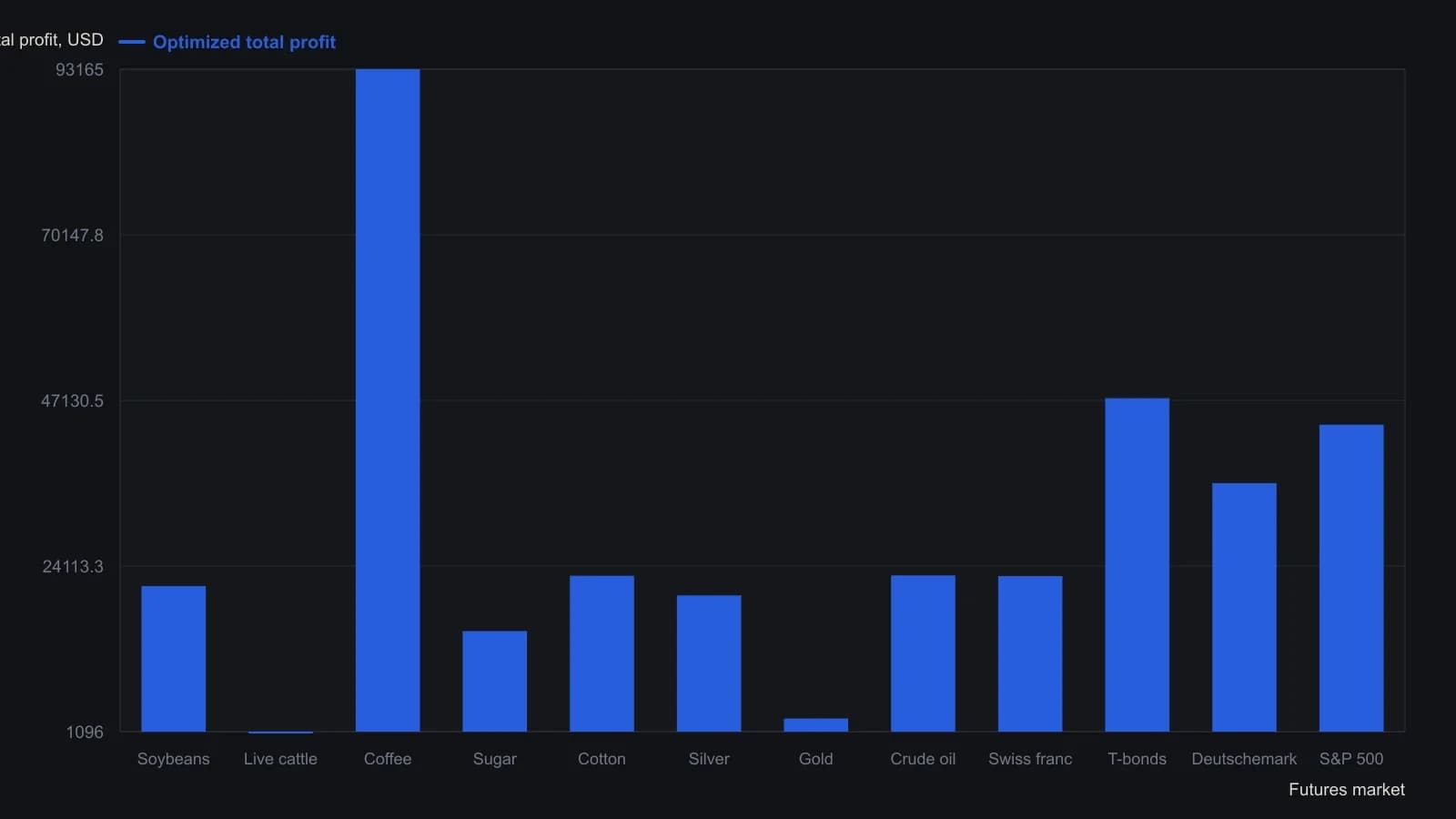
Channel length was searched from 3 to 40 days. Each row reports only the better stop convention for that market, not both methods side by side. Contract windows differ slightly and end in May or June 1988.
All readings on this track · 6 readings
- 1989Evaluating channel breakout with intraday and close-only stops
- 1990Delayed channel breakout stop construction
- 2000Fixed-horizon walk-forward tests of first-print breakouts
- 2013Z-score value filter on reversals and Donchian entries
- 2014Length fit versus later window for a two-length Donchian breakout
- 2014Walk-forward complexity in Donchian breakout systems