1987issue C101-7
Seasonal calendar spreads as financed capital slots
A seasonal calendar-spread is reserved as a capitalization-slot of margin plus the planned stop. Remaining equity, an overlay-filter that may refuse the seasonal-window, and a specified close-only-stop turn the dated idea into a bounded book.
- A seasonal program assembles many timed calendar-spreads into a diversified book that can be used across the calendar year.
- Each accepted spread is a capitalization-slot of margin plus the planned stop, so remaining equity sets how many similarly financed windows can be open at once.
- A seasonal-window is chosen from a grid of date pairs, then compared by annualized-slot-ranking so leftover funds go to higher-ranked candidates.
- Date-only entry and exit are incomplete without an overlay-filter that can advance, delay, or refuse the window, and without a close-only-stop when an official spread stop cannot be parked.
A seasonal spread program is framed as assembling many timed relative-value trades into a diversified book that can be used across the calendar year. Each idea is a calendar-spread: a paired long and short in related deliveries or related markets, so the exposure is to relative movement rather than a single outright price.
A candidate window is chosen from a grid
The working example is long December oats versus short December Chicago Board of Trade wheat, with a candidate seasonal-window from October 31 to November 30.
A quarter-month grid reports, for each entry and exit pair, average dollar change and the share of years that were profitable. A seasonal-window is chosen from many date combinations rather than from a single pair of dates.
Each spread occupies a capitalization-slot
Each accepted spread is financed as a capitalization-slot: initial margin plus the planned stop. With a $500 margin and a $700 stop the reserved slot is $1,200, so a full stop-out is treated as consuming the stop while freeing the margin.
Reserving that $1,200 slot in a $15,000 account leaves $13,800 for other similarly financed spreads, so the number of open positions contracts when capital is tied up and expands when it is not.
Remaining funds follow annualized-slot-ranking
Spreads of different length, hit rate, margin, and stop are ranked by annualized-slot-ranking. The historical average result is expressed as a return on the reserved slot and scaled to a year so remaining funds can be directed to the higher-ranked windows.
Yearly dollar result of the Oct 31–Nov 30 oats/wheat spread
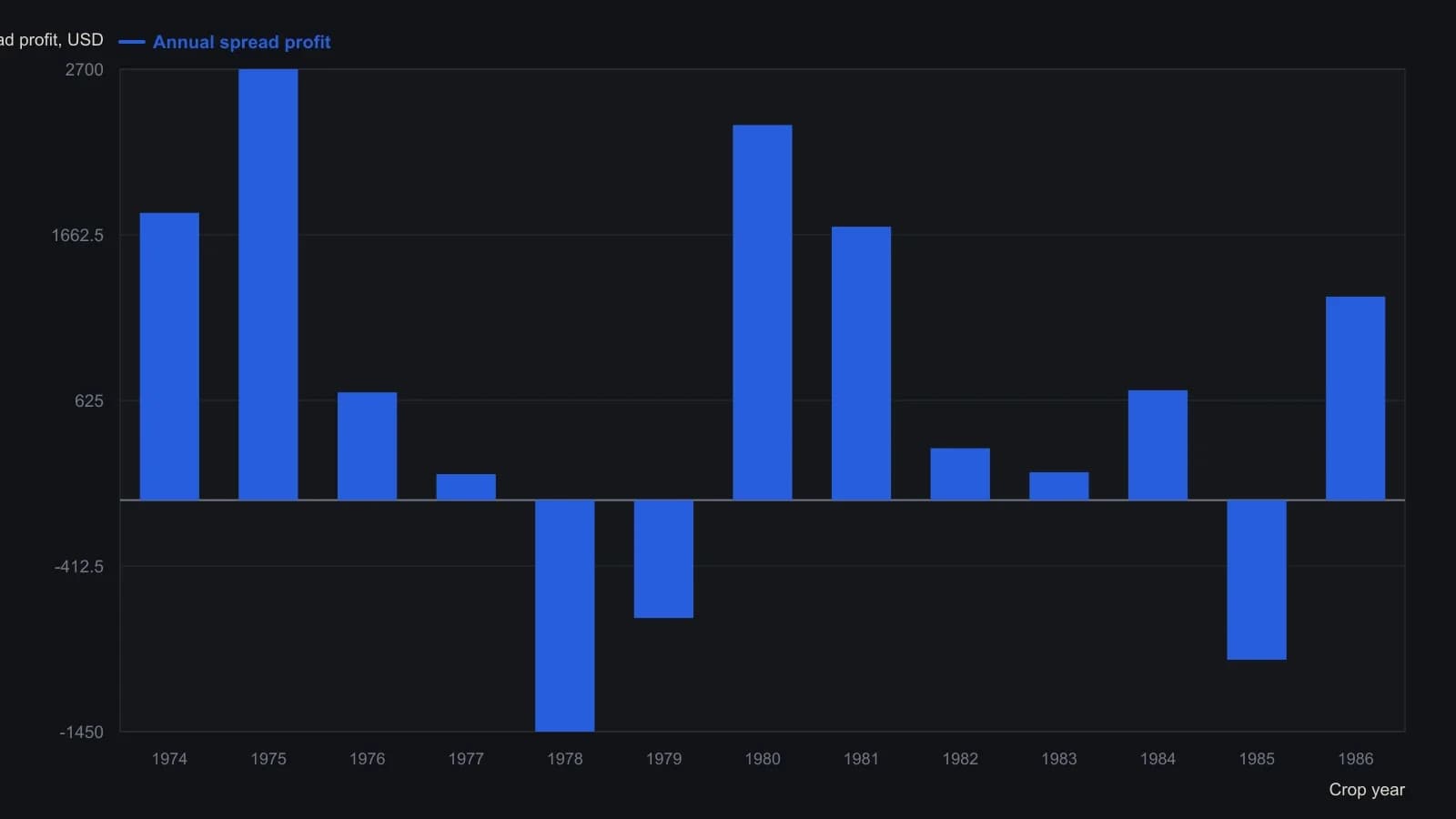
Window is OZ/WZ over crop years 1974–1986. Printed yearly profits sum to $8,676 while the SUMMARY line shows $8,675; each bar uses that year’s PROFITS figure as printed. Average profit on the printout is $667.
An overlay-filter can refuse the window
A seasonal move can begin early, begin late, or fail to appear, so date-only entry and exit are treated as incomplete without an overlay-filter. That second rule set is applied to the spread or its legs. It can advance, delay, or block a seasonal-window, and it can generate exits inside that window.
One overlay practice is to watch the spread from two weeks before the scheduled entry and to accept same-direction signals from one week before. A simple rule cited is two consecutive closes in the seasonal direction, with those signals continuing until the stop or the calendar exit. A still-trending spread is allowed to run past that exit until the overlay-filter turns.
A close-only-stop bounds the slot
Official stops often cannot be parked on the spread itself. Three practical alternatives are an immediate intraday exit, a close-only-stop, and a close-only decision that is filled on the next open. A close-only-stop is a loss bound judged from the session close rather than from an official spread stop order, and it is sometimes filled on the next opening if the decision is made after the close.
A June long-bond versus short-bill episode that was stopped the next day recorded losses of $500 on an immediate exit, $1,331 on a close-only-stop, and $1,950 when the close-only decision was filled on the following open.
All readings on this track · 18 readings
- 1982Constructing commodity spreads, calendar legs, and option straps
- 1987Seasonal calendar spreads as financed capital slots
- 1989Seasonal dates, confirmation, and reconstructed spread bars
- 1991Calendar-spread divergence as a demand clock for commodity reversals
- 1992Expiration-forced convergence for basis, calendar, and option-income trades
- 1993Write the soybean intercrop calendar as one procedure
- 1996A commodity-basket redesign read as a proxy and a calendar-spread
- 2003Calendar spread construction by volatility skew
- 2003Livestock calendar spreads during a commodity-index roll
- 2004Same-strike calendar construction, decay income, and account gates
- 2004Range-bound calendar spreads and precommitted exits
- 2007Construct futures size from the good-faith deposit and the spread
- 2007Critiquing calendar spreads when reversals overrun
- 2010Name the spread, then construct the legs
- 2012Monthly calendar income under a volatility-regime process
- 2016A VIX calendar-spread case after the 2015 volatility spike
- 2017Yield curve kinks as spread laboratories
- 2018Bitcoin futures contract choice, percentage margin and calendar spreads