1991issue C041-6
Write a staged RSI exit book with trailing stops
A nine-day relative strength index is reserved for exits and treated as a scale-out checklist, not a reversal call. The written book first reduces multi-contract size, then shortens the trailing stop, and it delays or keeps the first cut according to a prior sideways, bull, or bear classification.
- Treat the nine-day relative strength index as an exit tool only, not as a way to open positions or to pick tops and bottoms.
- Staged liquidation requires multiple-contract futures size so partial exits can cut remaining risk while a residual position stays in the trade.
- After each threshold, park leftover size behind a trailing exit that moves from the nine-day average to the four-day average and then to the prior session extreme.
- A regime-adjusted first cut postpones long-side liquidation in a classified bull market, while a classified bear market still begins tightening at the same short-side readings used in a sideways book.
Reserve the oscillator for exits
A directional entry plan is treated as incomplete unless it is paired with a predefined protection and exit procedure. In this historical workflow the nine-day relative strength index is reserved for those exit decisions and is treated as unreliable for opening positions.
The relative strength index is a zero-to-one-hundred oscillator built from the ratio of average up closes to average down closes over a chosen lookback. It measures a series against its own recent closes rather than against another market. The archive computes it from close-to-close up and down averages, mapped onto a 0 to 100 scale as 100 minus 100 divided by one plus that ratio, with a 14-session lookback in the original specification and a smoothed update after the first window. The procedure documented here uses a nine-day lookback for the oscillator readings and for the first trailing-average stop.
Size the book so partial exits are possible
Multiple-contract futures size is required so that partial exits can cut remaining risk while a residual position stays in the trade. Staged liquidation is the preset sequence that reduces that position in fixed fractions as successive oscillator thresholds are reached.
Write the sideways long ladder
In a sideways market a long position is reduced by 10 percent or at least one contract when the nine-day index reaches 75, by 50 percent of the remainder at 80, and by 90 percent of the remainder at 90.
After those long-side thresholds the leftover size is parked behind a trailing stop just under the nine-day average at 75, just under the four-day average at 80, and just below the prior day's low at 90. That trailing exit is advanced under the shortening average or the prior session extreme as the oscillator becomes more extended.
Write the sideways short ladder
In a sideways market a short position is reduced by 10 percent or at least one contract at 25, by 50 percent of the remainder at 20, and by 90 percent of the remainder at 15, with stops placed just over the nine-day average, the four-day average, and the prior day's high respectively.
Adjust the first cut to the classified regime
When prior analysis classifies the market as a bull trend, partial liquidation is delayed until the index reaches 80, at least 50 percent is closed near 85, and residual size is cut to 10 percent near 90, while the same stop-tightening sequence is kept.
In a classified bear market liquidation still begins near 25 and proceeds through 20 and 15, because the documented study found bear moves more protracted and, after the first decline, less steep than bull runs, so stops are tightened at less extreme readings than on the long side. That pairing is the regime-adjusted first cut: the first partial exit is postponed in a classified bull market relative to a sideways market, and tightening in a classified bear market begins at less extreme readings than the bull-market analogue.
Nine-day RSI on spot T-bonds through the 1989 bear
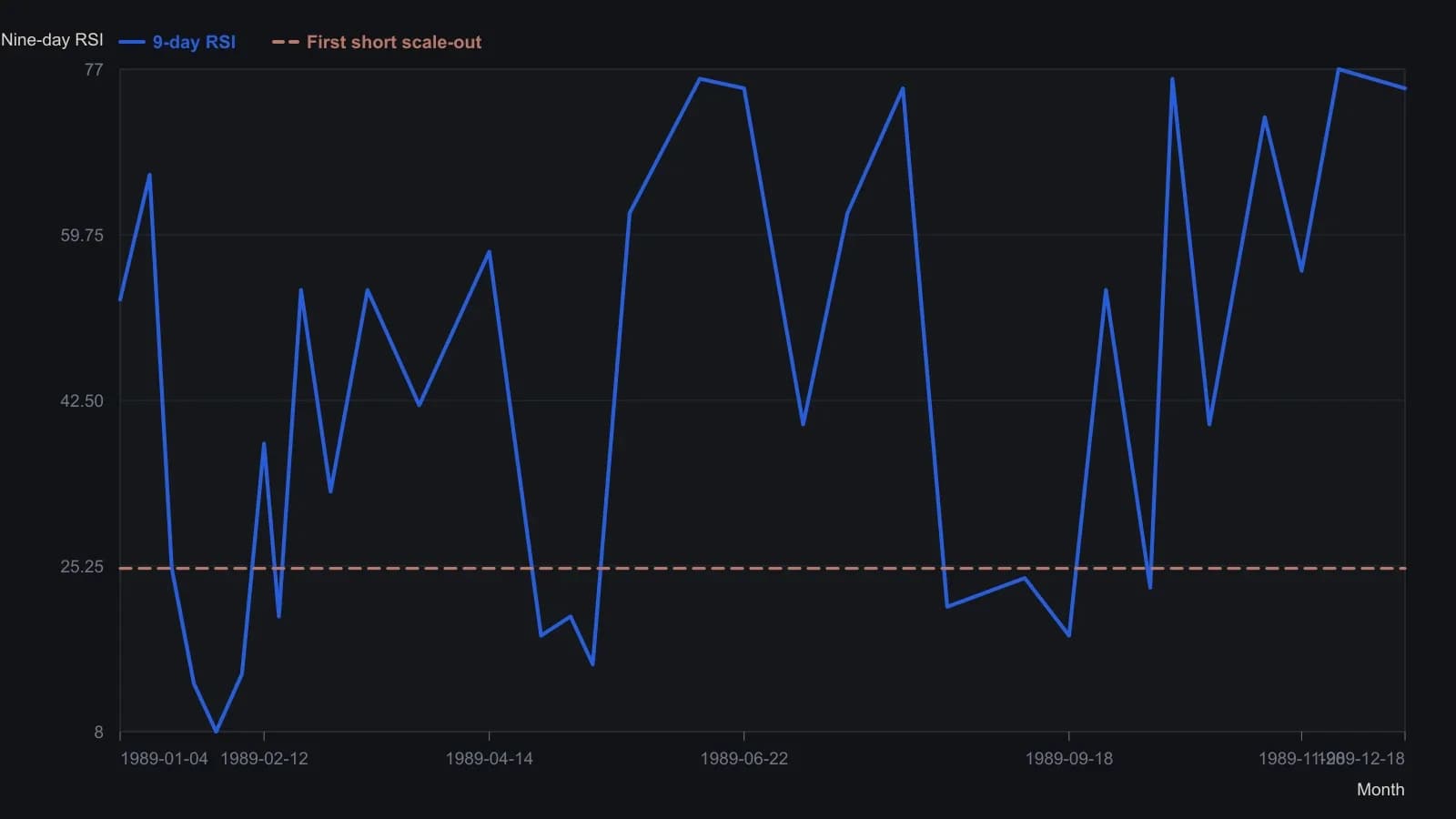
Cartwright plots a nine-day RSI, not Wilder’s 14-day default. Dates are month-axis estimates from a magazine scan; unmarked readings are approximate to a few RSI points.
Keep a residual piece on a trail
The oscillator can remain extreme for consecutive sessions in a strong directional move, including seven straight readings in the 90s during a 1989 pork-belly advance and as many as ten straight readings below 10 during a 1979 interest-rate decline, which is why using it to pick tops and bottoms is discouraged.
Rule-based entry is a prior directional decision that opens the position under a separate plan. The procedure documented here attaches only after that entry exists and then specifies how size and stops are reduced.
All readings on this track · 18 readings
- 1988Constructing a mechanical trend system with independent trailing exits
- 1991Write a staged RSI exit book with trailing stops
- 1993Evaluating filter-trigger trailing exits after breakouts
- 1995Weekly-close breakout entry and trailing exit in Eurodollars
- 1996Evaluating moving-average turn entries and slope exits
- 1997Precommit an equity-risk cap and a profit-retracement exit
- 1998Exit stops before entries
- 1998Exit rules evaluated with a fixed random entry
- 2002Construct the stay-or-flatten decision before entry
- 2006Audit the stop, trail, and risk-reward stack as one procedure
- 2007Building a momentum system with relative strength and trailing exits
- 2013When buy and hold needs a sell rule
- 2013A mechanical trend toolkit that turns screens into one entry-exit procedure
- 2014Is a two-period relative strength index, a channel breakout, and a trailing exit one long-only procedure?
- 2016Trend-aligned option entries and trailing exits
- 2017Monthly three-black candles as a trailing exit
- 2018Evaluating profit-taking and reentry in trend following
- 2020Treat the zigzag threshold as a volatility-scaled construction variable