1992issue C061-8
Intermarket confirmation for long-duration bond-fund timing
A 30-year-maturity zero-coupon Treasury fund can stand in for the cash 30-year bond because a single payment at maturity stretches price swings. The archive lines up money-market maturity, the U.S. Dollar Index, and bond Bullish Consensus with a 10-week minus 4-week oscillator that is acted on at direction changes, not zero-line crosses.
- A 30-year-maturity zero-coupon Treasury fund can stand in as an index-proxy for the 30-year Treasury bond because its single payment at maturity exaggerates cash-bond price swings.
- Money-market managers shorten average portfolio maturity when they expect higher rates and lengthen it when they expect lower rates; that path tracked the 90-day Treasury bill yield, and both downtrends stalled in January 1992.
- A rising U.S. Dollar Index is often read as currency-market expectation of higher long-term U.S. rates, and in the documented period the dollar peak occurred near the peak in the 30-year bond yield.
- Bond Bullish Consensus near 70 percent is treated as an optimism extreme and readings below 43 percent as a pessimism extreme, with pessimism described as the more consistent mark; on the fund, a ten-minus-four-oscillator is acted on at direction changes, and those turns aligned with price reversals.
A zero-coupon fund as the bond proxy
A 30-year-maturity zero-coupon Treasury fund can stand in as a proxy for the 30-year Treasury bond. The fund pays only at maturity, so its price swings exaggerate those of the cash-bond market.
That zero-coupon-exaggeration is why the fund is the index-proxy here: a more tradable vehicle chosen to stand in for a less convenient benchmark, with built-in volatility for timing drills.
Money-market maturity as a rate-expectation map
Money-market managers shorten average portfolio maturity when they expect higher interest rates and lengthen it when they expect lower rates. Money-market-maturity is the average days-to-maturity of those portfolios, read as a weekly map of short-rate expectations among cash managers.
Money-market maturities lengthened from December 1990 as policy rates were cut, found support near 52 days, and shortened from January 1992 as recovery and higher-rate expectations returned. The path of money-market maturities tracked the 90-day Treasury bill yield, and both downtrends stalled in January 1992.
Money-market fund average maturity, Dec 1990–Sep 1992
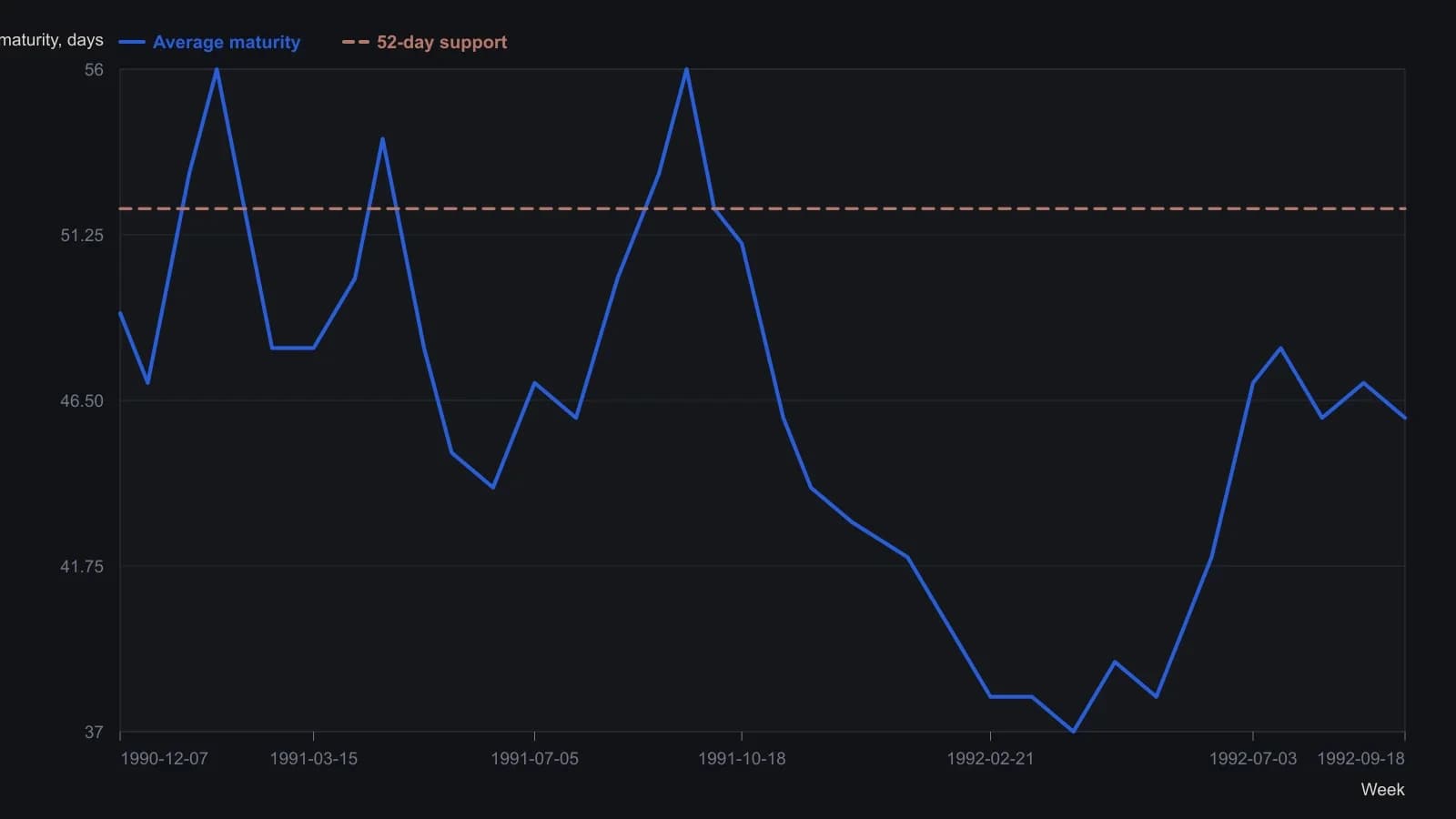
The source draws a horizontal support line at 52 days. Digitized weekly-ish samples; y-values are approximate to the nearest day because the raster has 2-day tick spacing.
Dollar-index confirmation
A rising U.S. Dollar Index is often read as currency-market expectation of higher long-term U.S. rates. Dollar-index-confirmation uses that index as an external check on whether currency traders share the long-rate expectation implied by bond yields.
In the documented period the dollar’s peak occurred near the peak in the 30-year bond yield, and a later dollar decline accompanied falling bond yields.
Bullish-consensus extremes
A bullish-consensus-extreme is a published share of bond bulls treated as a contrarian threshold. Bond Bullish Consensus near 70 percent is treated as an optimism extreme that often precedes a top, while readings below 43 percent are treated as a pessimism extreme that usually marks a bottom. The pessimism threshold was described as the more consistent of the two.
After December readings above 60 percent, a 67 percent bulls reading on January 11, 1991 marked a sentiment peak that preceded higher yields. Later pessimism in June and July, confirmed by a contemporaneous dollar-index top, preceded a bond-price advance.
The ten-minus-four oscillator
On the volatile zero-coupon fund, a ten-minus-four-oscillator is the difference between a 10-week and a 4-week moving average. It is acted on at direction changes rather than zero-line crosses. Those turns aligned with fund price reversals.
Editorial combination of the three checks
The documented sequence supplies the separate alignments: the January 1991 bullish-consensus-extreme, later mid-year pessimism confirmed by a dollar-index top, the 1990–1992 money-market-maturity path beside the 90-day bill yield, and oscillator turns that aligned with reversals on the fund.
Editorial interpretation: stay flat unless money-market-maturity, dollar-index-confirmation, and a bullish-consensus-extreme describe the same rate-expectation regime. When they agree, treat a change in direction of the ten-minus-four-oscillator as the cue to enter, reverse, or abstain. Requiring all three checks to agree before an oscillator turn is acted on is an editorial combination rule, not an archive instruction.
All readings on this track · 19 readings
- 1992Country regime inside global allocation and index proxies
- 1992Intermarket confirmation for long-duration bond-fund timing
- 1993Paired bond and currency proxies with weekly crossover confirmation
- 1995Walk-forward evaluation of a municipal futures timed fund switch
- 1999Regime-gated allocation with bounded index leverage
- 1999Testing trend following with cash-price controls
- 2002A capital-preservation case for index-proxy allocation
- 2003A shared weekly-average grid for four Asian index proxies
- 2005Index-etf-core weights, a growth-index-clock, and an implementation-cost-ledger
- 2005European index proxies as one weekly-regime panel
- 2006Index-fund proxies as intermarket regime instruments
- 2006Constructing metal option exposure with mining proxies and implied volatility
- 2010Matched straddles on levered versus unlevered index proxies
- 2013Inheritance as an index-proxy and allocation case
- 2014Headline index levels mix a changing basket with a changing divisor
- 2017Screening ETFs by liquidity, index fit, and rank
- 2019Leveraged commodity proxies fail the futures test
- 2020Constructing pre-listing paths for new fund sleeves
- 2020A sleeve after cost-drag, judged by an index-proxy, sized in a stock-bond mix