2006issue C081
Constructing metal option exposure with mining proxies and implied volatility
When a listed bullion fund has no options, the archive workflow was to take a mining-share index-proxy, then read implied-volatility and the recent range to judge whether option-premium was pricing a tight or wide volatility-regime.
- A listed bullion fund that holds physical metal and trades like a stock can still leave an options gap if no contracts are listed on that fund.
- A liquid gold miner or a mining-stock index can serve as an index-proxy through the mining-share-link, which is useful but imperfect.
- Option-premium on a fixed strike is cheaper after a tight range and richer after a wide range, and implied-volatility lifts or cheapens those premiums.
- Auto-exercise can convert an in-the-money call into shares and a margin call if the account cannot pay for the stock.
The options gap
A listed bullion fund that holds physical metal and trades like a stock can still leave an options gap if no contracts are listed on that fund. The archive workflow then moved the metal thesis onto a listed mining vehicle that did have contracts, and only after that read the premiums on that vehicle.
Choosing an index-proxy
When the metal fund has no options, listed contracts on a large, liquid gold miner can serve as a directional proxy because the shares generally move with the metal, though the link is imperfect. That mining-share-link is useful as a proxy but is not a one-for-one substitute.
Two mining-stock indexes, one with 16 leading names and one with 15, carry listed options and tend to move with the metal because they track mining-share performance rather than bullion. An index-proxy is a listed mining-stock index or liquid miner used to build option exposure when the metal or metal fund has no listed contracts.
Auto-exercise at expiration
A call that finishes in-the-money by 0.25 or more is subject to auto-exercise. Auto-exercise is the clearinghouse treatment that converts an in-the-money option into the underlying at expiration unless the holder instructs otherwise in time.
If the account lacks cash to buy the shares, the broker issues a margin call and may liquidate the stock, crediting the difference between the share price and the strike.
Volatility-regime and option-premium
All else equal, a one-month call struck at 35 is cheap when the stock has stayed in a 30-32 range, because there is little chance of finishing above the strike. The same one-month 35-strike call is more expensive when the stock has recently ranged from 30 to 80, because a return toward the upper end would make the right to buy 100 shares at 35 valuable.
Volatility-regime is whether the underlying has been confined to a narrow band or a wide band, which changes the chance a fixed strike finishes in the money. Option-premium is the price of the contract, which rises when expected or realized range is wide and falls when the underlying is expected to stay quiet.
Implied-volatility across names
Implied-volatility, readable from a pricing model or from option chains, is the market's expected volatility of the underlying. It is inferred from quotes or a pricing model and is used to compare premium richness across names and time. Rising implied-volatility lifts premiums and falling implied-volatility cheapens them.
At the time of the source, average implied-volatility differed across large names, with examples near 40 percent, 33 percent, and 30 percent, showing that premium levels are name-specific even in the same session.
Implied volatility priced on three equity option chains
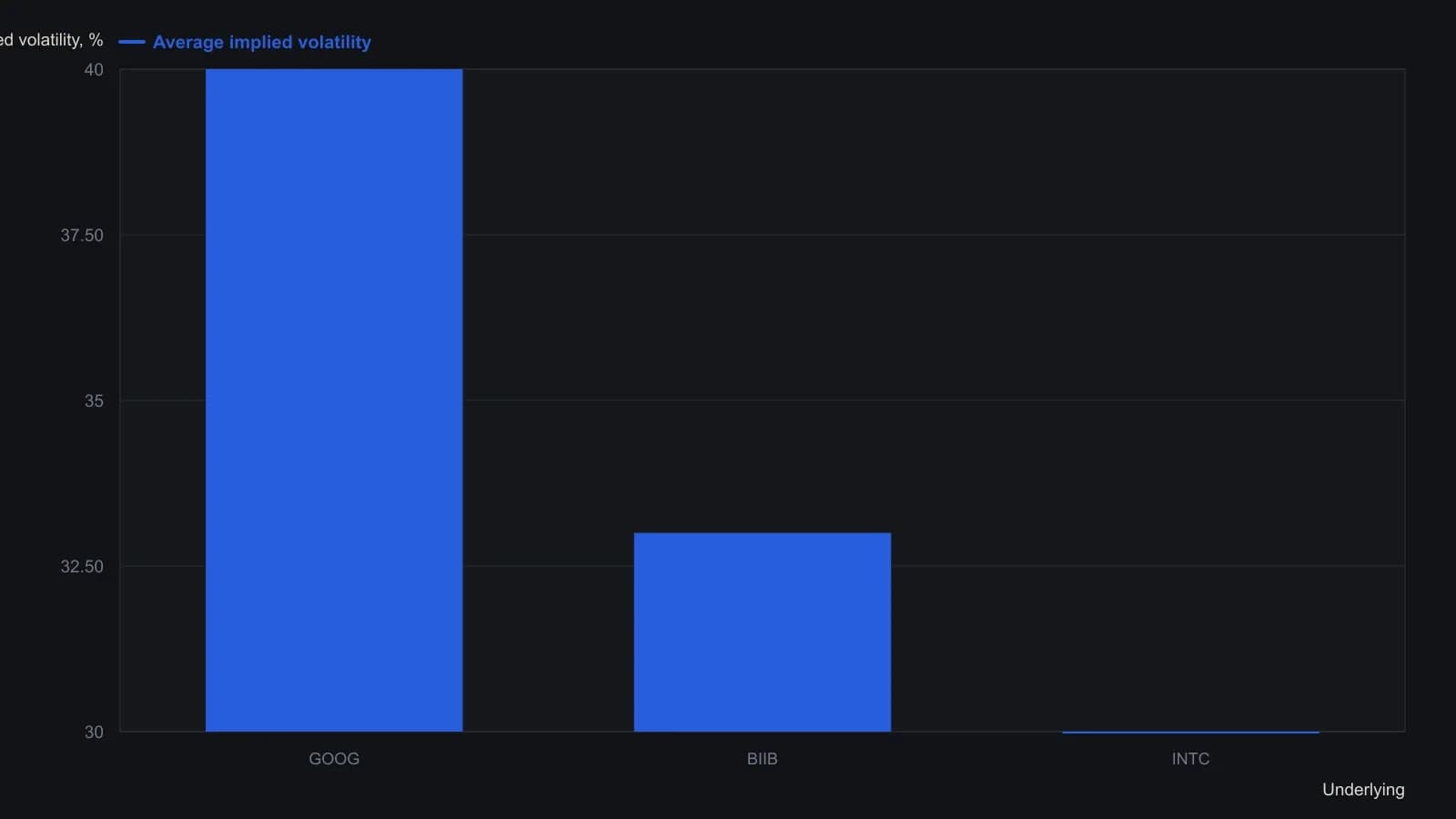
Single publication snapshot, not a history. Google is given as an average of 40 percent, Biogen Idec as near 33 percent, and Intel as roughly 30 percent.
All readings on this track · 19 readings
- 1992Country regime inside global allocation and index proxies
- 1992Intermarket confirmation for long-duration bond-fund timing
- 1993Paired bond and currency proxies with weekly crossover confirmation
- 1995Walk-forward evaluation of a municipal futures timed fund switch
- 1999Regime-gated allocation with bounded index leverage
- 1999Testing trend following with cash-price controls
- 2002A capital-preservation case for index-proxy allocation
- 2003A shared weekly-average grid for four Asian index proxies
- 2005Index-etf-core weights, a growth-index-clock, and an implementation-cost-ledger
- 2005European index proxies as one weekly-regime panel
- 2006Index-fund proxies as intermarket regime instruments
- 2006Constructing metal option exposure with mining proxies and implied volatility
- 2010Matched straddles on levered versus unlevered index proxies
- 2013Inheritance as an index-proxy and allocation case
- 2014Headline index levels mix a changing basket with a changing divisor
- 2017Screening ETFs by liquidity, index fit, and rank
- 2019Leveraged commodity proxies fail the futures test
- 2020Constructing pre-listing paths for new fund sleeves
- 2020A sleeve after cost-drag, judged by an index-proxy, sized in a stock-bond mix