2010issue C0739
Matched straddles on levered versus unlevered index proxies
A week-to-month, dollar-matched options straddle placed a two-times S&P 500 proxy beside an unlevered index fund. After implied volatility, breakeven bands, and the Greeks were scaled to similar cash outlay, little residual gap remained.
- Four May 41 straddles on the two-times S&P 500 proxy at 2.75 were treated as a near-dollar match for three May 116 straddles on the unlevered fund at 3.87.
- Quoted implied volatility was 50.5 on the leveraged-proxy straddle versus 25.3 on the unlevered-fund straddle, a near doubling in line with the two-times daily design.
- Leveraged-proxy breakeven bands implied about a 7 percent upside move and a 6.50 percent downside move, versus about 3.50 percent and 3.20 percent on the unlevered fund.
- Editorial reading: once those quotes and Greeks are scaled to leverage and similar cash outlay, the extra punch is already in the price rather than a free overlay.
A dollar-matched comparison after the shock
A few sessions after an early-May index shock, an options straddle, a same-strike, same-expiry long call and put, was used to compare two index vehicles on similar dollar risk over weeks to months. The index-proxy pair was a two-times daily S&P 500 fund and an unlevered S&P 500 fund, each started from the at-the-money strike, the front-month strike nearest the close, so both packages began from comparable moneyness.
The two-times S&P 500 proxy closed at 40.86 against a May 41 strike. The unlevered S&P 500 fund closed at 115.83 against a May 116 strike.
Matched-dollar-risk sized each straddle so outlay was a similar share of a small book rather than matching share count or notional. On a hypothetical 50000 book risking just over 2 percent per line, four May 41 straddles on the leveraged proxy at 2.75, an 1100 outlay, were treated as a near-dollar match for three May 116 straddles on the unlevered fund at 3.87, a 1161 outlay. Under that construction the three unlevered straddles cost about 6 percent, or 60 dollars, more than the four leveraged straddles.
Implied volatility and the breakeven band
Implied volatility is the volatility already quoted in each straddle. Quoted implied volatility was 50.5 on the leveraged-proxy straddle versus 25.3 on the unlevered-fund straddle, a near doubling in line with the two-times daily design.
The breakeven-band is the underlying percentage move each straddle needs before expiry to recover the premium paid. Leveraged-proxy breakevens of 43.75 and 38.25 implied about a 7 percent upside move and a 6.50 percent downside move from 40.86. Unlevered-fund breakevens of 119.87 and 112.13 implied about a 3.50 percent move higher and a 3.20 percent move lower.
Greek scaling on similar cash outlay
Greek-scaling asks how delta, gamma, theta, and vega of a leveraged-proxy package compare with a dollar-matched unlevered package. Both packages were near delta-flat. Gamma on the leveraged package was 93 versus 49 on the unlevered package. Theta was similar at -54 versus -58. Vega was 22 versus 46.
After implied volatility and the Greeks were scaled to the leverage and similar cash outlay, the side-by-side left little residual gap between the leveraged proxy and the unlevered index fund.
Breakeven moves on dollar-matched SSO and SPY straddles
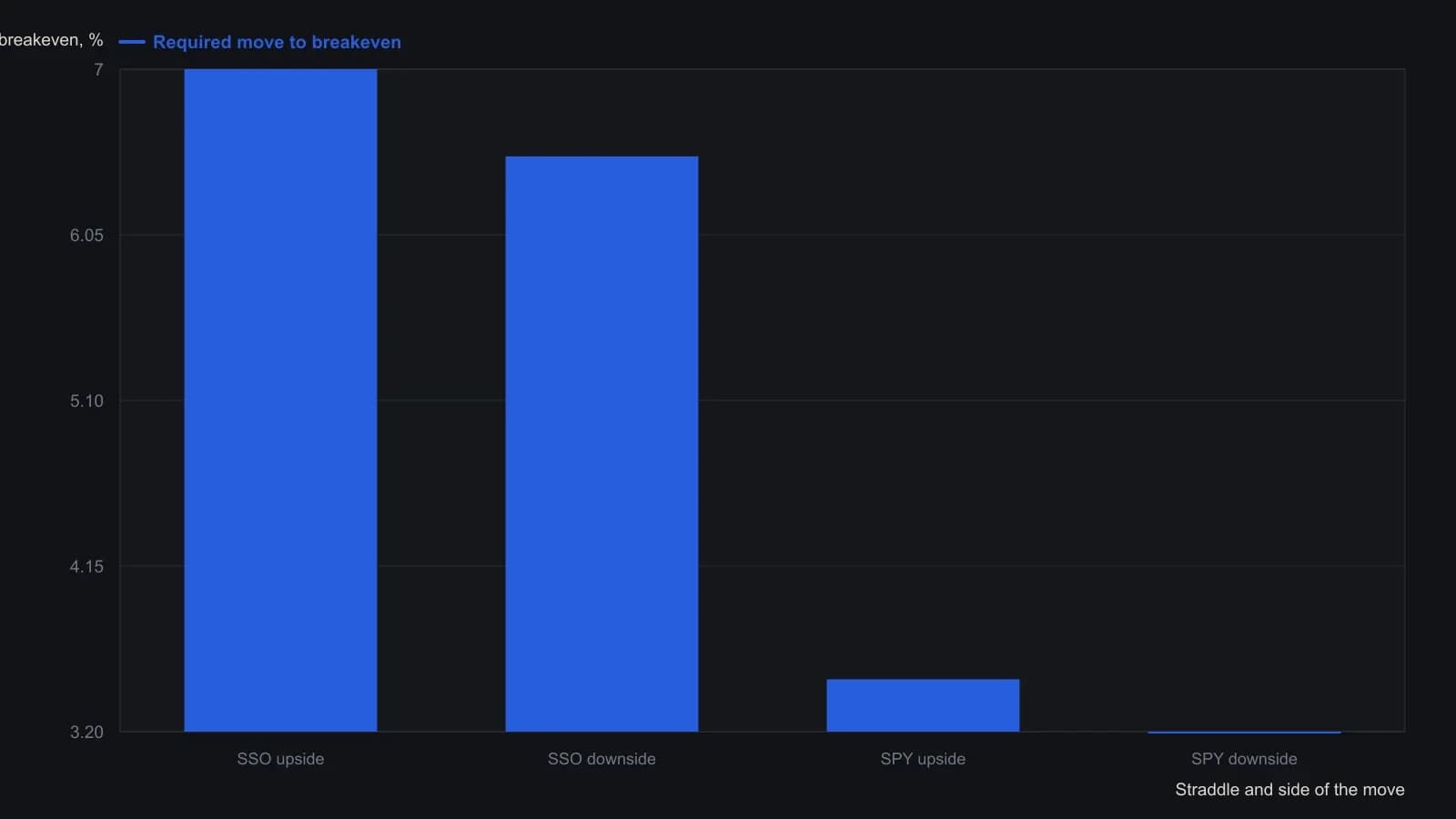
Front-month at-the-money straddles a few days after the May 2010 flash crash, sized as 4 SSO May 41 contracts versus 3 SPY May 116 contracts on a hypothetical $50,000 book. The SSO downside is the article’s rounded 6.50 percent.
All readings on this track · 19 readings
- 1992Country regime inside global allocation and index proxies
- 1992Intermarket confirmation for long-duration bond-fund timing
- 1993Paired bond and currency proxies with weekly crossover confirmation
- 1995Walk-forward evaluation of a municipal futures timed fund switch
- 1999Regime-gated allocation with bounded index leverage
- 1999Testing trend following with cash-price controls
- 2002A capital-preservation case for index-proxy allocation
- 2003A shared weekly-average grid for four Asian index proxies
- 2005Index-etf-core weights, a growth-index-clock, and an implementation-cost-ledger
- 2005European index proxies as one weekly-regime panel
- 2006Index-fund proxies as intermarket regime instruments
- 2006Constructing metal option exposure with mining proxies and implied volatility
- 2010Matched straddles on levered versus unlevered index proxies
- 2013Inheritance as an index-proxy and allocation case
- 2014Headline index levels mix a changing basket with a changing divisor
- 2017Screening ETFs by liquidity, index fit, and rank
- 2019Leveraged commodity proxies fail the futures test
- 2020Constructing pre-listing paths for new fund sleeves
- 2020A sleeve after cost-drag, judged by an index-proxy, sized in a stock-bond mix