1991issue C071-3
Advisor consensus fails as weekly contrarian timing
From 18 September 1981 through 9 February 1991, weekly advisor-consensus was specified as one contrarian-procedure and checked as a next-week signal. The one-week-hit-rate counts and the crisis dates are the record. The editorial reading is that crowding belongs as a weeks-to-months regime-overlay, in the same slot as commitment-of-traders positioning.
- Write advisor-consensus as one contrarian-procedure: a crowding-threshold, a holding period, and explicit cases where the rule stands aside.
- At a 55 percent crowding-threshold, the week after bearish extremes declined more often than it advanced, while the week after bullish extremes advanced more often than it declined.
- Crisis dates in 1982, 1987, 1989, and 1990 to 1991 show early entries, missed advances, and cutoffs that left the rule flat until after the rebound.
- The editorial conclusion is to keep crowding, including commitment-of-traders-style positioning, as a regime-overlay on a weeks-to-months horizon rather than as a one-week-hit-rate forecast.
The series that was tested
A weekly advisor-consensus series was examined as a short-horizon contrarian signal from 18 September 1981 through 9 February 1991. Advisor-consensus is the weekly share of investment-advisor letters classified as bullish versus bearish, used as a crowding reading.
One testable contrarian-procedure
A contrarian-procedure is a fully specified rule that treats crowded bullishness as a reason to exit or stand aside and crowded bearishness as a reason to enter, including the holding period and the cases where no trade is taken. The crowding-threshold is the consensus percentage at which a reading is treated as extreme enough to flip positioning. Common cutoffs in the record are 55 percent, 60 percent, and 65 percent.
The editorial task is to keep that rule as one procedure for entry, exit, and abstention, then ask whether the next week is the right horizon.
One-week hit rates in the record
A one-week-hit-rate is a count of whether the broad equity market rose or fell in the week after a crowded reading, used to test the rule as a short-horizon signal rather than as a regime-overlay.
When bearish consensus reached 55 percent, the following week advanced in six cases and declined in eight. Across 51 weeks with a 55 percent bullish consensus, the following week advanced 30 times and declined 21 times. A 65 percent bullish extreme appeared seven times, and the following week declined in only two of those cases.
The editorial reading of those counts is that a crowded print did not reverse the next week in a stable way.
Crisis timing and delayed entries
A 26 March 1982 reading of 60.9 percent bears and 25 percent bulls was treated as a clear contrary entry, but the advance that reading was meant to capture did not arrive until August 1982.
On 23 January 1987 bullish consensus was 63.9 percent and bearish consensus 12 percent, and a crowded-bullish mark was still 60.8 percent on 8 August 1987. Standing aside from January would have been out before the October 1987 break and would also have missed an intervening 500-point rise through August.
At the 11 December 1987 low of 1766.74, advisors were 29.5 percent bullish and 39.3 percent bearish, and a roughly 55 percent bearish reading did not appear until 27 May 1988, after a 200-point rebound.
Before the 190-point drop on 13 October 1989, bullish consensus sat between 50 and 54 percent in three episodes beginning 15 September 1989, so whether the rule stood aside depended on how the crowding-threshold was read.
On 14 September 1990 advisors were 56 percent bearish versus 29.6 percent bullish and the following week fell 60 points. By the mid-October low just below 2400, bearish consensus was 55.8 percent, and a lopsided bearish tilt persisted into the 15 January 1991 deadline.
The editorial point is that crisis timing broke down even when a crowding-threshold was met: entries arrived months early, stand-asides missed large advances, and some breaks sat just below the cutoff.
Dow Jones quarterly closes with sentiment buy and sell marks, 1982–1990
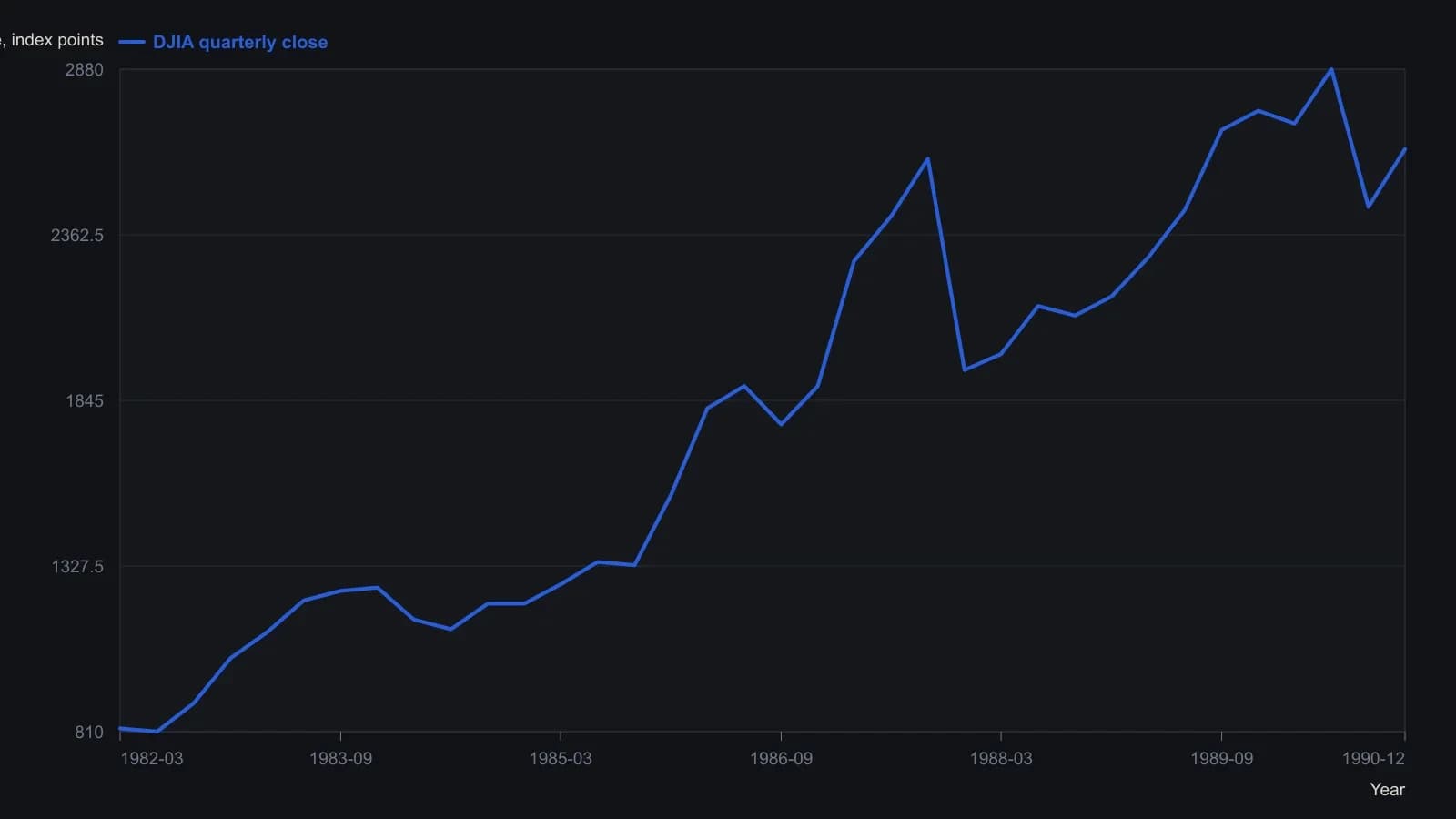
Figure 1 is a quarterly DJIA close with five labeled sentiment signals. Dates and a few levels are also stated in the article; the remaining y-values are approximate readings from the raster and are not more precise than about 25–50 Dow points.
Crowding as a slower regime overlay
A regime-overlay is a weeks-to-months backdrop from crowding or positioning that frames whether a trade belongs in the book, instead of forecasting the next weekly print. Commitment-of-traders is a positioning report used to place one idea in a diversified or regime-aware context, on a horizon of weeks to months rather than as a next-week forecast.
The editorial placement keeps advisor-consensus crowding in that same slower slot. It does not turn the weekly letter share into a one-week flip, and it does not treat commitment-of-traders as a next-week forecast.
All readings on this track · 20 readings
- 1990Constructing a COT index from the commercial-speculative spread
- 1990Crowded price rules need abstention and a regime overlay
- 1991Advisor consensus fails as weekly contrarian timing
- 1996When speculative flows decouple bonds from stocks
- 1996Score each trader class against itself, then slice by month
- 1996Pork belly Commitment of Traders signals depend on the seasonal window
- 2002Constructing regime context from trader commitment nets
- 2002Trader net positions as regime context for chart setups
- 2003Three states for a daily futures advisor consensus
- 2005Commitment of Traders open-interest extremes as regime filters
- 2005Commitment of Traders participant imbalance as regime context for commodity position trades
- 2006Housing slowdown as a cross-market regime lesson
- 2007Evaluate an index stance as a spread between trader books
- 2011Constructing weekly participant positioning ledgers
- 2012Commitment of Traders as crowded-book context, not a copy signal
- 2014When Commitment of Traders smart money fails as an intermarket regime filter
- 2014Constructing Commitment of Traders regime context when commercial hedgers fail
- 2015Leave a yen bottom unconfirmed until gold and positioning agree
- 2016Stacking volume, open interest, and trader books around expiration
- 2025Post-crash cash and regime-aware watchlists