2005issue C031-2
European index proxies as one weekly-regime panel
Four listed country baskets stand in for the Swedish, French, German, and United Kingdom equity indexes. The same weekly-moving-average scaffold across a shared 2003-2004 window places a single-country breakout, range, or peer-lag next to peer-market structure.
- Four listed country baskets are tradable stand-ins for the Swedish, French, German, and United Kingdom equity indexes.
- The same 2003-2004 weekly-moving-average window is used so a breakout, range, or peer-lag can be read against peer-market structure.
- After a shared early-2004 stall, the Swedish, French, and United Kingdom proxies later printed new multiyear highs, while the German proxy did not match those highs.
- The four index-proxies concentrate in different industry mixes, so a country-level comparison also embeds different sector weights.
Four country baskets as one panel
The archive presents four listed country baskets as tradable stand-ins for the Swedish, French, German, and United Kingdom equity indexes. Each basket is an index-proxy: a listed country basket used as a stand-in for a national equity index so one market can be compared with peers.
The same 2003-2004 window is used across the four country proxies so a single-market breakout, range, or lag can be read against peer-market structure. A weekly-moving-average is a 20-week or 50-week average of proxy prices used to mark whether an intermediate advance is still intact.
Shared stall, different later paths
The Swedish proxy is described as having cleared its 20-week and 50-week averages in late spring 2003, paused after an early-2004 stall, then later broken to a new multiyear high.
The French proxy is described as having bottomed in spring 2003, spent much of the next year ranging after an early-2004 stall, then later printed a new multiyear high relative to the January 2004 high.
The German proxy is described as not matching the new multiyear highs of the Swedish and French proxies after a March 2003 low, an early-2004 stall, a later range, and a subsequent reclaim of the 50-week average.
Editorial reading: the German path is a peer-lag, a country proxy that participates in a regional advance but has not yet matched a new high printed by related markets.
The United Kingdom proxy is described as remaining above its 50-week average after the shared early-2004 stall and later setting new multiyear highs.
EWD weekly close versus 20- and 50-week averages
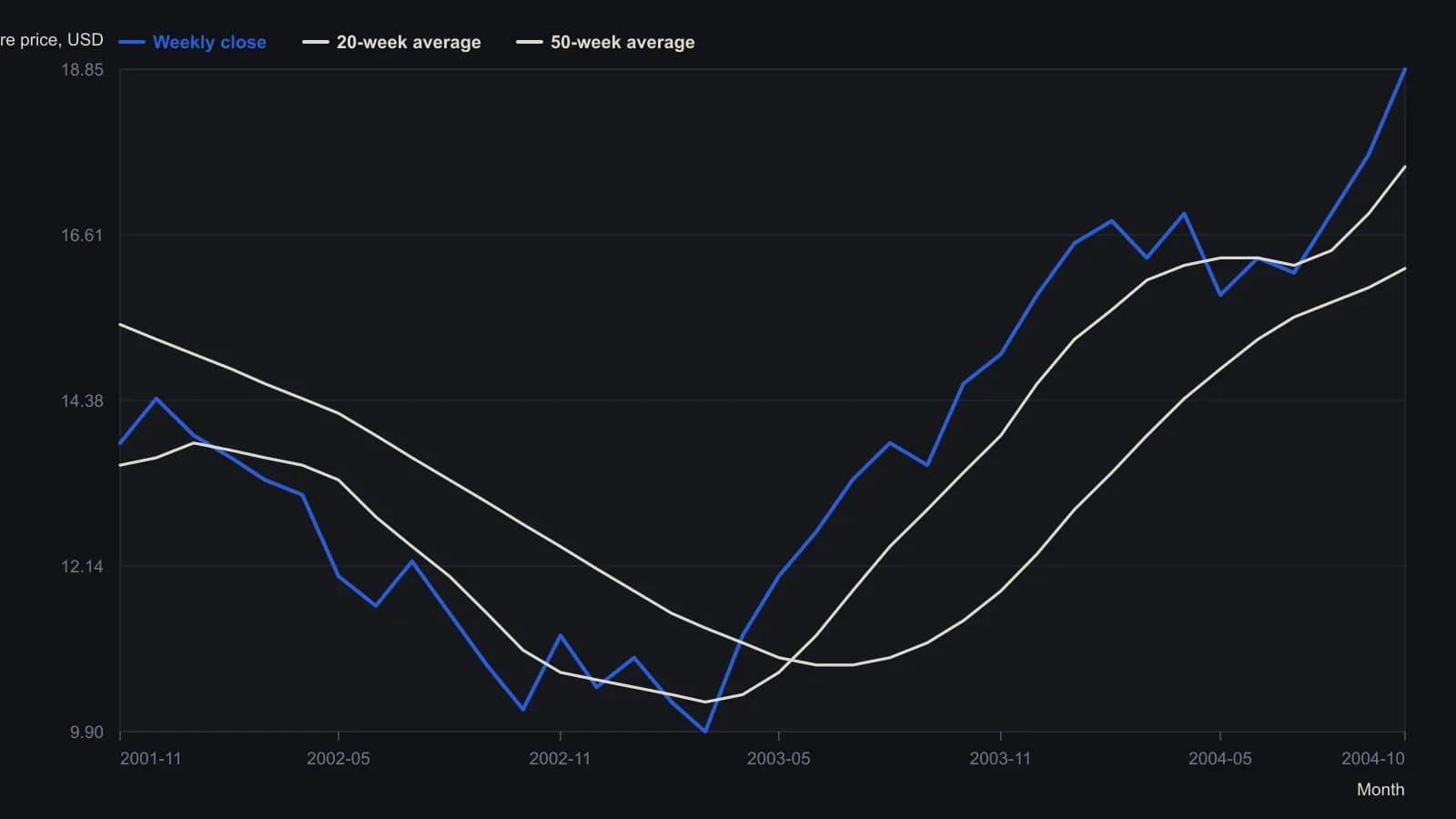
Weekly candlesticks with the faster overlay as the 20-week average and the slower overlay as the 50-week average. Path values are approximate to about a tenth of a dollar except for the three labeled last prints.
Country labels also carry sector weights
The four country proxies are concentrated in different industry mixes, so a country-level comparison also embeds different sector weights.
An intermarket-regime is a cross-country reading of whether related markets share the same advance, pause, or breakout structure. Editorial reading: because those industry mixes differ, a country-level comparison is not a pure single-country factor.
Breakout, range, and lag as context
Editorial reading: the same weekly-moving-average scaffold across peer markets turns a single-country breakout, range, or peer-lag into a portfolio-context fact rather than an isolated chart story. The 2003-2004 window is the shared frame that makes those differences readable.
All readings on this track · 19 readings
- 1992Country regime inside global allocation and index proxies
- 1992Intermarket confirmation for long-duration bond-fund timing
- 1993Paired bond and currency proxies with weekly crossover confirmation
- 1995Walk-forward evaluation of a municipal futures timed fund switch
- 1999Regime-gated allocation with bounded index leverage
- 1999Testing trend following with cash-price controls
- 2002A capital-preservation case for index-proxy allocation
- 2003A shared weekly-average grid for four Asian index proxies
- 2005Index-etf-core weights, a growth-index-clock, and an implementation-cost-ledger
- 2005European index proxies as one weekly-regime panel
- 2006Index-fund proxies as intermarket regime instruments
- 2006Constructing metal option exposure with mining proxies and implied volatility
- 2010Matched straddles on levered versus unlevered index proxies
- 2013Inheritance as an index-proxy and allocation case
- 2014Headline index levels mix a changing basket with a changing divisor
- 2017Screening ETFs by liquidity, index fit, and rank
- 2019Leveraged commodity proxies fail the futures test
- 2020Constructing pre-listing paths for new fund sleeves
- 2020A sleeve after cost-drag, judged by an index-proxy, sized in a stock-bond mix