1993issue C031-10
Paired bond and currency proxies with weekly crossover confirmation
When lifting cash in a downturn compresses a sleeve as short-term rates fall, the archive workflow first classifies the yield-and-currency regime. A weekly average crossover is allowed only when a slower ten-minus-four reading and a sentiment-plus-option overlay agree, so neither listed fund is taken as a standalone bet.
- Lifting the cash weight in a downturn can compress sleeve returns when short-term rates are also falling, which is why the archive used a paired-sleeve instead of one cash substitute.
- The rate-currency-regime is the observed tendency for higher long-bond yields to accompany a firmer domestic currency index, and the reverse when yields fall.
- A weekly moving-average-crossover marks only a candidate entry or exit until the ten-minus-four gap stays on the same side of zero.
- Bond-proxy trades still wait for sentiment-confirmation: the trader-sentiment series and the option-activity-ratio must point in the same direction.
A squeezed cash sleeve
A standard allocation sleeve shifts capital among equities, bonds, and cash. Lifting the cash weight in a downturn can compress that sleeve’s return when short-term rates are also falling.
The archive did not replace cash with a single market. When the same intermediate regime favored both sides, it used a paired-sleeve, splitting the cash-replacement allocation between a long-duration bond proxy and a foreign-currency proxy.
Classify the yield-and-currency regime first
In the described linkage, falling bond prices raise yields, and higher yields can increase demand for that country’s currency. That pairing is the rate-currency-regime: the observed tendency for higher long-bond yields to accompany a firmer domestic currency index, and the reverse when yields fall. The cross-market reading is the intermarket context that sits in front of any single-fund timing.
The sleeve held listed funds as an index-proxy, a listed fund used as a stand-in for a related futures or cash market so the sleeve can be held without managing contract expiration. A long-duration zero-coupon series stood in for the Treasury futures complex, foreign-currency funds stood in for individual exchange rates, and a money-market seven-day yield stood in for short-term rates.
A domestic dollar index was treated as rising when foreign currencies fell. Over the illustrated window, long-bond yields and that dollar index moved in the same direction. The illustrated proxies were described as tracking related markets: the long-duration zero-coupon fund moved opposite the 30-year Treasury yield, and the Deutschemark fund moved opposite the dollar index.
Weekly crossover needs a slower confirmation
Weekly timing used two layers. The first is a moving-average-crossover: a weekly close crossing and remaining on one side of a 10-week average, used to mark candidate entries and exits in the fund proxies.
The second is ten-minus-four, the arithmetic gap between a 10-week and a 4-week average of the same fund. A reading that stays on the same side of zero is used to confirm the weekly average crossover. Without that slower confirmation, the weekly close versus the 10-week average was not treated as enough.
Benham Target 2020 weekly price with 10-week average and 10-4 confirmation
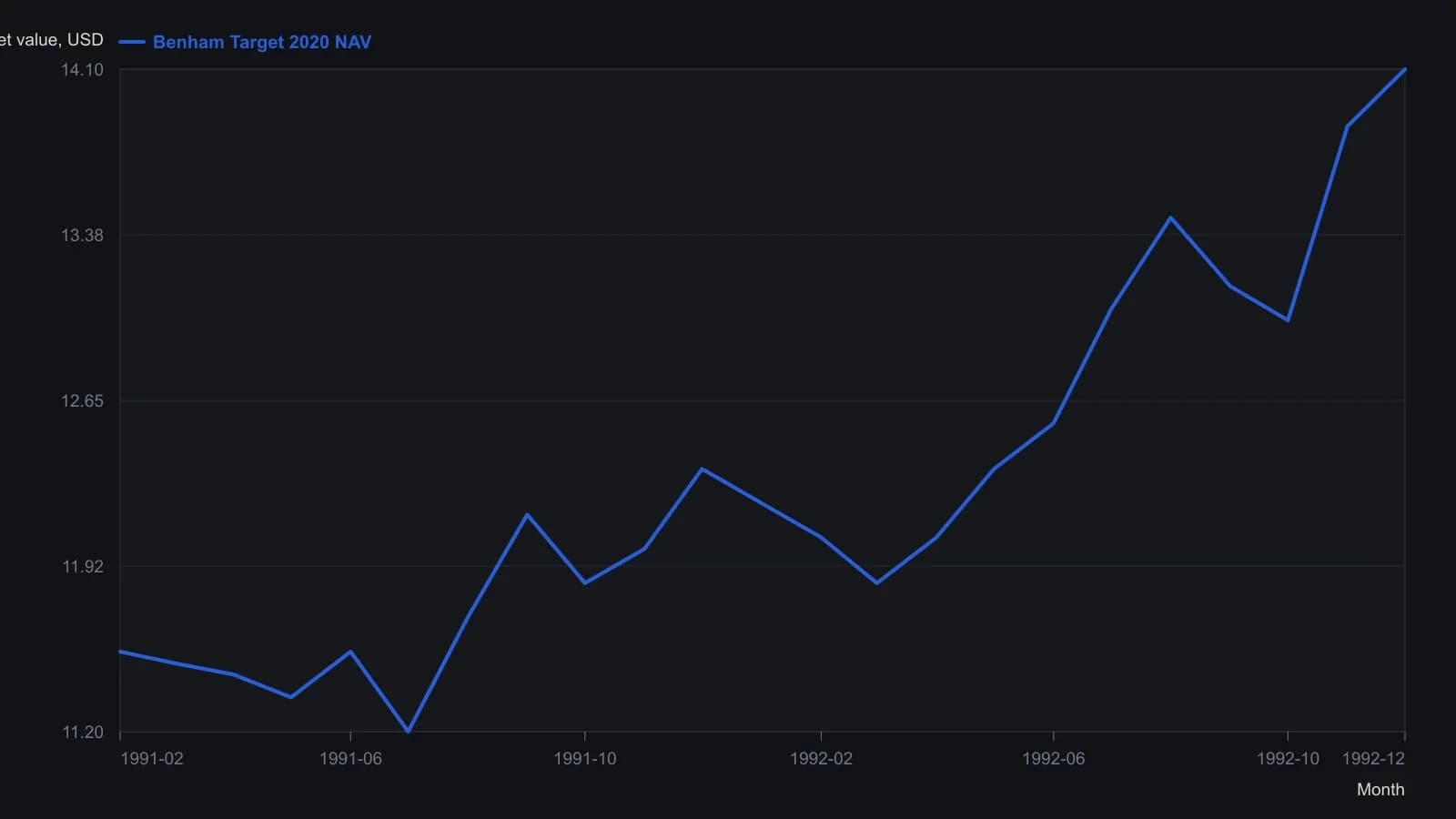
Raster is inverted and coarse; NAV points are approximate weekly readings, not official fund prints. Article buy marks (B) are the labeled confirmation points, not extra series.
Bond-proxy trades wait for two overlays
Bond-proxy trades were generally withheld unless a trader-sentiment series and a bond-option activity ratio agreed. That filter is sentiment-confirmation: it withholds a bond-proxy trade unless a trader-sentiment series and the option-activity-ratio point in the same direction. A sentiment reading below 43 percent was treated as a buy cue and readings of 60 percent or higher as a sell cue.
The option-activity-ratio is a bond-futures comparison of put volume to put open interest, divided by the same ratio for calls, used to flag intermediate extremes. Extreme readings on that ratio, often above 1.8 for buys and often, though not always, below 0.65 for sells, were used to mark intermediate turning points.
When the two proxies stop moving together
After a mid-September 1992 European currency shock, a firmer dollar coincided with a sharp drop in Treasuries and foreign-currency funds. Later that autumn both overlays flashed bond buy cues, but the currency proxy lagged the long-duration bond proxy.
The later split, bond proxy firm and currency proxy weak, was tied to a flattening-to-rising short-rate slope at home plus weaker European growth and expected lower European rates, with the dollar index described as meeting resistance near 91.
All readings on this track · 19 readings
- 1992Country regime inside global allocation and index proxies
- 1992Intermarket confirmation for long-duration bond-fund timing
- 1993Paired bond and currency proxies with weekly crossover confirmation
- 1995Walk-forward evaluation of a municipal futures timed fund switch
- 1999Regime-gated allocation with bounded index leverage
- 1999Testing trend following with cash-price controls
- 2002A capital-preservation case for index-proxy allocation
- 2003A shared weekly-average grid for four Asian index proxies
- 2005Index-etf-core weights, a growth-index-clock, and an implementation-cost-ledger
- 2005European index proxies as one weekly-regime panel
- 2006Index-fund proxies as intermarket regime instruments
- 2006Constructing metal option exposure with mining proxies and implied volatility
- 2010Matched straddles on levered versus unlevered index proxies
- 2013Inheritance as an index-proxy and allocation case
- 2014Headline index levels mix a changing basket with a changing divisor
- 2017Screening ETFs by liquidity, index fit, and rank
- 2019Leveraged commodity proxies fail the futures test
- 2020Constructing pre-listing paths for new fund sleeves
- 2020A sleeve after cost-drag, judged by an index-proxy, sized in a stock-bond mix