1995issue C111-18
Walk-forward evaluation of a municipal futures timed fund switch
When a cash fund has a yearly switch budget, an intermarket timing proxy should be judged only if it can be executed in the same session, uses a sparse two-threshold rule, and still operates after the sample halves are swapped.
- Use listed municipal bond futures as the index proxy, because listed trading was described as the first place over-the-counter, hedge, and speculative reactions appear.
- Require same-session execution so the futures close can still become a fund order that day. Next-day fills were not treated as the evaluation standard.
- Fit equal up and down delta-thresholds plus a jump-threshold on one half of the sample, under a switch-constraint that favors a low-trade rule set.
- Accept the design only if those same rules stay operational after the halves are swapped, and do not treat that agreement as proof that the parameters would forecast a later stretch of fund prices.
What the cash vehicle forces you to test
A long-term municipal bond fund was treated as a constant-maturity fund: it keeps swapping bonds so average maturity stays in a stated long range, and the share price never matures to a fixed par amount. A later sale can therefore return less than the amount invested. An index proxy that times that vehicle has to be evaluated as one mechanical trading system, including the times the system stays out.
The futures stand-in
Municipal bond futures were used as the intermarket driver. Listed futures were described as the first place over-the-counter, hedge, and speculative reactions appear. The fund stance is taken from that related listed contract rather than from the fund's own price.
A continuous daily municipal bond futures series was paired with a fund series adjusted for capital-gains distributions but not for monthly interest payouts.
The two-threshold mechanical rule
The mechanical trading system bought the fund when the municipal bond futures close rose by a set jump-threshold from the prior close, or recovered a set delta-threshold from the short-period futures low. It sold on the mirror conditions measured from the long-period high.
Up and down price-change thresholds were forced to be equal, and a jump-threshold was added. That kept the free parameters few and still let the rule react to a large consensus-shifting close.
Same-session execution and the yearly switch budget
Same-session execution was required. Futures settled early enough that a fund order could still be placed the same afternoon. Next-day fund fills were not accepted as the evaluation standard.
A switch-constraint, the fund-imposed yearly limit on buying and selling shares, made the evaluation favor a low-trade rule set. Alternatives that traded much more often were set aside even when they ranked higher in the in-sample screen.
Fit on one half, then reverse the halves
The sample was split into two roughly equal windows. Delta-threshold and jump-threshold were chosen on one window, with a preference for few trades, then applied unchanged to the other window. The procedure was reversed so each window served once for fitting and once for testing.
Walk-forward analysis here means optimizing entry, exit, and stay-out rules on one window, testing them on the other, then reversing the windows so the same procedure is run in both directions. Agreement between the two reversed out-of-sample windows was not treated as proof that the same parameters would forecast a later stretch of fund prices.
Long-trade net profit after swapping the sample halves
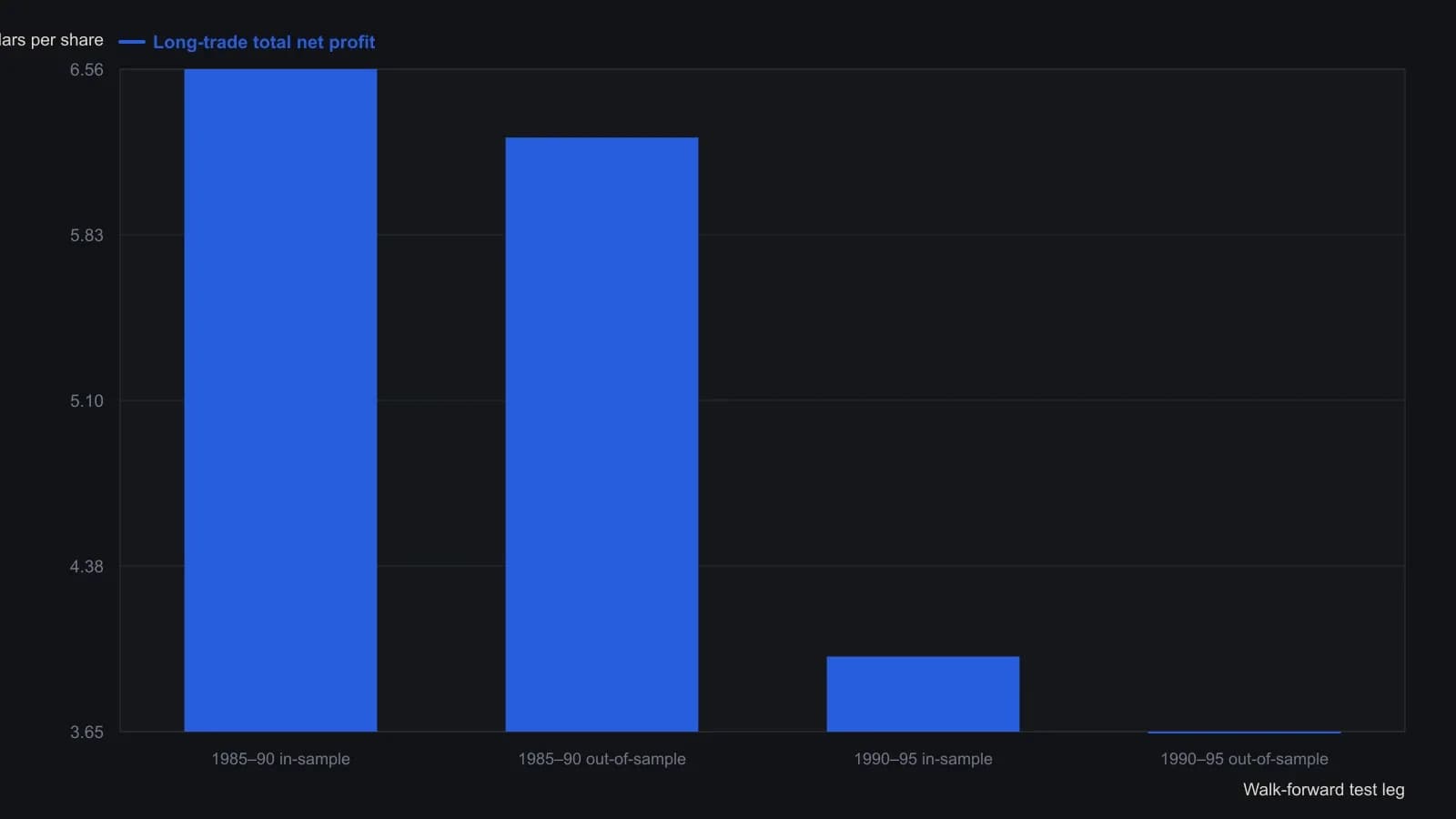
Section 1 is 11 June 1985–30 June 1990; section 2 is 15 June 1990–31 May 1995. The 1985–90 fit used delta 48/32 and jump 38/32; the 1990–95 fit used delta 57/32 and jump 33/32. Each out-of-sample bar uses the opposite half’s pair. Monthly interest distributions were not added back.
All readings on this track · 19 readings
- 1992Country regime inside global allocation and index proxies
- 1992Intermarket confirmation for long-duration bond-fund timing
- 1993Paired bond and currency proxies with weekly crossover confirmation
- 1995Walk-forward evaluation of a municipal futures timed fund switch
- 1999Regime-gated allocation with bounded index leverage
- 1999Testing trend following with cash-price controls
- 2002A capital-preservation case for index-proxy allocation
- 2003A shared weekly-average grid for four Asian index proxies
- 2005Index-etf-core weights, a growth-index-clock, and an implementation-cost-ledger
- 2005European index proxies as one weekly-regime panel
- 2006Index-fund proxies as intermarket regime instruments
- 2006Constructing metal option exposure with mining proxies and implied volatility
- 2010Matched straddles on levered versus unlevered index proxies
- 2013Inheritance as an index-proxy and allocation case
- 2014Headline index levels mix a changing basket with a changing divisor
- 2017Screening ETFs by liquidity, index fit, and rank
- 2019Leveraged commodity proxies fail the futures test
- 2020Constructing pre-listing paths for new fund sleeves
- 2020A sleeve after cost-drag, judged by an index-proxy, sized in a stock-bond mix