1992issue C061-7
Country regime inside global allocation and index proxies
A 1992 practitioner case treated non-domestic equity as a construction step that changes the risk mix. Editorial: before scoring a sleeve against a world basket, classify whether one country is the regime inside the index-proxy, then read the allocation gap as a country-weight-bet rather than as proof the process failed or succeeded.
- Treat non-domestic equity as asset-allocation that changes the risk mix through cross-market diversification, not as a stand-alone name.
- Compare a sleeve with an appropriate index-proxy and inspect the return path over time, because a multi-year record can be carried by a single year.
- Use market-regime-classification before judging a gap: a large-market overweight or underweight can be a country-weight-bet inside the proxy.
- A data-horizon-limit of about 10 years of non-domestic history restricts manager comparison and how confidently cycles or regime-dependent process behavior can be labelled.
Non-domestic equity as a construction step
A 1992 practitioner case presented non-domestic equity exposure as a portfolio-construction step meant to change the risk mix through cross-market diversification. Asset-allocation, in the sense used here, means setting country, currency, and sleeve weights so a single market or trade sits inside a diversified book instead of standing alone.
The allocation case rested on three stated premises: that low correlation with the home market would persist, that less mature economies were expected to grow faster, and that roughly two thirds of world output was generated outside the home market. Companion charts showed the home market as a smaller share of measured world output and of world equity-market capitalization than in earlier decades.
What cross-border books add
Cross-border construction was described as adding accounting, liquidity, settlement, political, economic, and currency variables beyond ordinary market or security risk. A one- or two-name sample can miss the broader market move.
Implementation was framed as a menu from country or regional sleeves to global books, depending on whether country and currency decisions were kept in-house or delegated.
Score the path, not only the headline
Process and portfolio review asked whether results came from asset allocation, country or currency weights, sector weights, or stock selection, rather than from a headline return alone. That check is return-source-decomposition: splitting realized results so the construction story can be inspected.
Comparison with an appropriate index-proxy was paired with inspection of return paths over time, because a multi-year record can be carried by a single year. An index-proxy is a capitalization-weighted market basket used as a comparison baseline for a manager or sleeve, not as a skill verdict by itself.
One country inside the world proxy
From the mid-1980s a capitalization-weighted world proxy was heavily influenced by Japan. After that market reversed in late 1989, underweighting Japan flipped from trailing the proxy to leading it, so the index gap functioned as a one-country regime bet.
That gap is a country-weight-bet: an active departure from the proxy's country mix, in which the large-market overweight or underweight drove the comparison. Market-regime-classification means labeling whether a return gap reflects a dominant country cycle or a change in cross-market conditions, rather than treating every gap as process quality.
A short history limits regime labels
Non-domestic histories were described as only about 10 years long. That data-horizon-limit restricted both manager comparison and the classification of market cycles or regime-dependent process behavior.
The case treated a pre-set objective and a multi-period evaluation window as construction discipline, contrasting that with rotating into the latest winning market or stock.
How to read the gap
Editorial: classify the country regime inside the proxy first. After that classification, the allocation gap is a weight decision. It is not, by itself, a verdict on whether the process failed or succeeded.
US weight inside world market capitalization
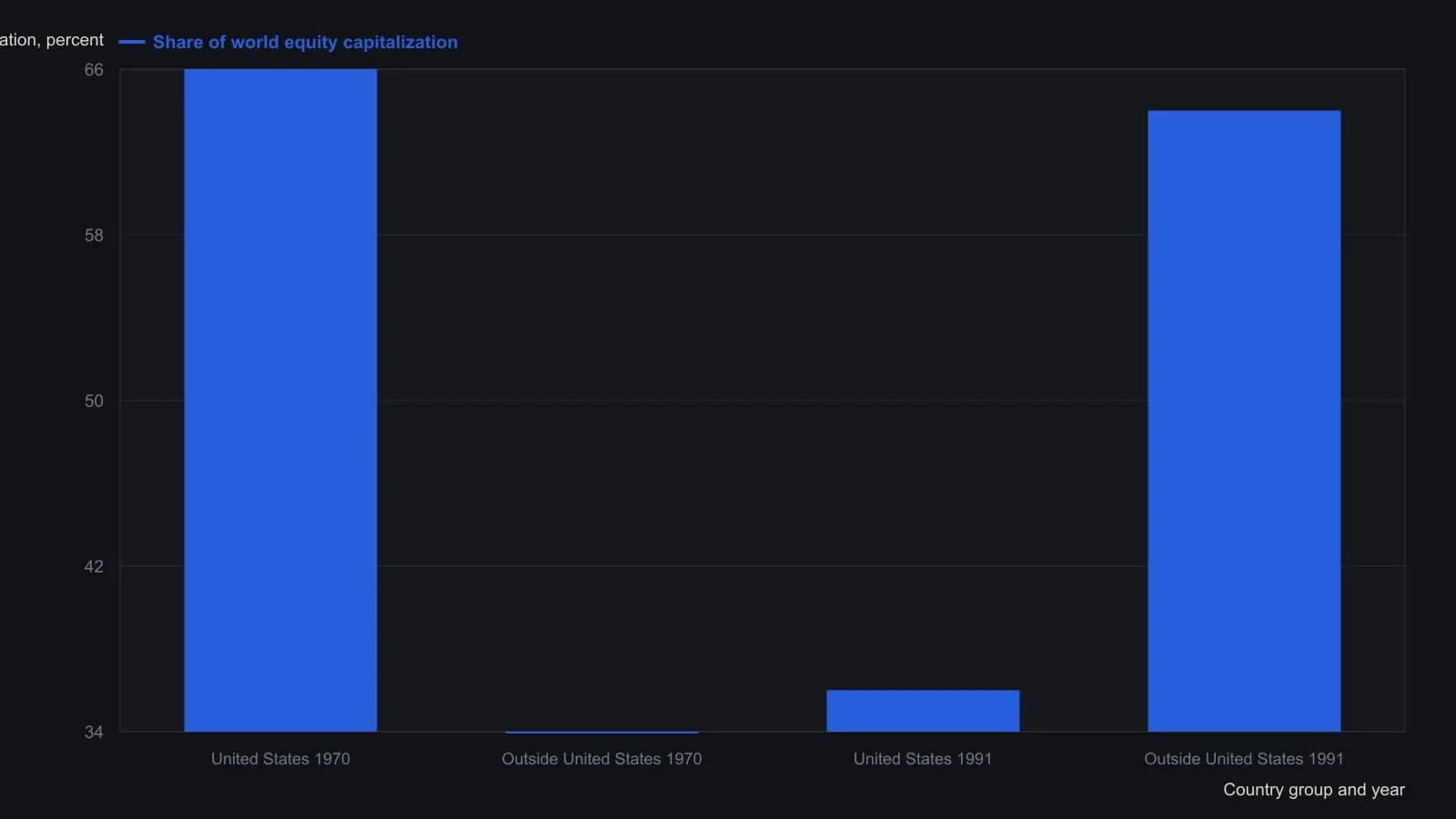
The source prints only 1970 and 1991 snapshots. Japan is discussed in the interview as the later cap-weight regime inside non-US indices but is not split out on this figure.
All readings on this track · 19 readings
- 1992Country regime inside global allocation and index proxies
- 1992Intermarket confirmation for long-duration bond-fund timing
- 1993Paired bond and currency proxies with weekly crossover confirmation
- 1995Walk-forward evaluation of a municipal futures timed fund switch
- 1999Regime-gated allocation with bounded index leverage
- 1999Testing trend following with cash-price controls
- 2002A capital-preservation case for index-proxy allocation
- 2003A shared weekly-average grid for four Asian index proxies
- 2005Index-etf-core weights, a growth-index-clock, and an implementation-cost-ledger
- 2005European index proxies as one weekly-regime panel
- 2006Index-fund proxies as intermarket regime instruments
- 2006Constructing metal option exposure with mining proxies and implied volatility
- 2010Matched straddles on levered versus unlevered index proxies
- 2013Inheritance as an index-proxy and allocation case
- 2014Headline index levels mix a changing basket with a changing divisor
- 2017Screening ETFs by liquidity, index fit, and rank
- 2019Leveraged commodity proxies fail the futures test
- 2020Constructing pre-listing paths for new fund sleeves
- 2020A sleeve after cost-drag, judged by an index-proxy, sized in a stock-bond mix