2001issue C011-2
Expire-worthless folklore and option-income risk
Circulated claims that as many as 90% of options expire worthless are unsubstantiated and far too high. A remaining-premium-test, secondary-market-closeout, path-to-breakeven, and implied-volatility all change the risk of treating uncovered-option-sale as a high-hit-rate income procedure.
- Circulated claims that as many as 90% of options expire worthless are unsubstantiated and far too high, and the inflated figures are traced to a late-1940s over-the-counter study that put the share well above 80%.
- Tracking that began in November 1999 found about 68% of options still had value at expiration and about 32% expired worthless, while a longer listed-market record running back to 1973 placed the expire-worthless-rate near 30%.
- Finishing with remaining value at expiration is not the same as a profitable outcome for the option buyer.
- Treating a 90% expire-worthless-rate as fact can push less-experienced traders toward widespread uncovered-option-sale framed as an income procedure.
The circulated expire-worthless-rate
Circulated claims that as many as 90% of options expire worthless are characterized as unsubstantiated and far too high.
The inflated expire-worthless-rate figures are traced to a late-1940s over-the-counter options study that put the share well above 80%.
What a remaining-premium-test counted
Tracking that began in November 1999 found about 68% of options still had value at expiration and about 32% expired worthless.
A remaining-premium-test counted a contract as not expiring worthless if its final expiration-day bid was at least 0.625, matching the auto-exercise-cutoff then in use.
Monthly stock-option expiration readings in that sample usually showed 60% or more of contracts still carrying value.
Secondary-market-closeout in the longer record
A longer listed-market record running back to 1973 placed the expire-worthless-rate near 30%, with the rest exercised or closed in the secondary market.
Monthly share of listed stock options expiring with remaining value
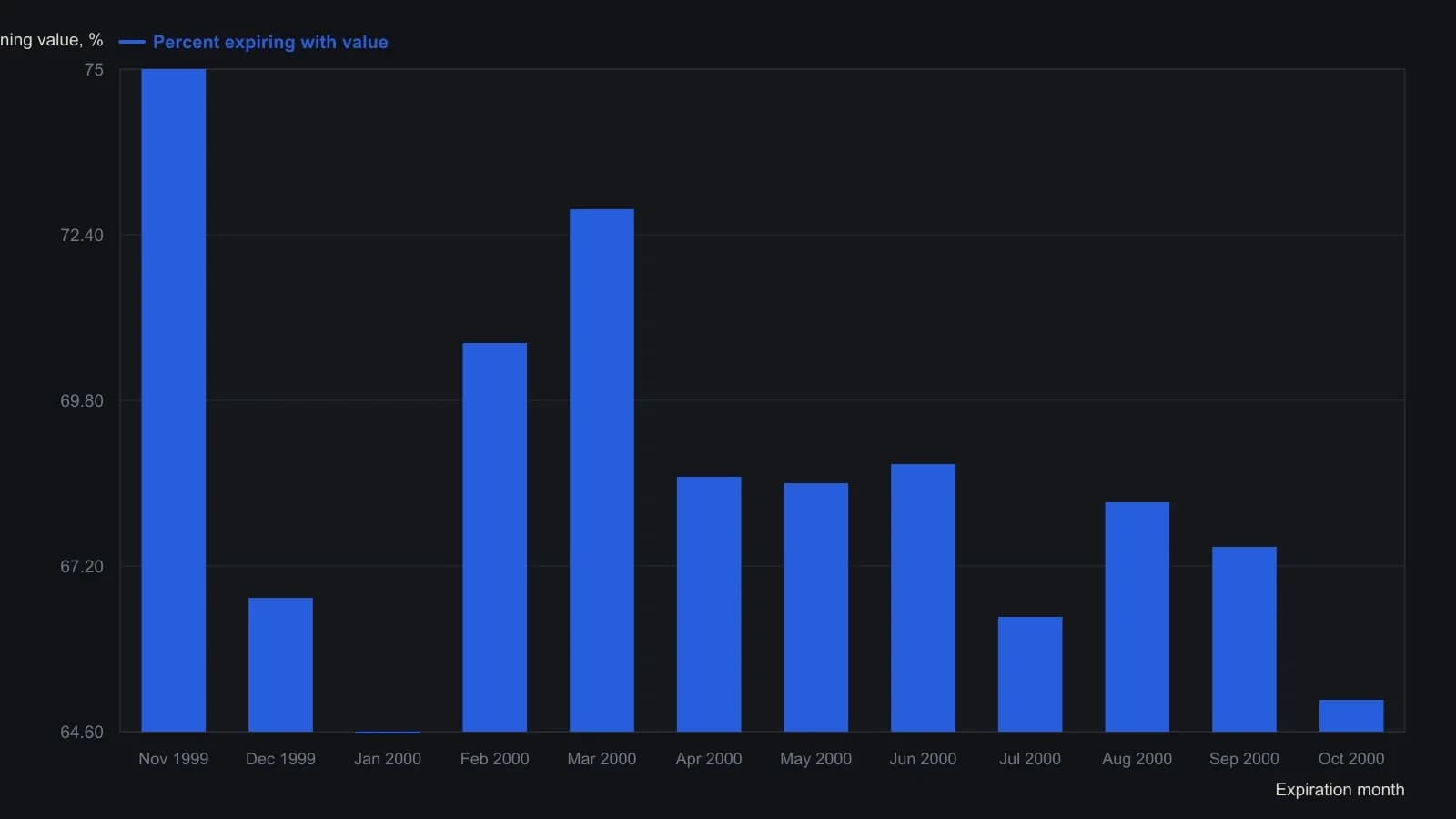
An option was counted as still having value when the expiration-day bid was at least 5/8 point (0.625), the OCC automatic-exercise threshold. The series is McMillan's own one-year tape, November 1999 through October 2000, not the longer CBOE back-history he cites only as a ~30 percent worthless check.
Remaining value, path-to-breakeven, and implied-volatility
Finishing with remaining value at expiration is not the same as a profitable outcome for the option buyer.
For an at-the-money or in-the-money long option, the stated chance that the underlying will trade at the position break-even sometime before expiration can be as high as 70%.
TradersWeek editorial: path-to-breakeven is not the same question as whether the contract finishes with no remaining bid, and that reading does not turn the expire-worthless-rate into an income edge.
A long option bought when implied-volatility is depressed can also gain if implied-volatility rises during the holding period.
Uncovered-option-sale framed as income
Treating a 90% expire-worthless-rate as fact can push less-experienced traders toward widespread uncovered-option-sale framed as an income procedure.
TradersWeek editorial: remaining premium at expiry, secondary-market-closeout, path-to-breakeven, and implied-volatility drift all change the risk of treating that uncovered-option-sale as a high-hit-rate rule.
All readings on this track · 14 readings
- 1989When broker advice replaces your rules
- 1990Constructing hybrid trend and option-income rules
- 1992Long-call cash sleeve as an option-income case study
- 1993One job per lookback in a breadth-based option-income procedure
- 2001Expire-worthless folklore and option-income risk
- 2005Conservative option writing after a climate and structure check
- 2007Unhedged option income with volume and the midterm trend
- 2007When option income ignores the implied-volatility range and liquidity
- 2008Horizon-first income spreads and expiration-week volatility
- 2014Seasonal oil calls across a tracking fund and an energy equity
- 2017Shoulder-season crude, the gasoline rebuild, and a put-income overlay
- 2017Seasonal energy window with a defined-risk call
- 2017Constructing short guts for option income decay
- 2018Seasonality as a holding-regime choice in commodity markets