2017issue C0426-27
Constructing short guts for option income decay
Short guts sells one in-the-money call and one in-the-money put, subtracts strike width from net credit, marks two breakevens, and treats the pre-expiration repurchase as part of one income procedure.
- A short-guts construction sells one in-the-money call and one in-the-money put, whereas a short strangle sells the out-of-the-money pair.
- Net credit is reduced by strike width to mark the capped profit, while losses are not given an upper bound.
- Both written contracts are meant to be bought back before expiration so assignment exposure does not become exercise against the seller.
- The procedure is framed as delta-neutral income that wants the underlying near the midpoint of the two strikes while time decay cheapens the buyback.
What short guts writes
A short-guts construction sells one in-the-money call and one in-the-money put. A short strangle sells one out-of-the-money call and one out-of-the-money put instead.
The construction collects a net credit from typically higher in-the-money premiums and then seeks to repurchase both contracts before expiration after time decay has reduced those premiums.
How the two sales are struck
Entry is two sales: an in-the-money call struck below the current underlying price and an in-the-money put struck above it. That pair produces the largest credit available from those two strikes.
The procedure is framed as a delta-neutral income construction. It wants the underlying near the midpoint of the two strikes while premiums decay, after which both legs are bought back before expiration.
Net credit, strike width and the cap
Profit is capped by net credit after subtracting strike width. Losses are not given an upper bound.
Strike width is the dollar gap between the higher put strike and the lower call strike. That gap is subtracted from net credit when the capped profit is computed.
A worked credit example
In the worked example a 60 underlying, a 55 call sold for a 6 credit, and a 65 put sold for a 6 credit produce a 12 net credit, or 1,200 before commissions and fees. Subtracting the 10-point strike width leaves a 2 per-share maximum, or 200 on a standard contract pair.
For that same example the stated upside breakeven is 67 and the stated downside breakeven is 53. A 200 gross result is shown if the underlying finishes at 60, 62, or 57 because the two remaining premiums still sum to 10 against the 12 credit.
Short guts expiration payoff for the XYZ example
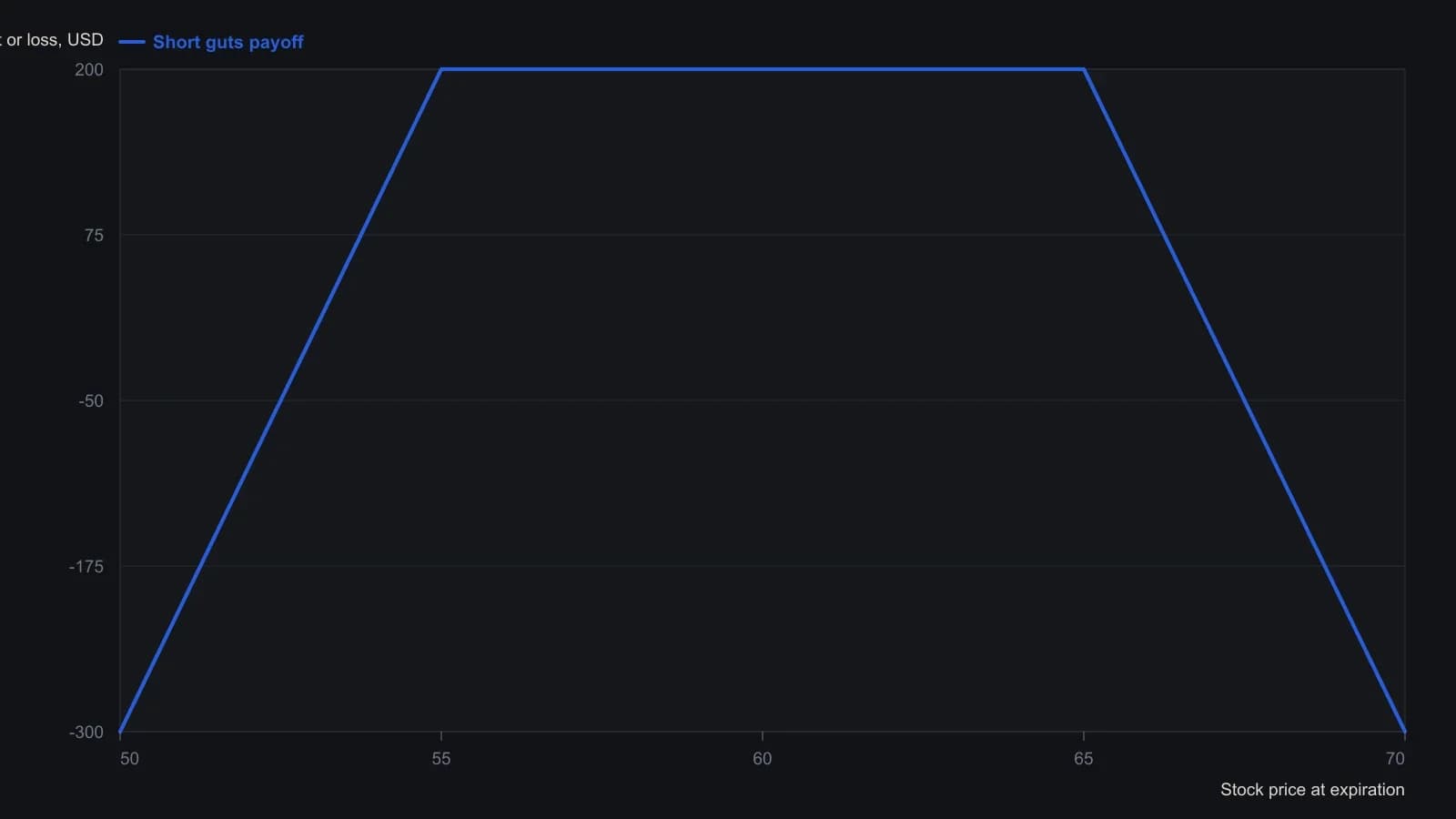
Dollar amounts use the magazine's one-contract scale, where $200 equals $2 per share. Values at $50 and $70 follow the stated breakeven formulas (lower strike minus net credit plus strike width; higher strike plus net credit minus strike width). The source also requires both legs to be bought back before expiration.
Screens and practical barriers
Screening conditions listed for considering the construction include a previously volatile name whose volatility is fading, a range-bound underlying with defined support and resistance and no scheduled news or earnings, and a liquidity screen of average daily volume of 500,000 or more.
Practical barriers listed for the construction include an uncapped loss profile, a highly uneven risk-to-reward shape, and a high margin requirement.
All readings on this track · 14 readings
- 1989When broker advice replaces your rules
- 1990Constructing hybrid trend and option-income rules
- 1992Long-call cash sleeve as an option-income case study
- 1993One job per lookback in a breadth-based option-income procedure
- 2001Expire-worthless folklore and option-income risk
- 2005Conservative option writing after a climate and structure check
- 2007Unhedged option income with volume and the midterm trend
- 2007When option income ignores the implied-volatility range and liquidity
- 2008Horizon-first income spreads and expiration-week volatility
- 2014Seasonal oil calls across a tracking fund and an energy equity
- 2017Shoulder-season crude, the gasoline rebuild, and a put-income overlay
- 2017Seasonal energy window with a defined-risk call
- 2017Constructing short guts for option income decay
- 2018Seasonality as a holding-regime choice in commodity markets