2007issue C031-5
Unhedged option income with volume and the midterm trend
An unhedged write keeps only a limited premium and can force an expensive cover after a large move. Editorial reading: the archive case becomes a three-lock income procedure only when sizing can survive an outsized loss, volume marks support or resistance on the underlying, and the intermediate trend is known in a window of weeks and months.
- An unhedged write is option writing without an offsetting long underlying or a similar long option, so the writer can keep only a limited premium and can face large losses if a big move forces an expensive cover.
- Income is the difference between sale price and cover price, while return on margin also counts the cash or securities posted to carry the write.
- Write entries are keyed to support volume on declines and resistance volume on rallies, read on daily and weekly charts of the underlying, and those signals are not identical to a companion option-buying rule set.
- The write is treated as a leveraged way to follow an intermediate trend of about six weeks to three-to-five months, and it is described as dangerous when that midterm trend is unknown.
What counts as unhedged
Retail commentary routinely ranks unhedged option selling among the most hazardous activities available to individual traders. An unhedged write is option writing without an offsetting long position in the underlying or a similar long option.
The writer receives a premium up front and can keep only that limited amount. A large move can force an expensive cover, so brokers typically require extra margin and equity.
How the short is closed
The unhedged writer wants the option's value to fall after the sale. The typical close is a cover that buys the contract back cheaper. The writer may hold instead if the contract expires with no remaining value.
If a short option still has value at expiration or is exercised early, the writer can be obligated to buy the underlying after puts or sell it after calls. Most options are closed in the market before expiration rather than exercised.
A direction bet and a duration bet
Selling puts and buying calls can both express a bullish view. The writer also benefits when the option behaves as a wasting asset. Time decay is the tendency of an option's value to decline as expiration approaches when other factors are unchanged.
Because the position combines a direction bet with a duration bet, the writer can profit from no movement, movement away from the strike, or a failed directional forecast.
Sizing before the sale
The case frames profitability as many more winners than losers while accepting that an infrequent loss can be several times the typical gain. It treats losses on the order of two or three times that typical gain as a trade-management benchmark.
Three sizing styles are distinguished: reinvesting principal plus profits, a fixed portfolio fraction, and a fixed dollar amount. Full reinvestment of principal and profits is marked unsuitable for options. The stated tests are recovery from losses, compounding, and avoiding total wipeout.
Volume that licenses a write
Entries are keyed to surges in a volume moving average, read on weekly as well as daily charts of the underlying. Support volume is a surge during a market decline. Resistance volume is a surge during a market rally.
Those write signals are not identical to signals from a companion option-buying rule set.
When the intermediate trend is known
The write is treated as a leveraged way to follow the underlying's intermediate trend. That midterm regime is described as about six weeks to three-to-five months. The workflow often uses options three or four months from expiration.
The write is described as dangerous when that midterm trend is unknown.
Income is not return on margin
Income-style profit is calculated as the difference between sale price and cover price. Return on margin is distinct because it includes the cash or securities posted to carry the write.
QQQQ January 2007 42-strike put premium
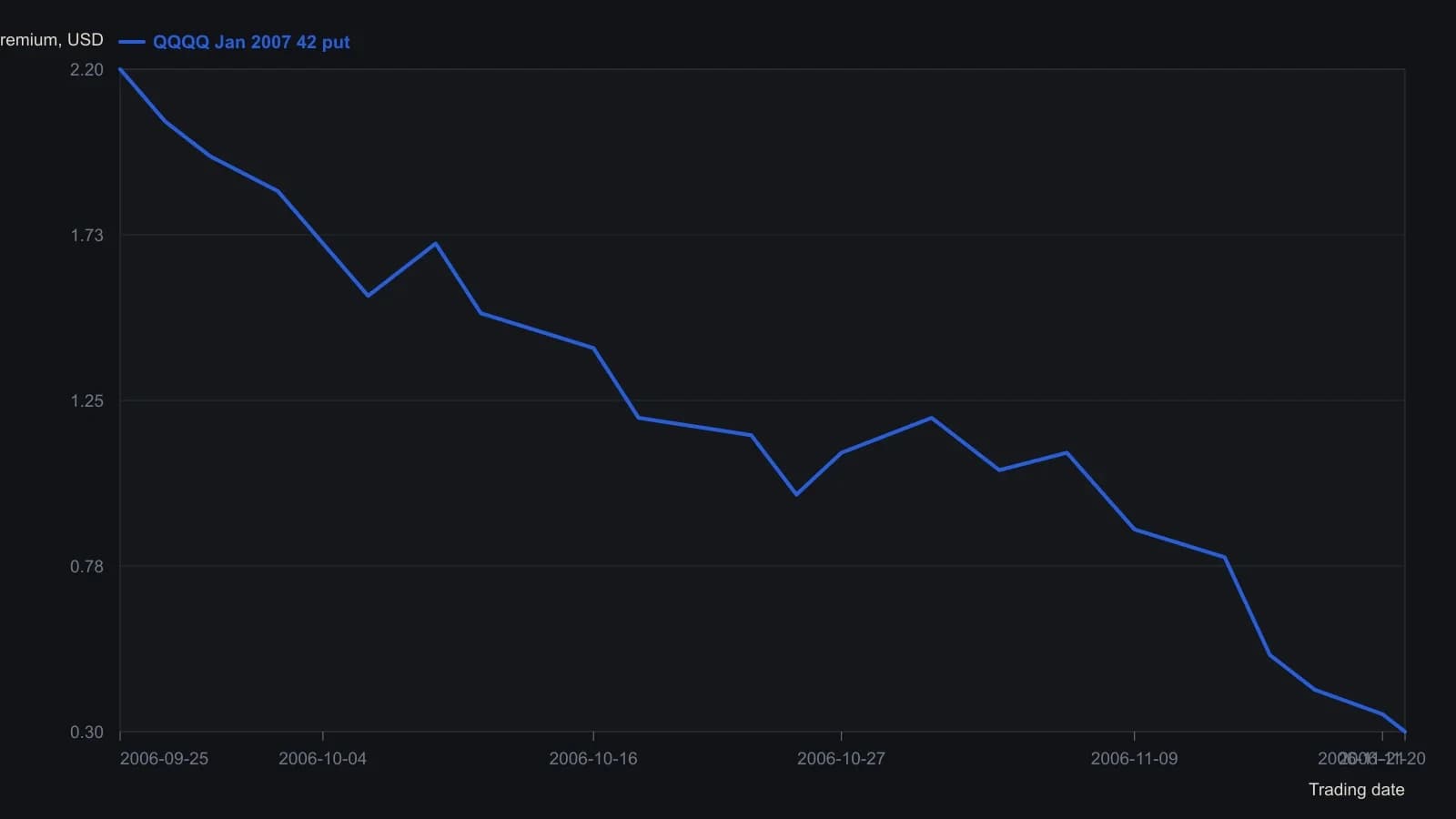
Closes digitized from the raster to the nearest nickel; expect about 0.05–0.10 error on unmarked bars. Volume is on a separate thousands scale and was not carried. The yellow highlights are source marks, not a second series.
All readings on this track · 14 readings
- 1989When broker advice replaces your rules
- 1990Constructing hybrid trend and option-income rules
- 1992Long-call cash sleeve as an option-income case study
- 1993One job per lookback in a breadth-based option-income procedure
- 2001Expire-worthless folklore and option-income risk
- 2005Conservative option writing after a climate and structure check
- 2007Unhedged option income with volume and the midterm trend
- 2007When option income ignores the implied-volatility range and liquidity
- 2008Horizon-first income spreads and expiration-week volatility
- 2014Seasonal oil calls across a tracking fund and an energy equity
- 2017Shoulder-season crude, the gasoline rebuild, and a put-income overlay
- 2017Seasonal energy window with a defined-risk call
- 2017Constructing short guts for option income decay
- 2018Seasonality as a holding-regime choice in commodity markets