2017issue C0243-44
Seasonal energy window with a defined-risk call
A case study that writes mid-February through mid-July as the energy seasonalWindow, uses a listed oil-services fund as the oilServicesProxy, prepays risk with a dated definedRiskCall, and applies an abstentionRule to the rest of the year.
- Treat mid-February through mid-July as the seasonalWindow and stay flat from mid-July through mid-February under an abstentionRule rather than reversing the trade.
- Replace single stocks and the raw commodity with an oilServicesProxy, a diversified listed energy-services fund.
- Buy a dated definedRiskCall so prepaidRisk is a known debit and the entire loss if the proxy fails to rise before expiry.
- Test the optionIncomeProcedure as one entry-exit-abstention sequence. The write-up states that repetition of the seasonal pattern is not guaranteed.
The seasonalWindow and the abstentionRule
This case study writes a spring-to-summer energy calendar as one optionIncomeProcedure. The rules name a seasonalWindow, an oilServicesProxy, a definedRiskCall that sets prepaidRisk, and an abstentionRule for the other half of the year.
The case study treats mid-February through mid-July as the bullish crude-oil holding period for the seasonal signal. That interval is the seasonalWindow, the system holding period for the energy signal.
Mid-July through mid-February is described as typically weaker but not a reliably sized reverse trade. The procedure therefore uses an abstentionRule: a written instruction to stay flat in those complementary months instead of flipping short.
The oilServicesProxy and three risk controls
A listed oil-services fund is the chosen oilServicesProxy. It stands in for single stocks and for the raw commodity.
Risk control is specified as three alternatives: a diversified energy fund rather than single stocks, a shorter hold than a full-year commodity position, and options that cap loss at a known debit.
The 2016 mid-February to mid-July path on that proxy is documented as a rise from 22 to 30.
Stated spring-to-summer energy-window moves
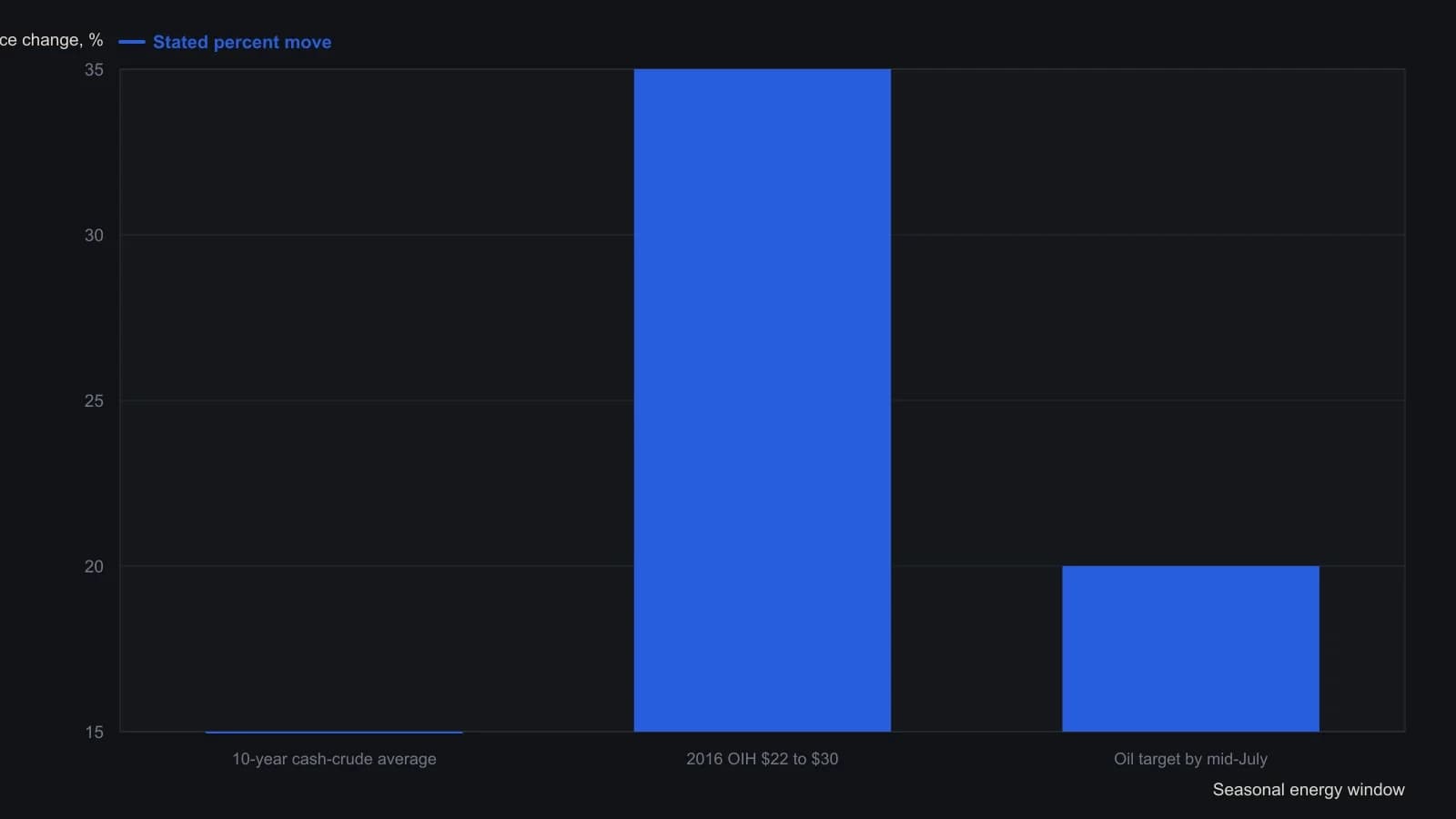
The source also writes the long-run crude move as slightly less than 15 percent and says a 20–30 percent upside is possible if short-covering accelerates; those looser bounds are not added as extra bars.
The definedRiskCall as prepaidRisk
The options case buys July 2017 35-strike calls on that fund at 2.89, or 289 dollars plus commissions. That cash outlay is prepaidRisk. It is both the cost of the position and the maximum loss if the fund falls.
Those purchased calls are the definedRiskCall: the debit is the entire loss if the oilServicesProxy fails to rise before expiry.
The payoff sketch states that if the fund reaches 42, those 35-strike calls would have 7.00 of exercise value, or 4.11 before commissions against the 2.89 debit.
What the cash-crude illustration recorded
In the 10-year weekly cash-crude illustration from 2006, the spring-summer window is recorded as down only once, bullish more than 90 percent of the time, and about a 15 percent average move.
The write-up states that repetition of the seasonal pattern is not guaranteed.
Editorial reading
Editorial interpretation: the teaching point is to test entry, exit, and abstention as one optionIncomeProcedure, with a dated call overlaid on the seasonal signal so the rules can be examined together.
Editorial interpretation: a shortCoveringScenario, in which buying and covering of shorts could enlarge the seasonal bounce, is an optional stretch case. It is not a required trigger for the procedure.
All readings on this track · 14 readings
- 1989When broker advice replaces your rules
- 1990Constructing hybrid trend and option-income rules
- 1992Long-call cash sleeve as an option-income case study
- 1993One job per lookback in a breadth-based option-income procedure
- 2001Expire-worthless folklore and option-income risk
- 2005Conservative option writing after a climate and structure check
- 2007Unhedged option income with volume and the midterm trend
- 2007When option income ignores the implied-volatility range and liquidity
- 2008Horizon-first income spreads and expiration-week volatility
- 2014Seasonal oil calls across a tracking fund and an energy equity
- 2017Shoulder-season crude, the gasoline rebuild, and a put-income overlay
- 2017Seasonal energy window with a defined-risk call
- 2017Constructing short guts for option income decay
- 2018Seasonality as a holding-regime choice in commodity markets