2017issue C0220-21
Shoulder-season crude, the gasoline rebuild, and a put-income overlay
A 2017 energy-calendar case that first isolates the U.S. shoulder-season, inventory-tax-deferral, and gasoline-rebuild sequence from geopolitical headlines, then asks whether a put-income-overlay must require a first-half rally or only reject a large further decline.
- Weather-linked heating, travel, and cooling cycles make crude especially sensitive to the calendar, and wholesale-demand is the layer treated as decisive for futures prices and for option sellers on those futures.
- The U.S. shoulder-season often weakens wholesale crude offtake. Late-year inventory-tax-deferral plus on-hand crude used to start the gasoline-rebuild can then open a November to December seasonal-low-window.
- After the calendar turn, refiners tend to buy crude more aggressively for spring driving-season output, but a January-to-spring price rise was not treated as guaranteed.
- The put-income-overlay sold puts below a projected-put-floor so the underwritten event was the absence of a large further decline, not an outright need for higher prices.
Two layers on one energy calendar
TradersWeek editorial framing treats this 2017 energy case as two layers. The first layer isolates the U.S. shoulder-season, inventory-tax-deferral, and gasoline-rebuild sequence from geopolitical headlines. The second layer asks whether a put-income-overlay should require a first-half rally or only reject a large further decline.
Weather-linked energy demand is higher for heating fuel in winter and for travel and cooling fuel in summer. Crude oil is treated as especially sensitive to those cycles. Wholesale-demand, meaning refiner and commercial buying of crude and products, is identified as the demand layer with the greatest effect on commodity-futures prices, and as the layer option sellers on those futures should watch.
Shoulder-season slack and the late-year setup
The U.S. stretch between summer driving-season and winter heating demand is the shoulder-season. It is often characterized by weak crude demand and weaker wholesale crude offtake.
By late October, heating-oil storage is often judged adequate for winter. Gasoline production is typically cut as winter approaches, and gasoline stockpiles often reach seasonal lows.
Gasoline-rebuild and inventory-tax-deferral
In December, refiners begin the gasoline-rebuild, lifting gasoline output and restocking depleted product inventories for the next driving-season. At the same time, inventory-tax-deferral in major refining states can delay forward crude purchases until the new year.
Using on-hand crude to start that rebuild can draw year-end crude supplies, postpone wholesale restocking, and allow crude inventories to build. That sequence is often aligned with the seasonal-low-window in November and December.
15-year seasonal average for June crude oil
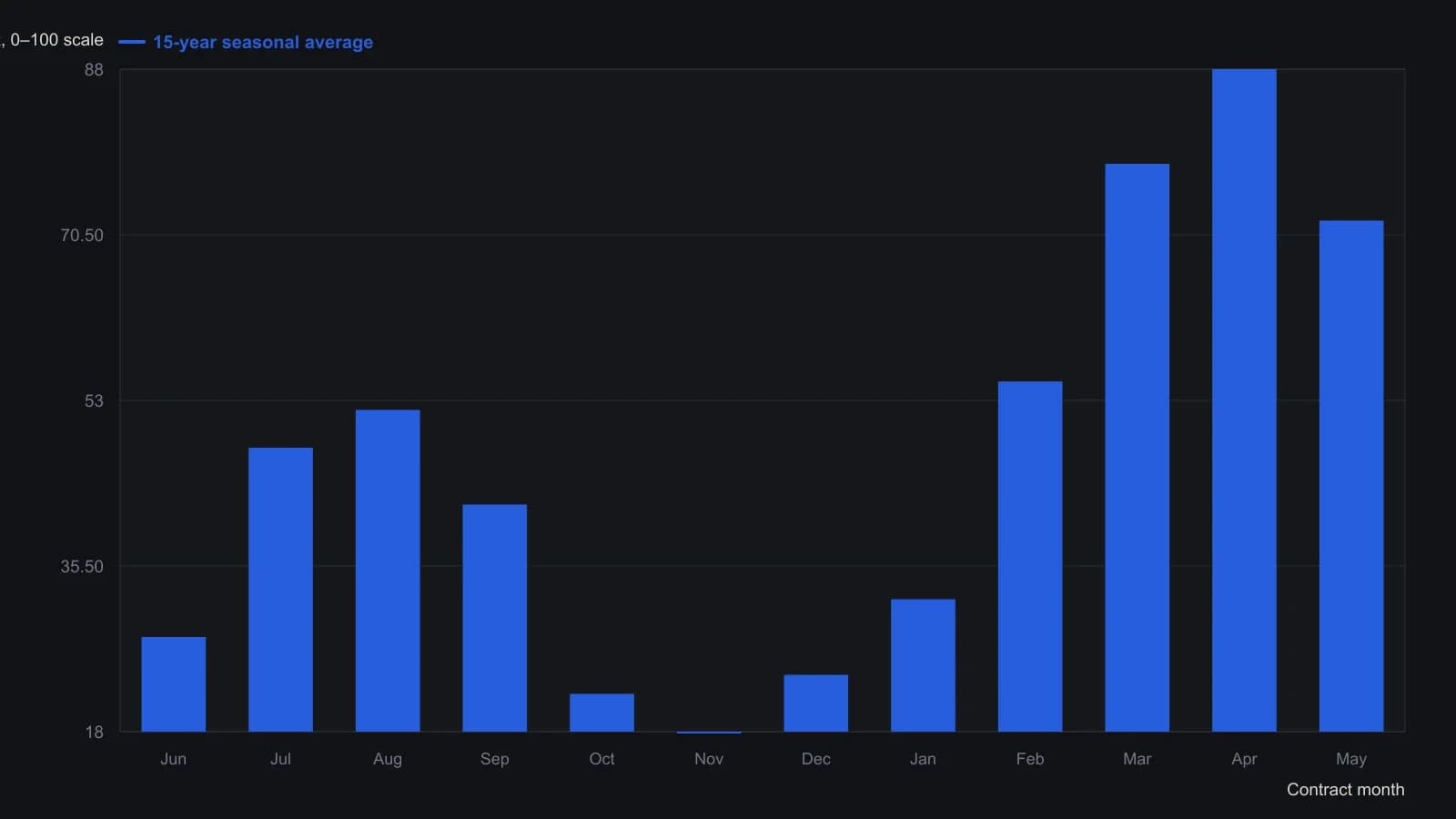
The source prints a 0–100 seasonal-index scale and no dollar prices. Digitized points are approximate; late-year wiggles finer than the raster are omitted.
After the calendar turn
After the calendar year begins, refiners tend to buy crude more aggressively for spring gasoline output. A 15-year seasonal average of June crude was used to illustrate a recurring first-half upward tilt as that production ramps.
In 2016, gasoline and crude stocks sat above prior-year and longer-run averages on a net basis. The intra-year path still followed seasonal norms, including a predictable gasoline-stock decline into November.
The 2017 case expected gasoline production to rise toward the end of 2016 and forward crude purchases to accelerate in January and February. It also stated that a January-to-spring price rise was not guaranteed.
What the put-income-overlay underwrote
The put-income-overlay collected premium by selling puts below a conservative projected-put-floor instead of taking an outright long futures stance. Worthless expiration depended on avoiding a large further decline, not on prices having to rise.
That framing was presented as more robust than requiring higher prices, especially when late-2016 crude sentiment was described as bearish despite OPEC-deal headlines.
As a TradersWeek editorial reading, the useful test is not whether the first-half tilt arrived on schedule. It is whether the option-income rule needed that rally at all, or only needed prices to stay above the projected-put-floor through a defined horizon.
All readings on this track · 14 readings
- 1989When broker advice replaces your rules
- 1990Constructing hybrid trend and option-income rules
- 1992Long-call cash sleeve as an option-income case study
- 1993One job per lookback in a breadth-based option-income procedure
- 2001Expire-worthless folklore and option-income risk
- 2005Conservative option writing after a climate and structure check
- 2007Unhedged option income with volume and the midterm trend
- 2007When option income ignores the implied-volatility range and liquidity
- 2008Horizon-first income spreads and expiration-week volatility
- 2014Seasonal oil calls across a tracking fund and an energy equity
- 2017Shoulder-season crude, the gasoline rebuild, and a put-income overlay
- 2017Seasonal energy window with a defined-risk call
- 2017Constructing short guts for option income decay
- 2018Seasonality as a holding-regime choice in commodity markets