1992issue C021-4
Long-call cash sleeve as an option-income case study
This archive case treats option-income-strategy as one capital-allocation procedure: specify a cash-equivalent-sleeve, buy a call, and compare that package with stock over the holding-period-horizon. The worked 100-dollar book shows how long-call-plus-cash keeps most capital intact if the shares fall and still participates if they rise, and why the construction is less appealing when short-term yields are low.
- Option-income-strategy pairs a purchased option with a cash-equivalent-sleeve so entry, exit, and stand-aside rules can be checked over one holding-period-horizon.
- Covered-call-writing sells a call against shares already held and caps gains if the stock rallies. Long-call-plus-cash buys the call and parks unused notional so most capital stays intact while upside remains.
- The worked case contrasts 10,000 dollars of a 100-dollar stock with a money-market or Treasury-bill sleeve at about 5 percent a year plus a six-month 105-strike call costing 500 dollars, then scores both books if the stock is 115 or 80 after six months.
- Editorial reading: abstain when short-term yields cannot offset the premium. The same rule set can use a broad-index call for a market-wide bullish view, or a long put plus cash instead of short stock for a bearish view.
One procedure and one holding period
The archive presents option-income-strategy as a single capital book that can be checked over one holding-period-horizon. The items to specify are the cash-equivalent-sleeve, the call that is bought, and the comparison of that package with outright stock over the life of the purchased option.
Covered-call-writing is described as selling a call against stock already held, with a better fit in stable or declining markets and a hard cap on gains if the stock rallies.
An alternative construction, long-call-plus-cash, buys a call and places unused funds in a cash-equivalent, aiming to keep most capital intact while retaining upside if the stock rises.
Rates and the cash-equivalent-sleeve
The construction is presented as more appealing when short-term interest rates are relatively high and less appealing when those rates are low, as at the end of 1991.
The cash-equivalent-sleeve is the money-market or Treasury-bill book that earns short-term interest on capital not spent on the option premium.
The 100-dollar stock case
The worked case starts from a 100-dollar stock. It contrasts buying 100 shares for 10,000 dollars with parking that cash in a money-market or Treasury-bill sleeve at about 5 percent a year and buying a six-month 105-strike call costing 5 dollars a share, or 500 dollars.
The holding-period-horizon is the life of that purchased option, used as the comparison window against outright stock.
Strike choice is treated as a budget-and-volatility decision. That is the delta-premium-tradeoff: a nearer strike raises both premium and delta, while a farther strike is cheaper but less sensitive to the stock.
Two endings after six months
If the stock is 115 dollars after six months, the share position is shown with a 1,500-dollar gain. The call is 10 points in the money, so 1,000 dollars of option value minus the 500-dollar premium, plus about 250 dollars of cash interest.
If the stock falls to 80 dollars, the share position is shown with a 2,000-dollar loss, while the call expires worthless and the 500-dollar premium is partly offset by about 250 dollars of cash interest, leaving starting capital largely intact.
The call holder forgoes stock dividends during the option life. Those dividends are described as likely smaller than the cash-equivalent interest over the same window.
Six-month P&L: outright stock versus long call plus cash
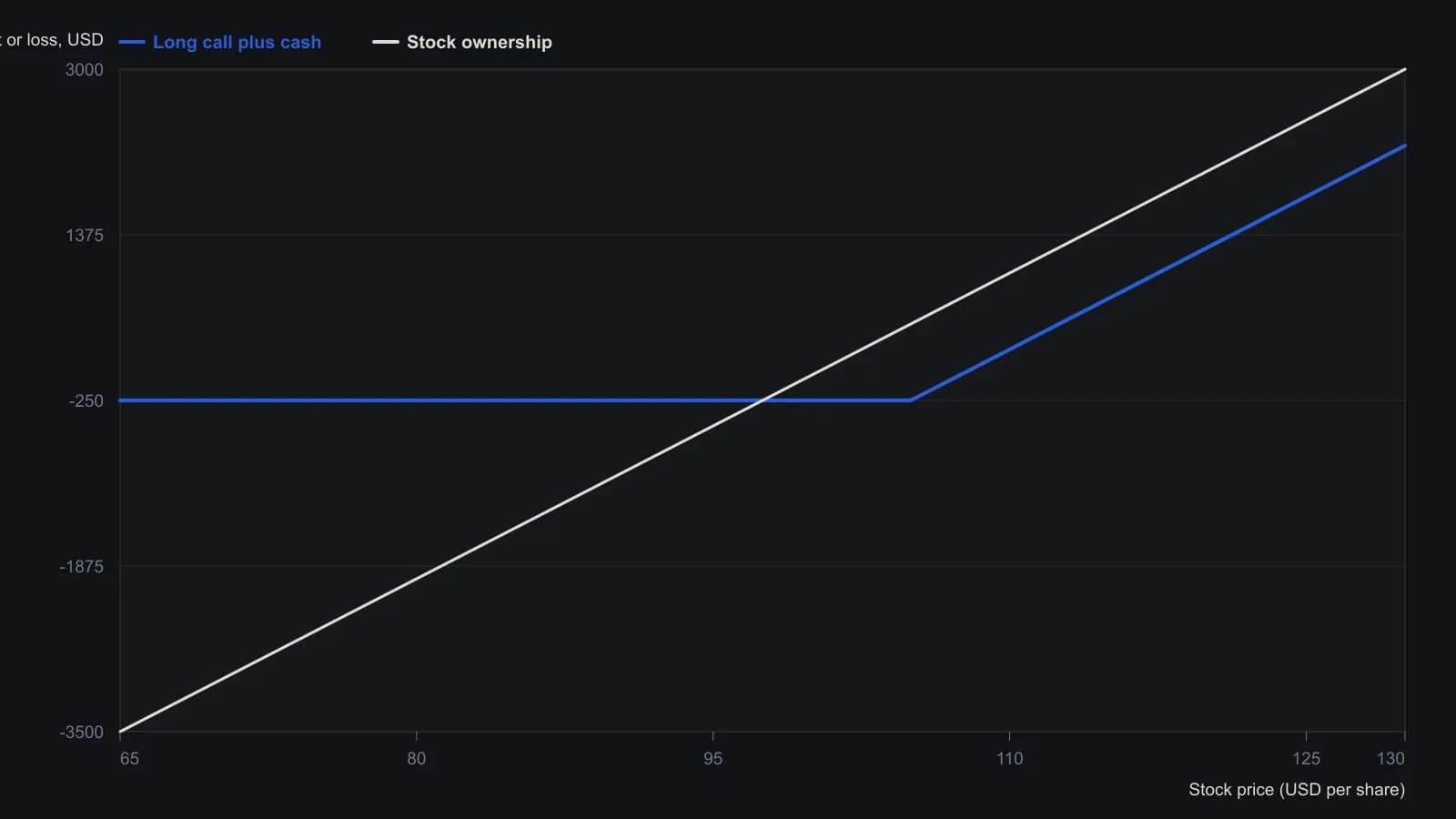
Commissions omitted. Six-month XYZ $105 call costs $500; $10,000 sits in a cash equivalent at 5% a year ($250 over six months). Option-side outlay in the table is $10,500.
Index calls and the put-plus-cash flip
The same rule set can be applied with a broad-index call for a market-wide bullish view, or flipped to a long put plus cash instead of a short stock position for a bearish view. In that flip, the holding-period-horizon is still the life of the purchased option, now compared with a short-stock alternative.
All readings on this track · 14 readings
- 1989When broker advice replaces your rules
- 1990Constructing hybrid trend and option-income rules
- 1992Long-call cash sleeve as an option-income case study
- 1993One job per lookback in a breadth-based option-income procedure
- 2001Expire-worthless folklore and option-income risk
- 2005Conservative option writing after a climate and structure check
- 2007Unhedged option income with volume and the midterm trend
- 2007When option income ignores the implied-volatility range and liquidity
- 2008Horizon-first income spreads and expiration-week volatility
- 2014Seasonal oil calls across a tracking fund and an energy equity
- 2017Shoulder-season crude, the gasoline rebuild, and a put-income overlay
- 2017Seasonal energy window with a defined-risk call
- 2017Constructing short guts for option income decay
- 2018Seasonality as a holding-regime choice in commodity markets