2014issue C0263-64
Seasonal oil calls across a tracking fund and an energy equity
The archive held one mid-February to mid-July 2013 crude window and showed it with a USO July 35 call and an NRG July 24 call, so the same seasonal hold could be compared on a listed fund and a related equity.
- The case studies used fund and equity options to express a seasonal crude tendency without requiring a position in the commodity itself.
- USO was shown as a listed commodity-pool product with options, moving from 35.5 to 38.5 in the mid-February to mid-July 2013 window, with an April setback before the rise resumed.
- NRG Energy was described as a power-generation name with more than 70 percent correlation to crude oil and USO, moving from 24.5 to 29 over the same window, with the retrace in May and June.
- The three-vehicle comparison said the commodity contract typically has the largest per-contract scale and the largest drawdowns, while a related fund or stock option usually has a smaller contract size and a lower premium outlay.
A fixed mid-winter to mid-summer hold
The archive presented one seasonal window from mid-February to mid-July 2013 and illustrated it with listed calls on a fund and on an equity. The case studies treated those options as alternative ways to express a seasonal crude tendency rather than requiring a position in the commodity itself.
The fund call
USO was presented as a listed commodity-pool product that also has options. Its mid-February to mid-July 2013 path was recorded from 35.5 to 38.5, including an April setback before the rise resumed.
The USO illustration used a July 35 call initiated at 1.76 per share, or 176 dollars per contract, with five months remaining until expiration.
Editorial: that listing is the tracking-etf ticket, and the five months are the time-to-expiration chosen so the seasonal hold can finish before the option expires. The April setback is the drawdown-timing recorded on this path.
The equity call
In mid-February 2013, NRG Energy was described as a power-generation name that also trades fuel energy products and as having more than 70 percent correlation with crude oil and USO.
Over the same mid-February to mid-July 2013 window, NRG was shown moving from 24.5 to 29, with its drawdown arriving in May and June rather than in April. The NRG illustration used a July 24 call initiated at 1.56 in February.
Editorial: NRG is the related-equity-proxy in this pairing. Its May and June retrace is a different drawdown-timing from the April setback on USO, even if both paths later completed the seasonal window.
Expiration P/L for the NRG July 24 call
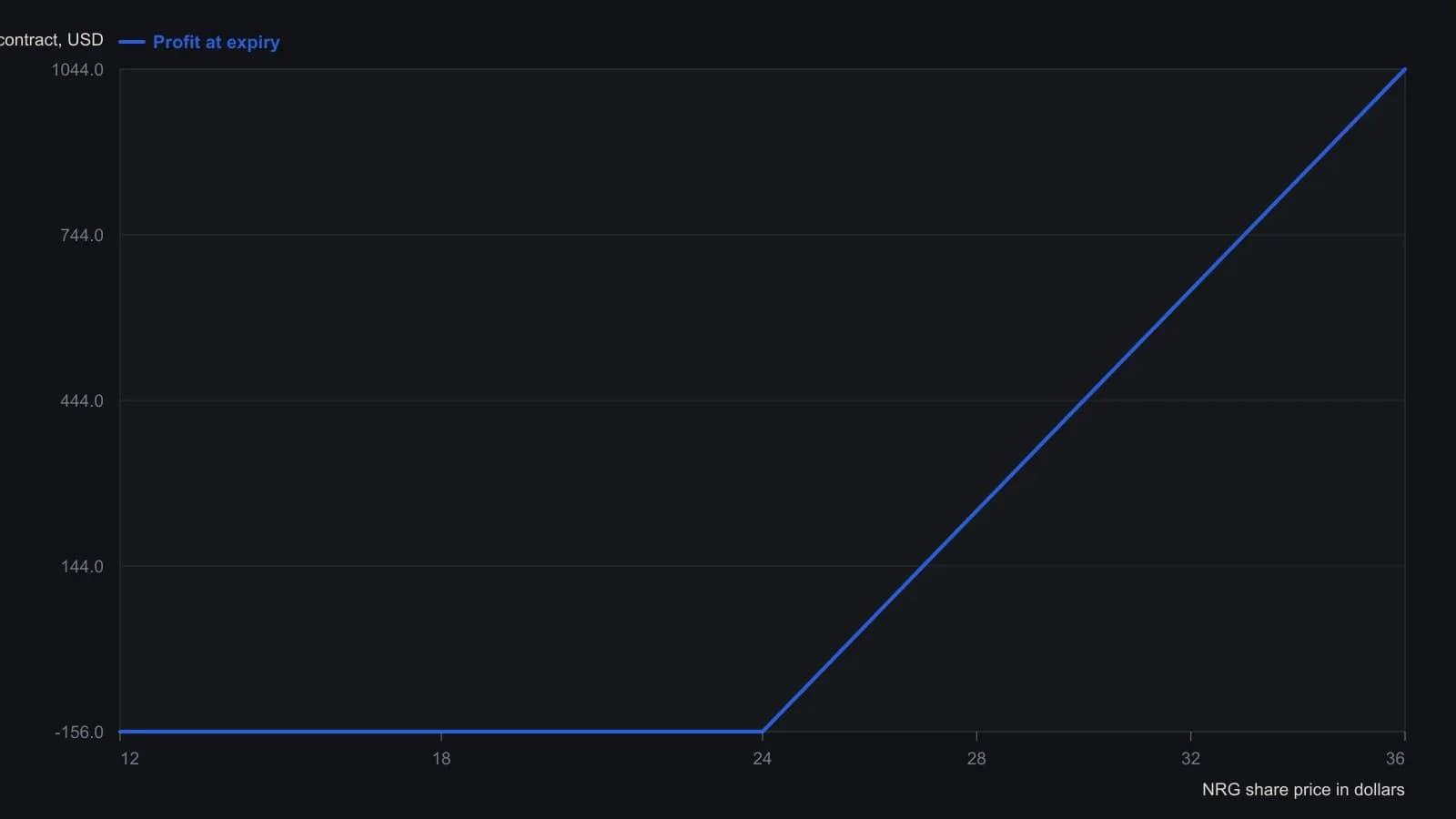
The 15 July 2013 snapshot still had four calendar days to the 19 July expiry, so the live mark ($344 mid, $354 natural, $364 optimistic) is a bid–ask band around nearly all intrinsic, not a second trade. Open interest on the ticket was 4 and that day’s volume was 0.
Contract scale and listing checks
The three-vehicle comparison stated that the commodity contract typically has the largest per-contract scale and the largest drawdowns, while a related fund or stock option usually has a smaller contract size and a lower premium outlay.
Editorial: that contrast is the contract-notional comparison. It lets the same seasonal-trading window be tested at different capital and risk scales.
A companion resource note said traders should identify which exchange lists a vehicle, compare equivalent products across venues, and confirm that a broker can route to the chosen marketplace.
All readings on this track · 14 readings
- 1989When broker advice replaces your rules
- 1990Constructing hybrid trend and option-income rules
- 1992Long-call cash sleeve as an option-income case study
- 1993One job per lookback in a breadth-based option-income procedure
- 2001Expire-worthless folklore and option-income risk
- 2005Conservative option writing after a climate and structure check
- 2007Unhedged option income with volume and the midterm trend
- 2007When option income ignores the implied-volatility range and liquidity
- 2008Horizon-first income spreads and expiration-week volatility
- 2014Seasonal oil calls across a tracking fund and an energy equity
- 2017Shoulder-season crude, the gasoline rebuild, and a put-income overlay
- 2017Seasonal energy window with a defined-risk call
- 2017Constructing short guts for option income decay
- 2018Seasonality as a holding-regime choice in commodity markets