2001issue C051-4
Credit-spread construction that can fail before any order is sent
A same-expiration credit-spread caps loss with the long wing, then still has to clear a positive expected-return screen and sit in a range-bound setting when implied volatility is above normal.
- A credit-spread sells one option and buys a cheaper option of the same type and expiration, so the opening net credit is the maximum gain and the strike width minus that credit is the maximum loss.
- A bear-call-spread sells the lower strike and a bull-put-spread sells the higher strike. A dual-credit-spread places both around a recent range so the underlying cannot finish through both wings at once.
- A correctly formed structure must show a positive expected-return before it is accepted. A negative figure is a reason to move strikes, raise the credit, or refuse the trade.
- After those checks, the procedure still allows holding to expiration because loss is already capped, and it locates the structure in market-neutral ranges when volatility is above normal.
What the credit-spread locks in
A same-expiration credit-spread is built by selling one option and buying a cheaper option of the same type. The opening net credit is the maximum gain. Unlimited loss from an uncovered short is replaced by a loss equal to the strike width minus that credit.
Call-side, put-side, and the time-decay-window
Call-side construction is a bear-call-spread. It sells the lower strike and buys the higher strike when the working outlook is neutral to downward. Put-side construction is a bull-put-spread. It sells the higher strike and buys the lower strike when the working outlook is neutral to upward. Both legs stay in one expiration month.
Construction is described as using the time-decay-window: the two nearest expirations, when time value is described as decaying faster and the underlying has less time to travel through the short strikes. Index underlyings are preferred over many single names because a gap through the short strikes is treated as less likely.
A worked IBM call example
In the IBM call example, a 10-point 125/135 credit filled at 1.20 has a 120 maximum credit, an 880 maximum loss, and a 126.20 credit-spread-breakeven equal to the short call strike plus the credit. On the put side, credit-spread-breakeven is the short strike minus the net credit.
That call credit-spread is treated as able to finish with a gain if the underlying falls, stays unchanged, or rises only enough to remain below the 126.20 breakeven.
IBM March call bid and ask by strike
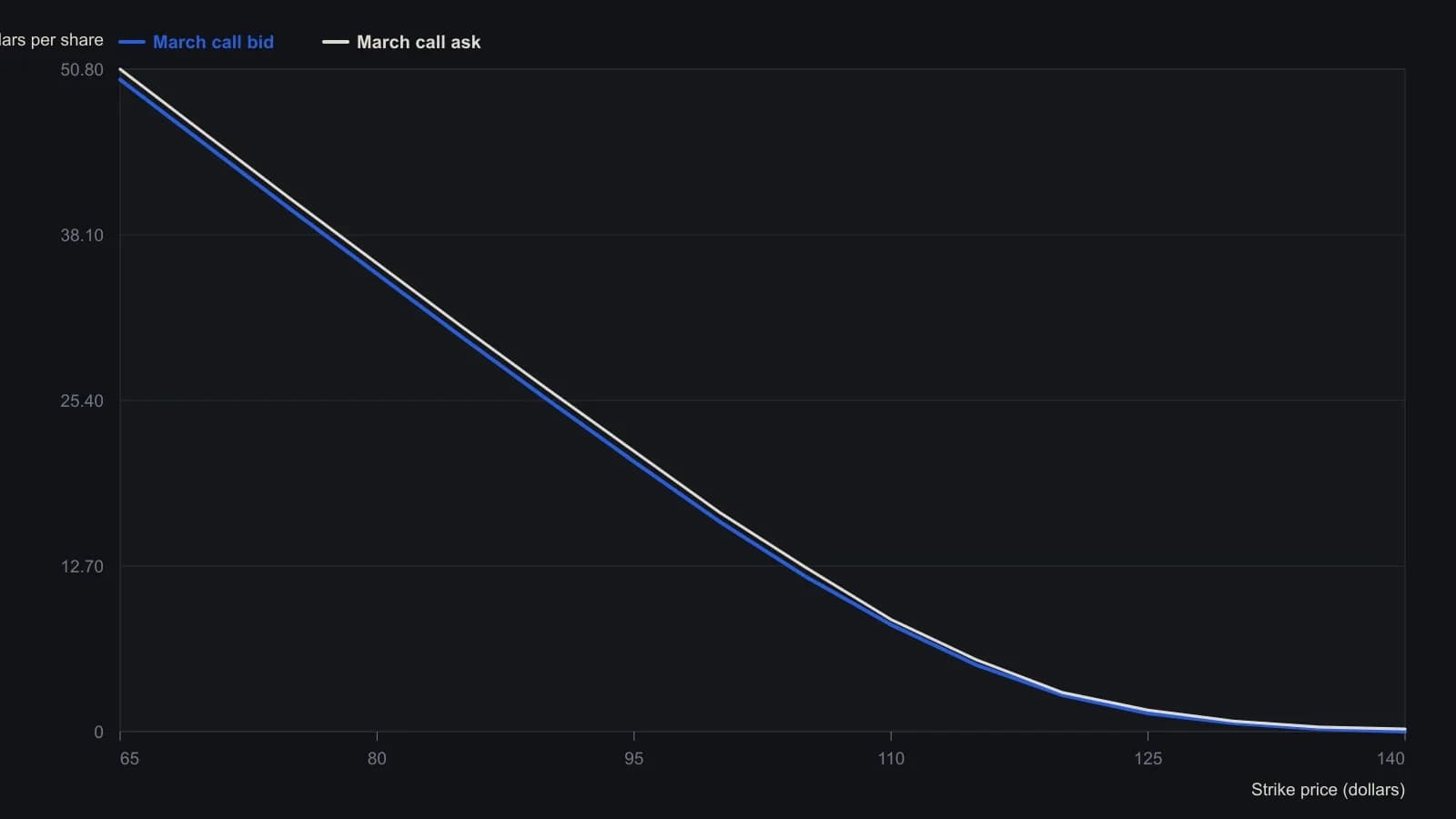
Several deep in-the-money last prints sit below the live bid, so the series uses the bid and ask columns the article treats as the market rather than the last column.
A dual-credit-spread around a range
A dual-credit-spread pairs a call credit-spread above a recent range with a put credit-spread below it, so the underlying cannot finish through both wings at once. The February 2001 SPX example used a March 1450/1475 call credit and a March 1250/1225 put credit for a 2.8-point credit while the cash index sat at 1315.92 inside a 1250 to 1450 range.
The expected-return screen
Expected-return is defined as probability of profit times maximum profit minus probability of loss times maximum loss. A correctly formed credit-spread is required to show a positive expected-return before the structure is accepted.
When that expected-return figure is negative, as in 0.75 times 280 minus 0.25 times 2250 equals minus 345, construction responses are to move strikes farther out of the money, raise the required credit from 280 to 625, or demand a credit larger than strike width times the loss probability. In that last check, 25 times 0.25 equals 6.25 points.
After the gate: hold, stop, and regime
After the probability and expected-value checks, the procedure still allows holding to expiration because loss is already capped, or overlaying a discretionary stop such as 50 percent of the position. It locates the structure in market-neutral ranges when volatility is above normal. That implied-volatility-regime is the market-state filter used after the structure has already been formed and screened.
All readings on this track · 22 readings
- 1995A pre-trade checklist that bounds loss before the order
- 1998Ledger audit of exits, payoff, and overlap
- 1998A return-to-loss filter for drawdown-aware evaluation
- 2000Pair historical volatility with return-to-loss filters
- 2001Credit-spread construction that can fail before any order is sent
- 2002Evaluating mechanical systems in a traders market
- 2002Profitability as a bound implied by RWL and commission
- 2004A day-trading breakeven matrix for size and win rate
- 2006Sit out, size and expectancy as one procedure
- 2006A testable intraday procedure from setup to stand-down
- 2007A planned liquidity offer at the inflection point
- 2011A style-neutral expectancy filter for system evaluation
- 2011Separate buying power from posted risk capital
- 2012Design before you trade: testing mechanical systems
- 2014Ideal trader hindsight as a pretrade filter
- 2014When expectancy and drawdown limits disagree
- 2015Signal, confirm, and invalidate before the trade
- 2015Price the win, stall, and loss before a stock entry
- 2016Construct expectancy by bounding losses and winner size
- 2017Estimate expectancy before you accept the trade
- 2017Size ladder tests for drawdown caps and expected value
- 2017Evaluate a high-yield correlation break as one locked procedure