1991issue C061-4
When a narrow index becomes the cash-flow proxy
A concentrated ownership regime can flip the usual reading of averages and breadth. Identify which short list of liquid names absorbs institutional cash, then treat that listed average as the cash-flow stand-in and treat advance/decline counts plus secondary averages as possible late echoes.
- If institutional-concentration sits in a short list of liquid names, the listed average that holds those names is the index-proxy, not a diversified sample of the whole market.
- Indexing and small-basket practice can make a support-resistance break in that proxy extend, because funds that must keep baskets aligned stop buying or sell the same components.
- Market-breadth-context from advance/decline counts can be a late echo: dealers may reprice peripheral names after the proxy moves and print thin advances that are not independent buying.
- Broader listed averages can be dragged by cash flow already committed in the industrial average, so they may confirm only after the fact rather than lead.
The older preference for a broad average
Older technical practice treated more broadly based listed averages as a clearer read of equity-market conditions than the industrial average. That ranking treats the broad list as the market and the narrower industrial average as a thinner sample.
Editorial reading: the ranking holds only when cash is actually spread across the broader list. Once institutional-concentration has already chosen a short list of names that funds can trade in size, the listed average that contains those names becomes the index-proxy.
A short list that absorbs the cash
A survey cited in the source stated that 27 percent of institutional equity funds were indexed, leaving a small set of large-capitalization names concentrated with institutional owners. Twenty-eight of the 30 industrial-average members were described as typically sitting in that concentrated institutional set.
Those names were characterized as liquid enough for large tickets, linked to listed options, large enough to hold size, and paying widely anticipated regular dividends used in derivative trading. Indexing, in this setting, is the practice of mirroring a published average instead of trying to outperform it.
For about 30 percent of institutional money in 1991, the described practice was assembling a small basket rather than covering the full universes of the broader published averages. Two of the 30 industrial-average names were identified as usually left out of those baskets. The basket is that small set of large, liquid names used to approximate an average for cash and derivative positioning.
Dow Jones Industrial Average, Jan–Jan
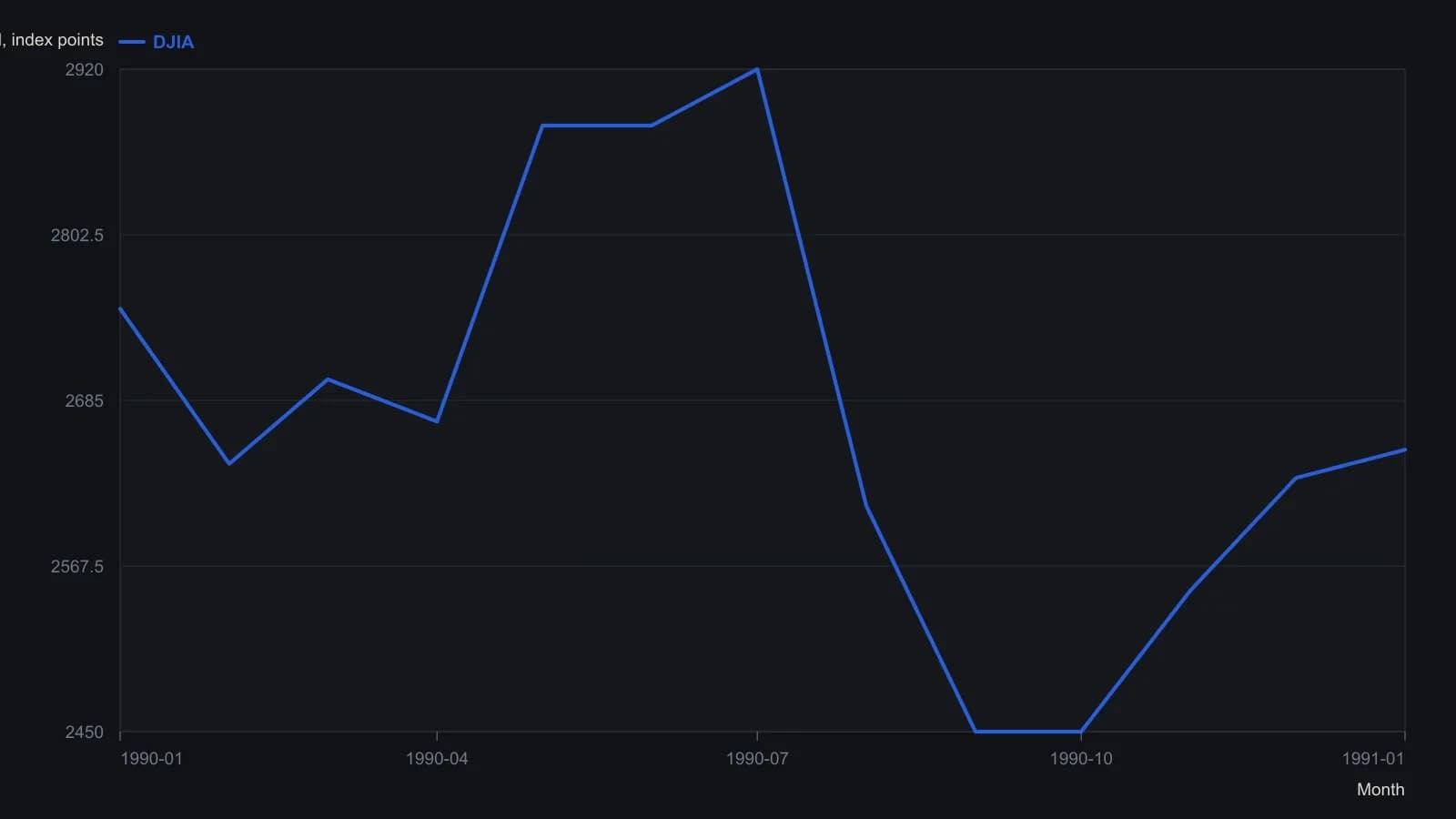
Approximate closes read from the scanned daily bar chart; the raster does not support tick-level precision, so the path is sampled rather than every session.
When a support break forces the same names
The source argued that a break of support in the industrial average would tend to extend because index funds would stop buying or would sell basket components to keep weights aligned. Support-resistance is used here as a price level on the watched average whose break is hypothesized to force funds that must keep baskets aligned to add or cut the same names.
An opinion-driven move in a basket name was described as being amplified when index funds then added or resized that name, unlike a similar move in a small name outside the basket.
Breadth and secondary averages as late echoes
The advance/decline line was rejected as a useful contemporaneous breadth check because dealers in peripheral names could shift quotes after industrial-average moves and later print thin advances that were not independent buying.
Broader averages were described as being dragged by industrial-average cash flow and confirming only after the fact, so they would not lead the industrial average in that ownership regime.
Editorial reading: market-breadth-context is still the shared-versus-concentrated read of a move, often taken from how many names advance or decline with the average. In this ownership regime that count can arrive as a mechanically pulled echo of cash already committed in the index-proxy, not as independent confirmation.