1992issue C121-7
Evaluating equity sleeves against an index-proxy cost drag
Before judging a single trade or an active book, rebuild the same capital as a low-turnover index-proxy and as an equal-weighting of that universe. The sleeve is a diagnostic instrument for separating expense-ratio, turnover-cost, and concentration from the market regime already held.
- Treat a broad market sleeve as a diagnostic instrument: rebuild the book as an index-proxy before scoring a trade or an active manager.
- Equal-weighting the same universe is a second lens that shows how much of the result is concentration rather than the diversified market regime.
- Published index figures are gross of costs; expense-ratio, turnover-cost, and any sales load sit between that gross figure and what investors keep.
- Passive-indexing means matching a chosen index without market timing or sector selection, but a passive sleeve is not automatically free of entry costs.
Rebuild the book before scoring the trade
A broad market sleeve is a diagnostic instrument, not a product to recommend. Before judging a single trade or an active book, rebuild the same capital as a low-turnover index-proxy. Then rebuild it again as an equal-weighting of that universe. Expense-ratio, turnover-cost, and concentration can be read separately from the market regime the trader is already holding.
Editorial interpretation: the archive describes a historical evaluation workflow. TradersWeek uses that workflow to put a trade or an active book into a diversified, regime-aware context. It does not treat the rebuilt sleeve as a recommendation.
Cost drag on conventional equity funds
Conventional stock mutual funds typically face combined expense-ratio and transaction costs that consume a material share of assets. The average general-equity expense-ratio is the recurring advisory, distribution, and operating charge deducted from fund assets.
Average fund turnover is described as high, and the turnover-cost tied to that activity is said to subtract further from annual results. Sales commissions, where charged, reduce results further.
The index-proxy as the first baseline
Passive-indexing is a passive attempt to match a chosen stock or bond index by holding all of its securities or, for very broad indices, a representative sample, without market timing or sector selection. The index-proxy is that low-turnover basket, used here as the evaluation baseline for active funds and single trades.
Matching a broad published index in a private account requires buying every constituent and continually adjusting for dividends, splits, and membership changes. Ordinary brokerage costs make that exercise impractical for a typical investor.
A well-run index fund is specified as paying no advisory fee, keeping operating expenses as low as possible, and minimizing trading so its result can stay close to the mirrored index.
Gross index figures and the manager problem
Taken as a group, all stock investors cannot outperform the overall stock market. Published index figures are gross of costs, so typical buying-and-holding costs leave investors with less than that gross figure. Diversification spreads exposure across a broad security set so one name, sector, or manager bet does not define the portfolio's market regime, but it does not cancel expense-ratio or turnover-cost.
Some active funds will beat index funds over long stretches. The evaluation problem is identifying consistently superior managers before the fact rather than after the record is known.
Equal-weighting as the second lens
Equal-weighting assigns similar capital to each name so no single holding dominates the sleeve. Set next to a concentrated active book and a cap-weighted index-proxy, it shows how much of the result is a few large names rather than the diversified regime already held.
Entry costs still appear on some passive sleeves
Most index funds discussed were of recent origin and therefore lacked long operating histories. The tabulated comparison covered only products with at least one full year of results. Some index products in the survey still charged a sales load or a purchase fee, so a passive sleeve is not automatically free of entry costs.
Ten-year annualized equity-fund returns versus market indices
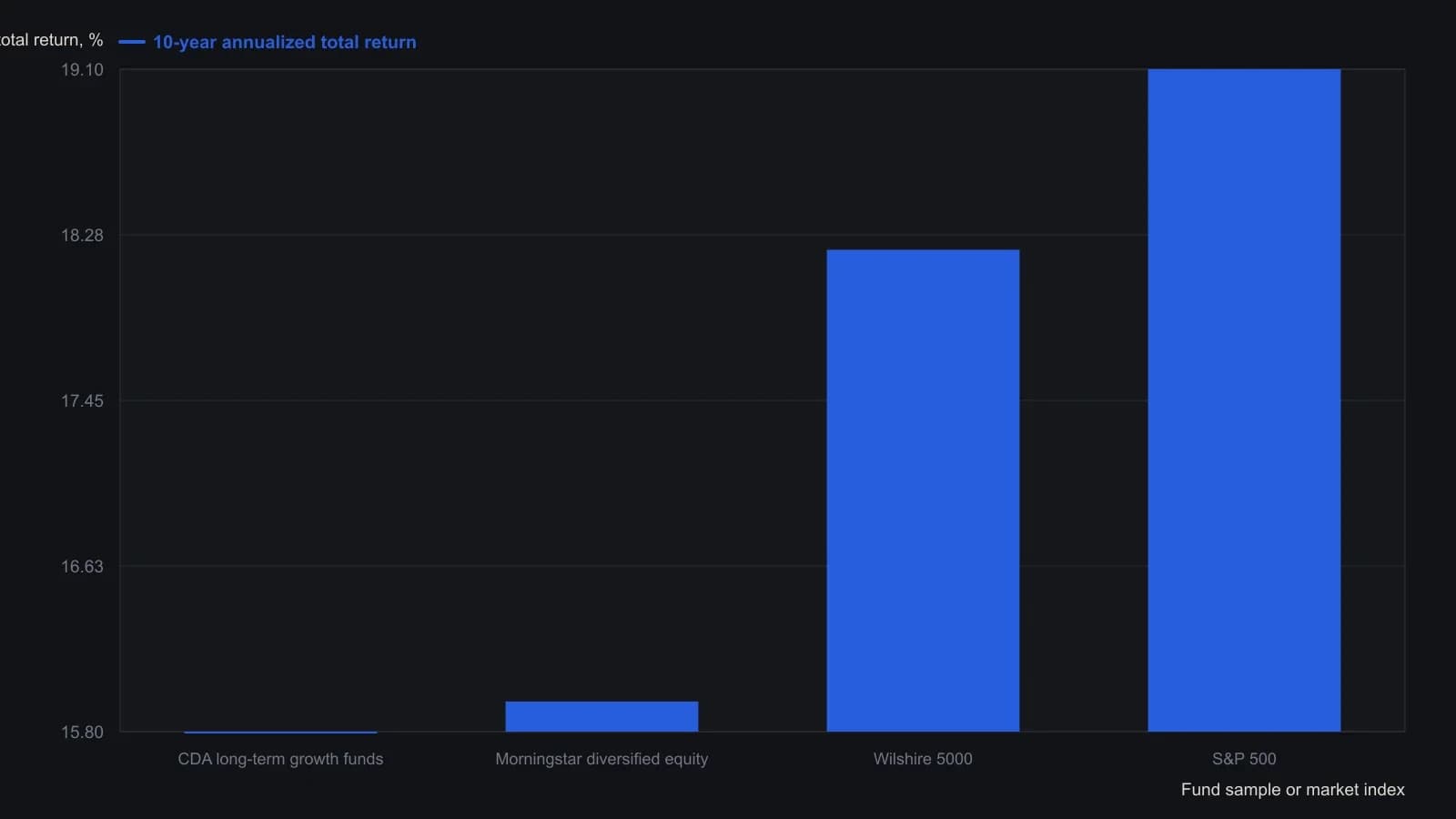
CDA/Wiesenberger is 356 long-term-growth funds at 15.8%; Morningstar is 534 U.S. diversified equity funds at 15.95%. Both refer to the same roughly 10-year window cited in the 1992 article, not one pooled sample.
All readings on this track · 10 readings
- 1992Evaluating equity sleeves against an index-proxy cost drag
- 1996Match a technology position to an index-proxy, then to a listed futures contract
- 2001Equal-weight pictures, rank rotation, and regime-aware allocation
- 2005Listed index baskets as allocation sleeves
- 2016A 9/36 inflation state for a commodity and dollar basket
- 2016Liquidity filters, weighting rules, and index proxies in a same-category sleeve
- 2018Values-screened ETF sleeves as an allocation case study
- 2019Equal-weight rank-rotation tests for a disclosed value book
- 2019High-dividend-paying ETFs as a portfolio-construction choice
- 2020A Nasdaq-100 proxy as a construction problem, not a ticker