2003issue C101-2
Volatility regime sleeves for spreads, straddles, and leverage
Editorial view: treat the options book as a weather station rather than a single forecast. Fund the live volatility-and-direction sleeve, keep a spread and a straddle ready for the next sleeve, and refuse any ticket whose contract count exceeds the stock lot already used.
- Open interest is the count of still-open contracts at a strike. That total alone does not identify retail or institutional flow, or a hedge that will never be closed.
- A low-volatility rising tape can sit in a call or call-spread sleeve, a high-volatility sideways tape in a calendar-spread sleeve, and a low-volatility directionless tape in a straddle sleeve.
- One bullish, low-volatility template puts 40 percent of trading capital into calls or call spreads, 30 percent into high-volatility nondirectional structures such as calendars, and 30 percent into low-volatility nondirectional structures such as straddles.
- Keep option contract count aligned with the equity lot already used, for example two contracts where 200 shares would be the stock size.
The book as a weather station
Editorial view: treat the options book as a weather station rather than a single forecast. Assign capital to the live volatility-and-direction sleeve, keep a spread and a straddle ready for the next sleeve, and refuse any ticket whose contract count exceeds the stock lot you already know how to lose.
The archive workflow does not require one directional idea to carry the whole book. A low-volatility rising tape can be treated as a call or call-spread sleeve, a high-volatility sideways tape as a calendar-spread sleeve, and a low-volatility directionless tape as a straddle sleeve.
What open interest can show
Open interest is the total of still-open long and short contracts at a strike. That total alone does not show which side is retail or institutional. It also does not show whether the flow is a hedge that will never be closed.
In liquid names, combining open interest with other indicators and reading how it is stacked across nearby strikes can suggest possible support or resistance in the underlying.
Three sleeves instead of one idea
An option spread is a multi-leg structure, such as a call spread or a calendar, used as one procedure for entry, exit, and sitting out under a stated market state.
A straddle is a low-volatility, nondirectional structure used to place one idea inside a weeks-to-months regime allocation rather than as a standalone bet.
Editorial view: keep both structures ready so the live tape can change sleeves without converting the whole book into one directional bet.
A bullish, low-volatility split
One allocation template for a bullish, low-volatility state puts 40 percent of trading capital into calls or call spreads, 30 percent into high-volatility nondirectional structures such as calendars, and 30 percent into low-volatility nondirectional structures such as straddles.
Editorial view: that template is a regime allocation. It splits options capital across directional, high-volatility nondirectional, and low-volatility nondirectional sleeves instead of funding one favorite structure.
Capital split across three options sleeves
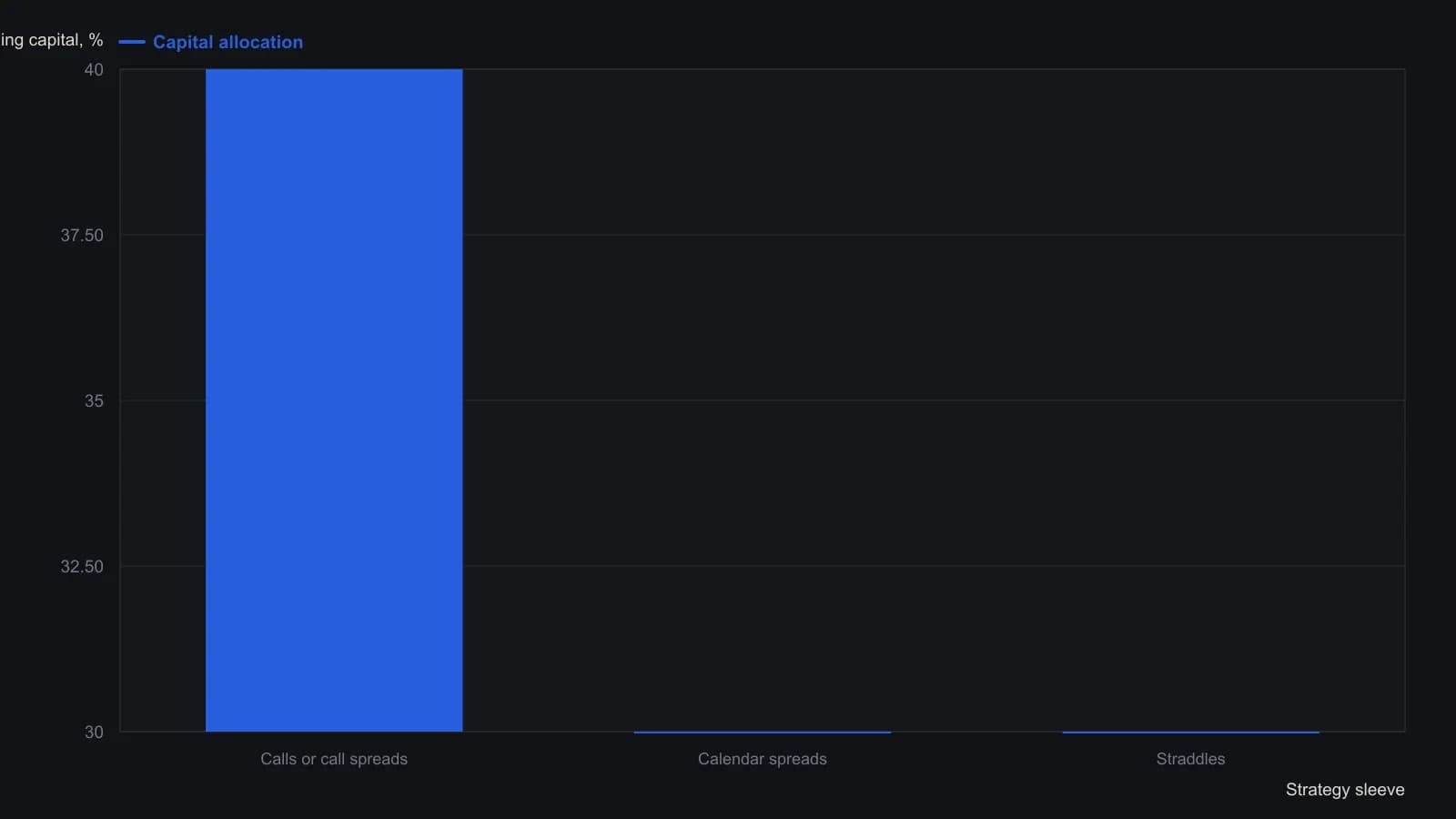
Gentile presents the 40/30/30 split as an adjustable template for one market regime, not as a historical average.
Hedges first, then liquid trades
Options are framed first as hedges that reduce the risk of holding an underlying, and only second as standalone trading vehicles when the listed market is liquid.
The expire-worthless claim
The belief that 90 percent of options expire worthless is treated as false. The breakdown given is about 30 percent expiring worthless, 10 percent exercised, and 60 percent closed by offsetting trades.
Keep contract count on the stock lot
A leverage-control rule is to keep option contract count aligned with the equity lot already used, for example two contracts where 200 shares would be the stock size, rather than spending the 10-to-20-times notional that leverage appears to unlock.
Editorial view: if the ticket needs more contracts than the stock lot you already know how to lose, sit out. The filter belongs before entry and while the position is open.
Time decay inside 30 days
Buying options that expire in under 30 days concentrates the fastest time decay, which can keep the option from rising even when the underlying moves as expected.
All readings on this track · 17 readings
- 1993Implied volatility zones for straddle overlays
- 2000Option premiums, implied volatility, and multi-leg payoffs
- 2003Volatility regime sleeves for spreads, straddles, and leverage
- 2003Implied-volatility regimes, straddles, and protective puts
- 2004Constructing an options straddle from historical and implied volatility
- 2004Credit-spread exits, implied volatility, and strike grids
- 2005Two gates for option-structure selection: regime, checklist, then strike geometry
- 2008Unused days in a short-hold straddle are still priced
- 2008Why a long-straddle misfits a readable sideways market
- 2011Sample variance as a context check for range and straddle ideas
- 2013Straddle construction across index dilution and volatility rank
- 2015Implied volatility, straddles, and premium-weighted put-call regime context
- 2016Isolating implied volatility with a delta-neutral option-income book
- 2017Stochastic divergence as a capped-payout options case
- 2017Implied versus realized volatility in a straddle case study
- 2018Why option risk curves fail to deliver theta
- 2019Long-dated call ratio backspread under compressed implied volatility