2004issue C111
Credit-spread exits, implied volatility, and strike grids
A listed-option case binds three checks into one procedure: whether implied-volatility premiums look rich enough for a defined-risk credit spread, whether strike spacing is fine enough for spreads and straddles, and whether the expire-versus-offset exit is written before the trade is opened.
- Implied volatility is a market-regime reading of whether listed premiums look rich enough to justify a defined-risk credit spread.
- Strike spacing and settlement-style decide whether an option-spread or options-straddle can be placed with enough precision.
- A multi-decade study found that about 60 percent of listed options were closed with offsetting trades, so the exit rule cannot assume worthless expiry.
- In the equity case, elevated premiums were the reason for bull-put-spreads, with expire if the stock rose and an offsetting-close or assignment if it fell.
One procedure, three checks
An option-spread is a paired long and short option treated as one entry, exit, and abstention procedure rather than two separate bets. Implied volatility is a premium-implied market-regime reading used to decide whether listed prices are rich enough to justify opening a defined-risk credit spread. An options-straddle is a same-expiration call-and-put structure that is practical only when listed strikes sit close enough to center the underlying.
Editorial reading: the archive is most useful when those three ideas are written as one checklist before any order is sent. First, ask whether listed premiums look rich enough for a credit-spread. Second, confirm that strike spacing is fine enough to place the spread or the straddle. Third, state whether each path ends in expiration, an offsetting-close, or assignment.
When premiums look rich enough
A credit-spread is a defined-risk opening that sells the richer option and buys a farther option of the same type so the account receives a net credit. A bull-put-spread is that structure in puts: sell a higher-strike put and buy a lower-strike put, keeping the net credit if both puts finish unexercised.
In one equity case, elevated implied-volatility premiums were the stated reason for opening multiple June put credit spreads. The planned exit if the stock rose was to let both legs expire. If the stock fell, the plan was to close the spread or accept assignment on the short put while the long put limited further downside.
Strike spacing and settlement-style
Nasdaq-100 cash-index options and the related exchange-traded fund options reference the same 100-stock basket. They differ in cash versus share settlement, European versus American exercise, and how finely strikes are listed. Settlement-style is whether exercise can occur before expiration and whether the deliverable is shares or cash.
The fund share was described as about one-fortieth of the cash index, so an index near 1,000 corresponded to a fund price near 25. One-point strike increments on the fund options were cited as making option spreads and straddles easier to place than on the cash-index contract. Strike spacing is the listed increment between available strikes, and it sets how precisely a spread or straddle can be placed.
Mini Nasdaq-100 options were described as cash-settled and European-style, equal to one-tenth of the full index, and more actively traded than the full-size index options.
Why most paths are not worthless expiry
A multi-decade study of listed options found that about 30 percent expired worthless, about 10 percent were exercised, and about 60 percent were closed with offsetting trades. Informal guesses that 70, 80, or 90 percent of options expire worthless were described as higher than that study’s result.
An offsetting-close is an opposite transaction that ends an option before expiration instead of leaving exercise or worthless expiry as the outcome. Editorial reading: because offset was the most common ending in that study, a credit-spread procedure is incomplete until it states when to expire, when to offset, and when assignment on the short put is acceptable.
How listed option contracts actually end
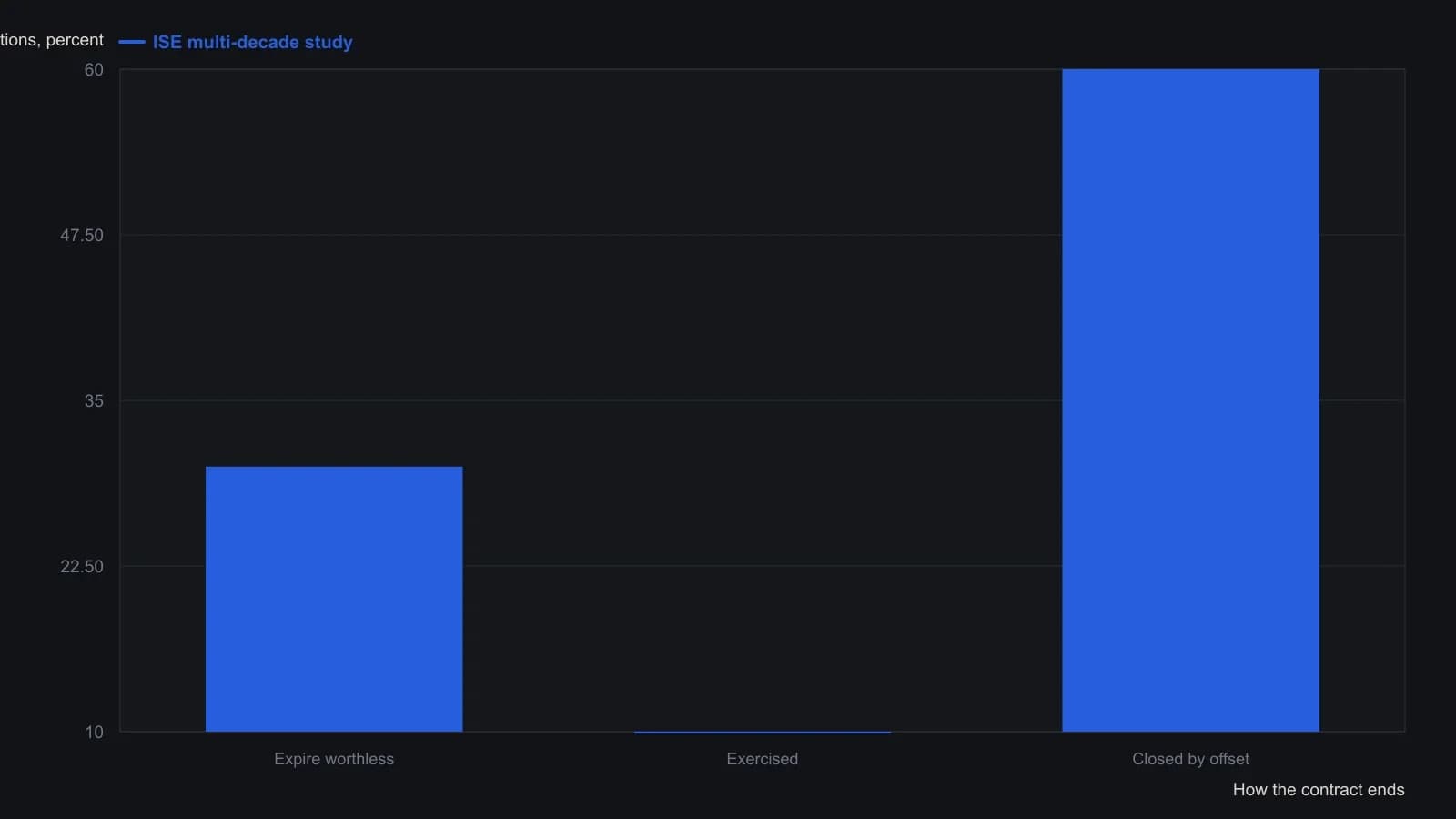
The exercise share is stated as roughly 10 percent; the 60 percent offset share is the residual after the 30 percent worthless-expiry figure. Street talk of 70–90 percent worthless expiry is mentioned only as a contrast, not as a measured series.
All readings on this track · 17 readings
- 1993Implied volatility zones for straddle overlays
- 2000Option premiums, implied volatility, and multi-leg payoffs
- 2003Volatility regime sleeves for spreads, straddles, and leverage
- 2003Implied-volatility regimes, straddles, and protective puts
- 2004Constructing an options straddle from historical and implied volatility
- 2004Credit-spread exits, implied volatility, and strike grids
- 2005Two gates for option-structure selection: regime, checklist, then strike geometry
- 2008Unused days in a short-hold straddle are still priced
- 2008Why a long-straddle misfits a readable sideways market
- 2011Sample variance as a context check for range and straddle ideas
- 2013Straddle construction across index dilution and volatility rank
- 2015Implied volatility, straddles, and premium-weighted put-call regime context
- 2016Isolating implied volatility with a delta-neutral option-income book
- 2017Stochastic divergence as a capped-payout options case
- 2017Implied versus realized volatility in a straddle case study
- 2018Why option risk curves fail to deliver theta
- 2019Long-dated call ratio backspread under compressed implied volatility