2015issue C0243-46
Implied volatility, straddles, and premium-weighted put-call regime context
A historical options research day used a morning premium-weighted put-call briefing and a late-day implied-volatility and straddle follow-up so one listed contract could be judged inside a weeks-to-months market-regime overlay.
- Morning recommendations were typically a single listed put or call purchase, and some sessions carried no new recommendation, so the opening briefing could stand as backdrop without a new trade.
- Option-premium-analysis built a weighted-put-call-ratio from premium times volume, then required an overnight computer screen, a next-day chart check, moving-average smoothing, and support-and-resistance context.
- The afternoon list centered on options-straddle purchases and a two-bucket volatility-extremes-screen so implied-volatility could frame weeks-to-months structure instead of a one-sided price wager.
- Editorial reading: the two passes belong together as market-regime context so one listed contract is judged inside a diversified, weeks-to-months overlay.
An opening briefing and a late-day follow-up
The archive describes an options research workflow that split the session into an opening market briefing and a late-day volatility follow-up. The later sitting was there so open option positions could be reviewed with current profit-or-loss figures.
New morning recommendations were typically a single listed put or call purchase. Some sessions carried no new recommendation.
Morning premium-weighted sentiment
The morning sentiment measure used option-premium-analysis. It multiplied each option's premium by its volume, summed those put products, and divided by the matching call sum. The archive treated that weighted-put-call-ratio as distinct from a raw put-volume-to-call-volume ratio, so sentiment reflected priced option dollars rather than contract counts alone.
Equities stayed on the put-call signal lists only if recent listed option activity cleared a stated volume floor. Names were first screened overnight by computer and were treated as confirmed only after a next-day visual check of the chart pattern.
The premium-weighted put-call series was smoothed with a simple moving average. It was meant to be read with other technical context such as support and resistance.
21-day dollar-weighted equity-only put-call ratio
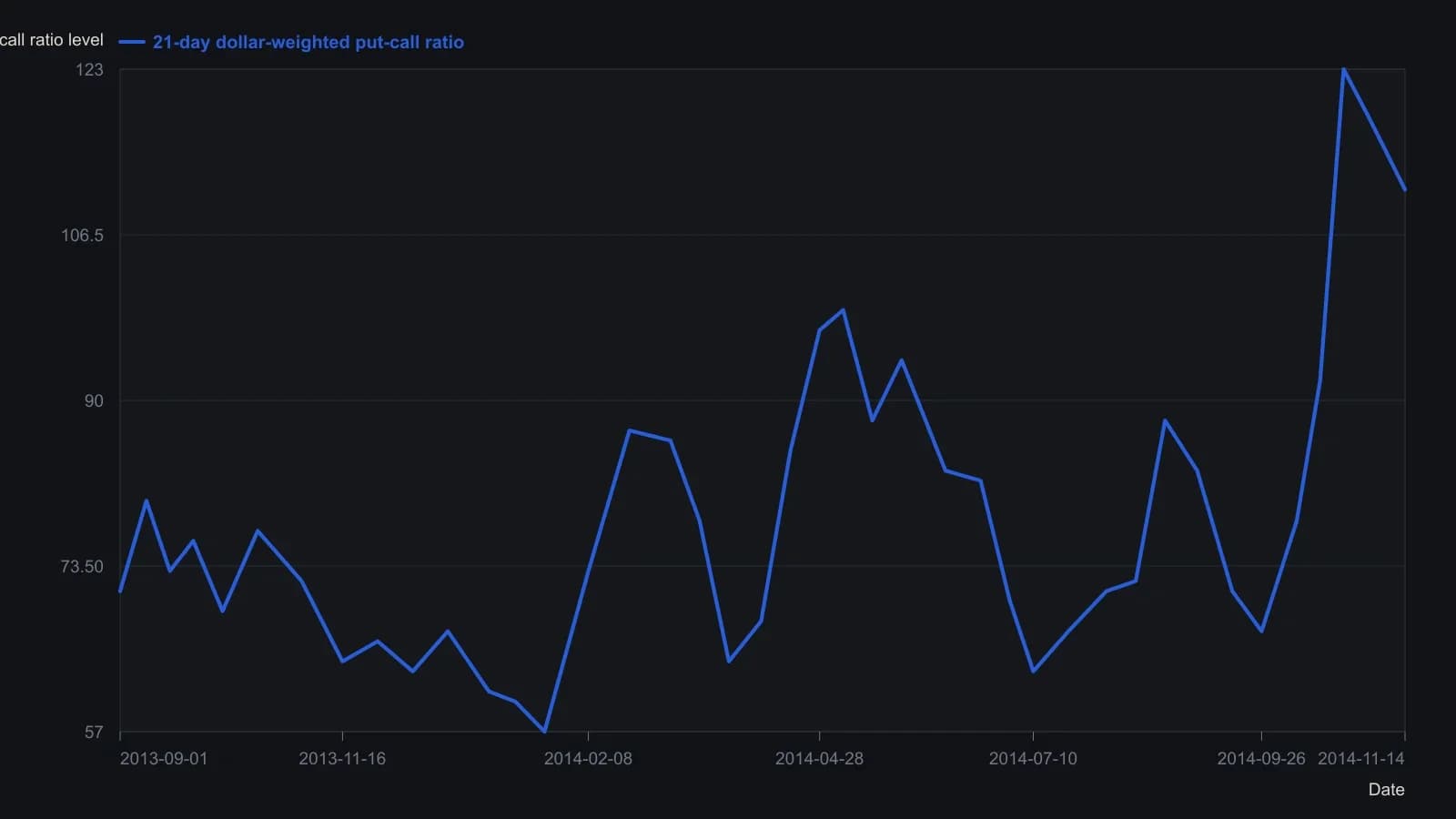
The source smoothed the premium-weighted equity-only ratio with a 21-day simple moving average and annotated buys at peaks and sells at troughs. A companion $SPX price trace appears on the same figure without a labeled price scale, so it was not digitized. Readings are approximate from the printed plot.
Afternoon straddles and implied-volatility extremes
The afternoon report included a dedicated straddle-purchase section. Most tracked positions were described as options-straddle structures, with only a few non-option holdings. An options-straddle here was a long call-and-put structure the follow-up list treated as a core way to express volatility over weeks to months instead of a one-sided price wager.
Implied-volatility extremes were listed with a volatility-extremes-screen in two buckets: a stated decline over a longer lookback and a stated rise over a shorter lookback. Implied-volatility was the options-implied estimate of future price variability, used to flag recent expansions or contractions as market-regime context rather than as a standalone forecast.
Skew, put sales, and the wider book
After the straddle and implied-volatility sections, the same report added volatility-skew notes and a put-sale review. It favored uncovered put writing over covered-call writing as the income-style overlay.
Editorial reading: those later notes keep the single morning purchase inside a broader book. Market-regime, in this archive, is a weeks-to-months backdrop built from prices, volatility, and related portfolio context so a single trade can be judged inside a diversified frame.
All readings on this track · 17 readings
- 1993Implied volatility zones for straddle overlays
- 2000Option premiums, implied volatility, and multi-leg payoffs
- 2003Volatility regime sleeves for spreads, straddles, and leverage
- 2003Implied-volatility regimes, straddles, and protective puts
- 2004Constructing an options straddle from historical and implied volatility
- 2004Credit-spread exits, implied volatility, and strike grids
- 2005Two gates for option-structure selection: regime, checklist, then strike geometry
- 2008Unused days in a short-hold straddle are still priced
- 2008Why a long-straddle misfits a readable sideways market
- 2011Sample variance as a context check for range and straddle ideas
- 2013Straddle construction across index dilution and volatility rank
- 2015Implied volatility, straddles, and premium-weighted put-call regime context
- 2016Isolating implied volatility with a delta-neutral option-income book
- 2017Stochastic divergence as a capped-payout options case
- 2017Implied versus realized volatility in a straddle case study
- 2018Why option risk curves fail to deliver theta
- 2019Long-dated call ratio backspread under compressed implied volatility