2017issue C0332-34
Stochastic divergence as a capped-payout options case
A 15-minute GBPUSD divergence is booked only as short-dated binary-style options. The entry debit is the entire risk budget, and nearby two-hour strikes change the debit-credit mix without rewriting the upside statement.
- On a 15-minute GBPUSD chart, price made lower lows while the slow stochastic rose, and a close above the open was cited as added support for an upside statement.
- The illustrated contracts paid a fixed maximum of 100 if the strike statement finished true at expiration, and the amount paid to enter was the maximum loss.
- One upside view was booked as five neighboring two-hour strikes at one contract each, so deeper in-the-money strikes carried larger debits and smaller residual credits inside the same 100-unit cap.
- Besides rolling two-hour windows, same-day expirations at 7:00, 11:00, 15:00, 19:00, and 23:00 were listed on the pair, so the same setup could sit on more than one clock.
The 15-minute chart condition
On a 15-minute GBPUSD chart, price made lower lows while the slow stochastic rose. That pairing is a divergence: a chart condition in which price prints a new swing extreme that a companion oscillator does not confirm. The oscillator in this case is the slow variant of the stochastic oscillator, read against those 15-minute currency swings. A close above the open was cited as added support for an upside statement.
A two-outcome ticket with a fixed cap
The illustrated contracts were binary-style options. Each paid a fixed maximum of 100 if the strike statement finished true at expiration, and the amount paid to enter was the maximum loss. Each contract was identified by instrument, a greater-than price statement, and an expiration clock. The ladder also showed nearby strikes, the indicative price used at expiry, and a time axis.
A buy treated the price statement as true at expiration and risked the displayed debit. A sell treated the statement as false and risked 100 minus the displayed credit unless a limit changed the price. A long needed the indicative print to expire one tick above the strike. A short needed it to expire at or below the strike.
Strike depth inside one hypothesis
The two-hour GBPUSD book in the case listed nine strikes. A strike at least two listed increments from the live print was treated as deep in-the-money. One upside view was booked as five neighboring two-hour strikes at one contract each, so deeper in-the-money strikes carried larger debits and smaller residual credits inside the same 100-unit cap.
Editorial: that book is a defined-risk, multi-strike options construction. It seats one market hypothesis inside a capped gain and a capped loss, instead of an open-ended leveraged account.
Margin contrast and more than one clock
The case contrasted a leveraged countertrend entry, which can gap through a stop and therefore needs margin, with the binary ticket, which cannot lose more than the entry debit and does not require margin.
Besides rolling two-hour windows, same-day expirations at 7:00, 11:00, 15:00, 19:00, and 23:00 were listed on the forex pair, so the same setup could be placed on more than one clock.
GBPUSD two-hour binary debit and profit by strike
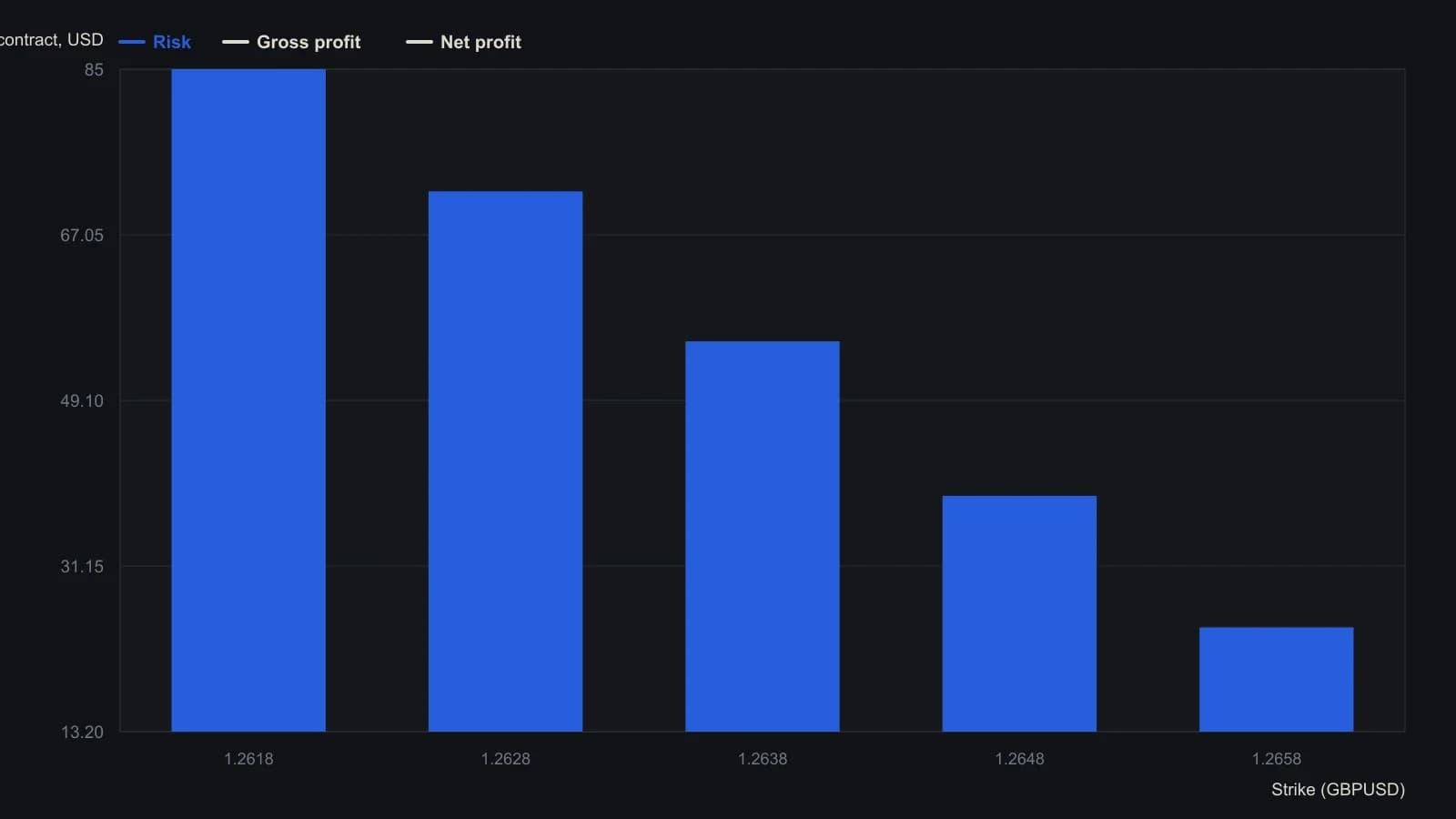
Each strike is one long contract on the 6 a.m.–8 a.m. EST expiration. Net profit subtracts a $1.80 exchange fee; combined five-contract ROI of 78 percent is not plotted.
All readings on this track · 17 readings
- 1993Implied volatility zones for straddle overlays
- 2000Option premiums, implied volatility, and multi-leg payoffs
- 2003Volatility regime sleeves for spreads, straddles, and leverage
- 2003Implied-volatility regimes, straddles, and protective puts
- 2004Constructing an options straddle from historical and implied volatility
- 2004Credit-spread exits, implied volatility, and strike grids
- 2005Two gates for option-structure selection: regime, checklist, then strike geometry
- 2008Unused days in a short-hold straddle are still priced
- 2008Why a long-straddle misfits a readable sideways market
- 2011Sample variance as a context check for range and straddle ideas
- 2013Straddle construction across index dilution and volatility rank
- 2015Implied volatility, straddles, and premium-weighted put-call regime context
- 2016Isolating implied volatility with a delta-neutral option-income book
- 2017Stochastic divergence as a capped-payout options case
- 2017Implied versus realized volatility in a straddle case study
- 2018Why option risk curves fail to deliver theta
- 2019Long-dated call ratio backspread under compressed implied volatility