2016issue C0214-19
Isolating implied volatility with a delta-neutral option-income book
This historical case treats delta neutralization as the control on an option-income book. After signed deltas are brought to zero, the residual hypothesis is an implied-volatility reset, the short-premium structure has a short-straddle equivalent, and listed move-size, margin, and account constraints mark when the test is invalid.
- A book is treated as delta-neutral when the signed deltas of its calls, puts, and any stock sum to zero or nearly zero, because those deltas are its directional exposure.
- Once direction is removed, the residual pricing inputs named for the hypothesis are usually implied volatility, sometimes time to expiration, and only rarely interest rates.
- A long-stock versus short-call income book is synthetically the same as selling the matching-strike straddle and selling one extra call.
- The case lists failure modes that invalidate the test: an outsized underlying move, implied volatility that does not compress or that rises on a downside shock, margin and account restrictions on uncovered short calls, and frictional costs.
When a book is treated as delta-neutral
A position is treated as delta-neutral when the signed deltas of its calls, puts, and any stock sum to zero or nearly zero, because those deltas are the directional exposure of the book. Small underlying moves then leave the mark largely unchanged.
One operational band used for retail-scale books is a net delta between -50 and +50. A market-making scale used a band inside 500 deltas.
What remains after direction is removed
After direction is removed, the remaining pricing inputs named for the residual hypothesis are usually implied volatility, sometimes time to expiration, and only rarely interest rates. Implied volatility here is the volatility input already priced into the options.
Contract delta, gamma, and a narrow-range mark
Contract delta is the per-share delta times 100 and reads as a share-equivalent position. Long stock is fixed at +100 with zero gamma. Cash has zero delta. Bought options add gamma, sold options subtract it, and stock contributes none.
If other inputs are held fixed, premium and delta after a stock move M are approximated as P_new = P_old + M times D and D_new = D_old + M times G.
In a constructed zero-delta book of long calls, short puts, and short stock, the dollar mark did not change when the underlying moved from 55 to 55.50 or to 54. The archive used that path to illustrate insurance over a narrow price range.
One zero-delta ratio, three gamma profiles
A two-contract ratio of 12 puts to 5 calls, from deltas 60 and -25, can be assembled long-long, short-short, or mixed with stock. Each package is delta-neutral but shows a different gamma. The worked lines give gamma of 88, -88, and 72.
The earnings implied-volatility case
In the earnings case, implied volatility that normally sat between 35 percent and 55 percent was observed at 60 percent and projected to 50 percent. A long 100-share position versus three short calls, each with delta 33.3, was sized to net-zero delta.
The one-day mark-to-market table after that projected implied-volatility drop mapped a positive value from a 10 percent decline through a 15 percent rise, with breakevens near those bounds.
Synthetic equivalence to a short straddle
The stock-versus-short-calls income book is synthetically the same as selling the matching-strike straddle and selling one extra call. That options-only package was presented as the synthetic of long stock versus short out-of-the-money calls, with the same residual exposure.
Constraints that invalidate the test
Failure modes listed for the case include an outsized underlying move, implied volatility that does not compress or that rises on a downside shock, margin and account restrictions on uncovered short calls, and frictional costs.
One-day P/L of the delta-neutral short-call book after the IV reset
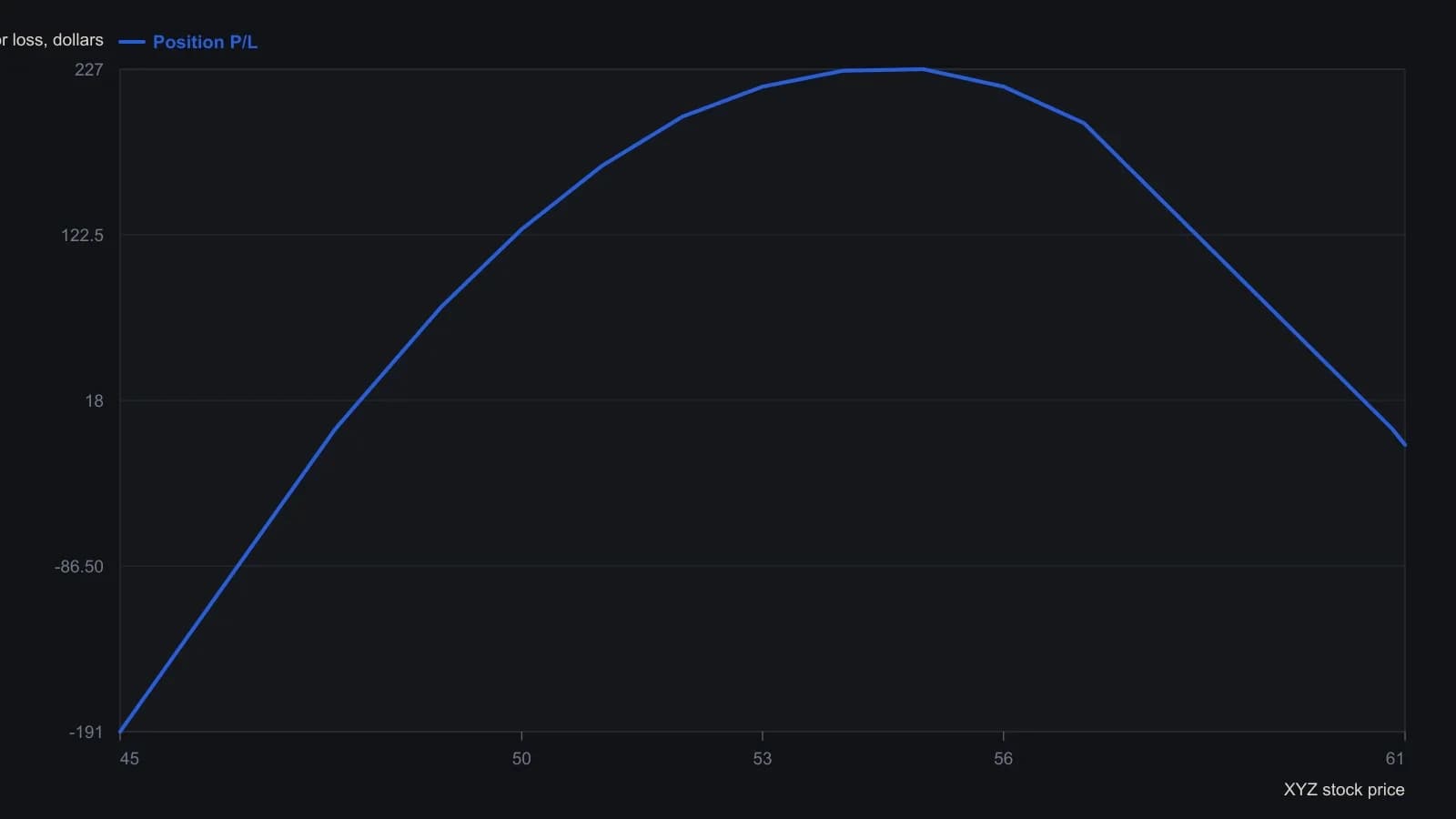
The table holds implied volatility at the predicted 50 percent one day after earnings. Two of the three short calls are naked, so margin and account type can invalidate the trade even when this P/L path holds.
All readings on this track · 17 readings
- 1993Implied volatility zones for straddle overlays
- 2000Option premiums, implied volatility, and multi-leg payoffs
- 2003Volatility regime sleeves for spreads, straddles, and leverage
- 2003Implied-volatility regimes, straddles, and protective puts
- 2004Constructing an options straddle from historical and implied volatility
- 2004Credit-spread exits, implied volatility, and strike grids
- 2005Two gates for option-structure selection: regime, checklist, then strike geometry
- 2008Unused days in a short-hold straddle are still priced
- 2008Why a long-straddle misfits a readable sideways market
- 2011Sample variance as a context check for range and straddle ideas
- 2013Straddle construction across index dilution and volatility rank
- 2015Implied volatility, straddles, and premium-weighted put-call regime context
- 2016Isolating implied volatility with a delta-neutral option-income book
- 2017Stochastic divergence as a capped-payout options case
- 2017Implied versus realized volatility in a straddle case study
- 2018Why option risk curves fail to deliver theta
- 2019Long-dated call ratio backspread under compressed implied volatility