1996issue C121-4
Constructing a two-bar clearance breakout from a twenty-session exponential average
Editorial aim: teach a complete breakout procedure by treating a twenty-session exponential average as a location baseline only, then writing a two-bar clearance alert, an offset stop entry, and a baseline trailing exit as one joint, testable rule set rather than acting on every average cross.
- Use the twenty-session exponential average as a roughly one-month trend-location baseline, not as a reason to buy or sell on every cross.
- Arm a buy alert or sell alert only after two-bar clearance, when the last two session extremes stay entirely on one side of that baseline.
- Place an offset stop entry beyond the two-bar extreme, then use a baseline trailing exit at the same average after a fill.
- Keep the joint entry, exit, and abstention rules testable in each market, and prefer fewer contracts because the protective stop is relatively wide.
The twenty-session average as a location baseline
A twenty-session exponential average is used as a trend-location baseline because it spans roughly one month of trading and weights recent prices more than a simple average. Editorial note: treat that line as a location reference only, not as a buy or sell trigger by itself.
Why a breakout filter is added
Sideways intervals often produce repeated penetrations of that baseline and multiple false reversal signals. When a full-range clearance has not occurred, price tends to return toward the twenty-session exponential average. Those conditions are the construction reason for adding a breakout filter instead of acting on every cross.
The filter is justified by the stated observation that markets trend only about 30 percent of the time. An unfiltered buy-above and sell-below rule is therefore expected to generate short-term whipsaws.
April 1980 gold against its 20-day exponential average
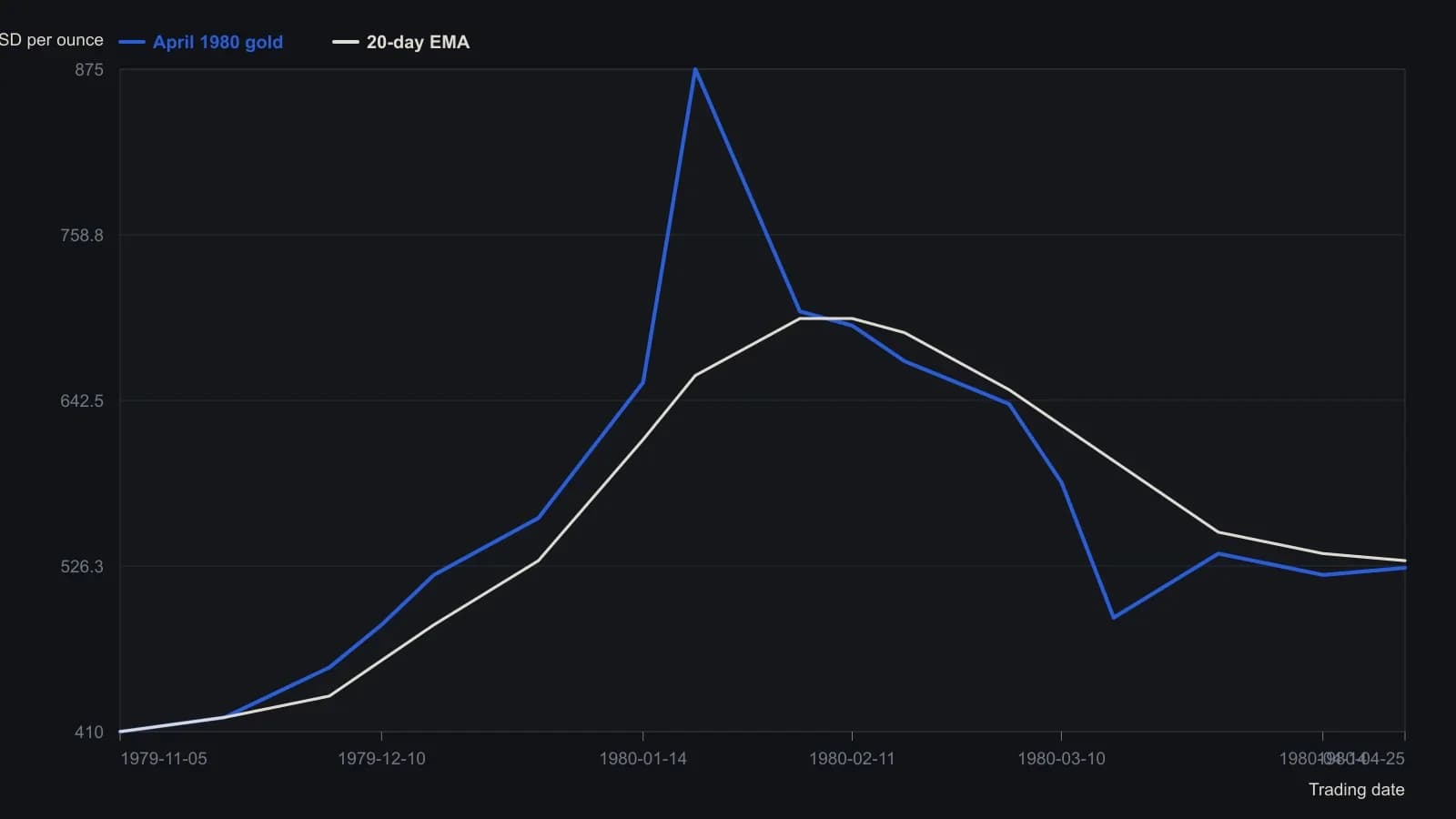
The source pane uses a 50-dollar grid; readings are rounded to 5 dollars. The 21 January gold point is the high of the blow-off bar, not a settlement.
Two-bar clearance and alerts
A true directional breakout is defined only after the entire session range has cleared the twenty-session exponential average. The construction waits for at least two such sessions before arming an alert. In that two-bar clearance, the last two session extremes stay entirely on one side of the exponential baseline.
A buy alert requires that today's low and yesterday's low both stay above the twenty-session exponential average. The buy alert remains valid until a later low touches or falls through that average.
A sell alert requires that today's high and yesterday's high both stay below the twenty-session exponential average. The sell alert remains valid until a later high touches or rises through that average.
Offset stop entry
Entry is not taken at the alert. A buy uses an open stop 10 ticks above the two-bar high. A sell uses an open stop 10 ticks below the two-bar low. Each of those offset stop entries is kept only while the matching alert remains valid, so a fill occurs only if price continues in the breakout direction.
Baseline trailing exit
After a fill, the exit is a stop placed at the twenty-session exponential average and updated each session. That baseline trailing exit treats a return to the line as a possible reversal and as the farthest acceptable protective level.
Fewer contracts and separate market tests
Because the protective stop sits at a relatively wide baseline, the construction prefers fewer contracts per signal rather than maximizing leverage. The same entry, exit, and abstention rules are not to be applied blindly across contracts. Each market is described as having its own nuances and requires its own test.
All readings on this track · 23 readings
- 1995Range breakout rules with an expansion filter and moving-average exits
- 1995Write a weekly breakout as one parameterized entry and exit
- 1995Combining a trend rule, a breakout trigger, and a seasonal filter
- 1996Constructing a two-bar clearance breakout from a twenty-session exponential average
- 1996Two-bar exponential-average breakout as setup, stop, and flatten
- 1998A noise-offset breakout judged after walk-forward re-estimation
- 1998Gating a weekly average crossover with stored support and resistance
- 1998Moving-average candidates gated by support and resistance
- 2000Constructing next-close envelope targets for breakout stops
- 2001February soybean high breakout and June trailing stop
- 2005Box-and-breakout states written as ordered entry and exit rules
- 2007Match trend and breakout rules to the market condition
- 2010How a JM internal band becomes long and short entry and exit rules
- 2013Constructing a three-average trend-aligned breakout system
- 2016Volume-confirmed breakout entry rules
- 2017How to construct exponential standard deviation bands
- 2017Four-day green candle breakout as one swing procedure
- 2018Constructing inverse ETF breakouts above a 200-day average
- 2018Evaluating trend, breakout, and regression rules by average robustness
- 2019A crypto pair breakout after a sideways range
- 2019Next-session breakout rules after a high-volume close
- 2020Altcoin dual-stop breakout with a timed exit
- 2020Critiquing required stops in mechanical breakout systems