2001issue C031-2
February soybean high breakout and June trailing stop
A long-only soybean procedure allows a fifty-day high breakout only in February, can withhold the trade after a prior-year major high, and shortens a trailing stop after June 1.
- The soybean procedure is long-only and may enter only in February, when a fifty-day high breakout is allowed inside that seasonal permission window.
- A prior-year major high veto can withhold the February long even when the fifty-day high breakout appears.
- The time-stepped trailing stop starts at the fifty-day low and, after June 1, follows a ten-day low as information-date tightening.
- The long condition does not trigger in every year, and an out-of-the-money call overlay is described as one alternative when the buy condition appears.
A February-only long procedure
The soybean procedure is specified as long-only and may enter only in February. February is the seasonal permission window: a calendar interval during which an otherwise identical price event is allowed to generate a signal.
Entry requires a fifty-day high breakout in February. That long trigger fires only when price makes a new high versus the prior fifty daily highs. The February long is withheld if the prior year already posted a major high. The prior-year major high veto therefore blocks the trade even when the breakout appears.
The protective stop is a time-stepped trailing stop. It starts at the fifty-day low and, after June 1, follows a ten-day low.
The rule set was examined on a continuous contract series of soybean prices. The long condition does not trigger in every year.
Cumulative profit of the February soybean 50-day high breakout
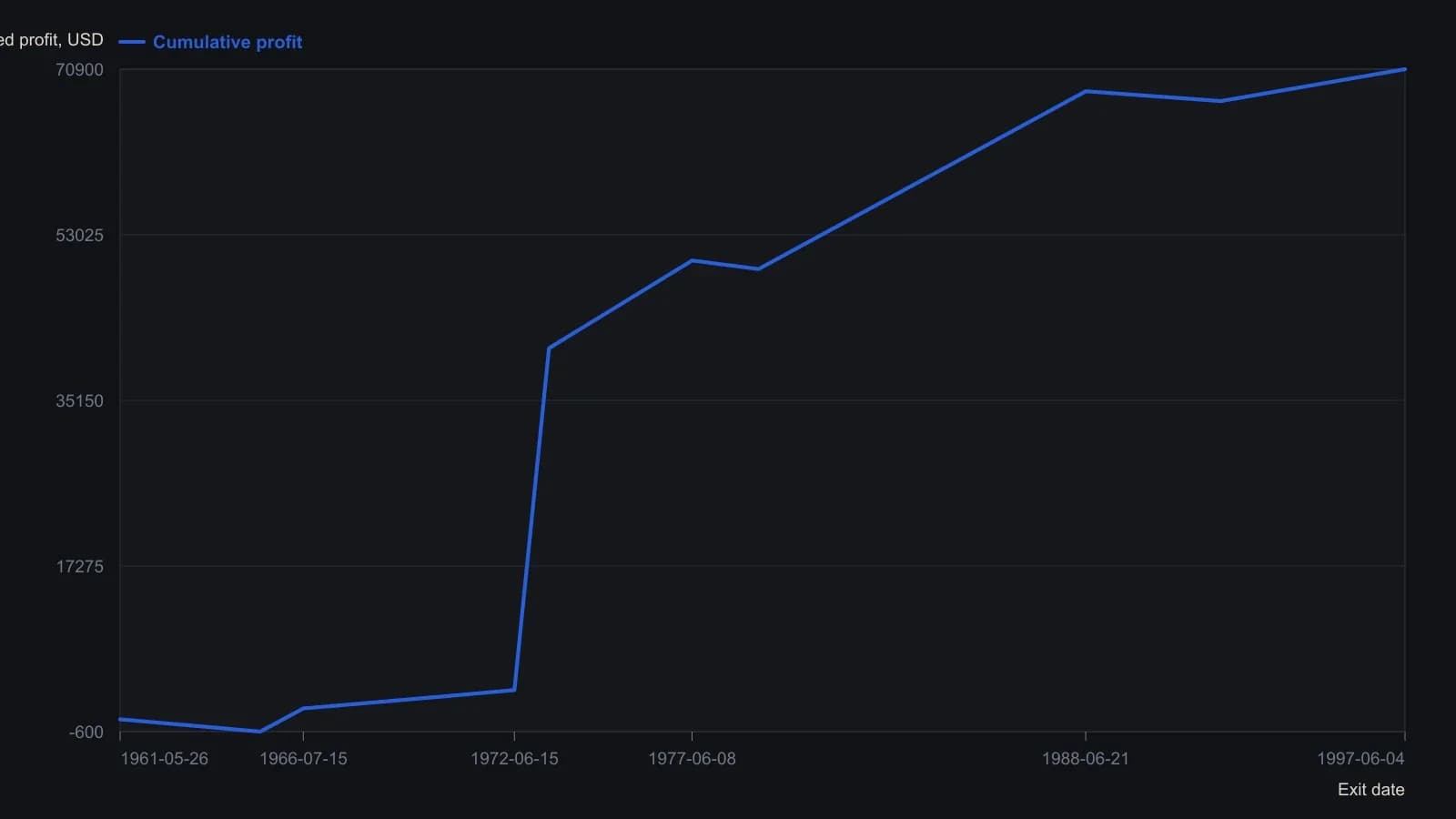
Continuous soybean futures, one contract, no commission. Longs only: buy a 50-day high in February unless the prior year made a major high; initial stop is the 50-day low, tightened to a 10-day low after June 1. Cumulative profit is the closed-trade running total reported in the list.
Seasonal path and the June tightening
A typical November-contract seasonal path advances into spring and then declines more sharply in summer. February strength is treated as an early price summary of crop-stress and demand conditions that are widely known by June, which is why the stop is tightened after June 1.
That later change is information-date tightening: stop distance is shortened once crop and demand news are treated as widely known rather than early and private.
A listed alternative to the futures signal
When the buy condition appears, one alternative to following the futures signal is an out-of-the-money call overlay. That overlay buys a call struck above the market instead of holding only the futures signal. Those calls are described as usually cheaper in winter.
All readings on this track · 23 readings
- 1995Range breakout rules with an expansion filter and moving-average exits
- 1995Write a weekly breakout as one parameterized entry and exit
- 1995Combining a trend rule, a breakout trigger, and a seasonal filter
- 1996Constructing a two-bar clearance breakout from a twenty-session exponential average
- 1996Two-bar exponential-average breakout as setup, stop, and flatten
- 1998A noise-offset breakout judged after walk-forward re-estimation
- 1998Gating a weekly average crossover with stored support and resistance
- 1998Moving-average candidates gated by support and resistance
- 2000Constructing next-close envelope targets for breakout stops
- 2001February soybean high breakout and June trailing stop
- 2005Box-and-breakout states written as ordered entry and exit rules
- 2007Match trend and breakout rules to the market condition
- 2010How a JM internal band becomes long and short entry and exit rules
- 2013Constructing a three-average trend-aligned breakout system
- 2016Volume-confirmed breakout entry rules
- 2017How to construct exponential standard deviation bands
- 2017Four-day green candle breakout as one swing procedure
- 2018Constructing inverse ETF breakouts above a 200-day average
- 2018Evaluating trend, breakout, and regression rules by average robustness
- 2019A crypto pair breakout after a sideways range
- 2019Next-session breakout rules after a high-volume close
- 2020Altcoin dual-stop breakout with a timed exit
- 2020Critiquing required stops in mechanical breakout systems