2017issue C107
Four-day green candle breakout as one swing procedure
This archive case study specifies a swing-trading breakout-system in which a four-day-green-run must appear before an offset-buy-stop, a fixed-dollar-trail, and any later-run-add are allowed. TradersWeek editorial reading: continuation is taught as one testable entry-exit-abstention procedure, not as a chart impression.
- The price-band-uptrend-scan limits the field to shares priced between 20 and 70 dollars that already show an uptrend on a daily candlestick chart covering about 90 sessions.
- A four-day-green-run of at least four consecutive bullish daily candles is the momentum-strength filter that must be present before the offset-buy-stop is placed.
- Every swing position uses a fixed-dollar-trail: a 2-dollar initial stop that is then trailed.
- A later-run-add is permitted only after another four-day bullish-candle streak appears on an already open winner.
What the archive specifies
The archive describes one swing-trading breakout procedure. A breakout-system here is a rule set that turns a scanned market state into a buy-stop, a hold-or-exit decision, and an optional add, all as one procedure.
Candlestick-patterns supply the setup condition: daily open-high-low-close structure, especially a streak of consecutive bullish candles. A trailing-stop is a protective exit distance that is set before entry and then moved with an open swing position.
Entry, the protective trail, and any later add are specified together as one swing-trading breakout procedure.
How names are screened
The price-band-uptrend-scan is a visual screen of about 90 daily sessions. It keeps only names that are already rising and priced between 20 and 70 dollars a share.
The scan is limited to that price band and to an uptrend already visible on the daily candlestick chart. Names outside that screen are not part of the procedure.
The four-day green run as a gate
A setup is defined as a four-day-green-run: a streak of at least four consecutive bullish daily candles on that chart.
The four-day candle streak is used as a momentum-strength filter. It must be present before the breakout stop is placed. If the streak is absent, the offset-buy-stop is not armed.
Weight Watchers daily closes, April–July 2017
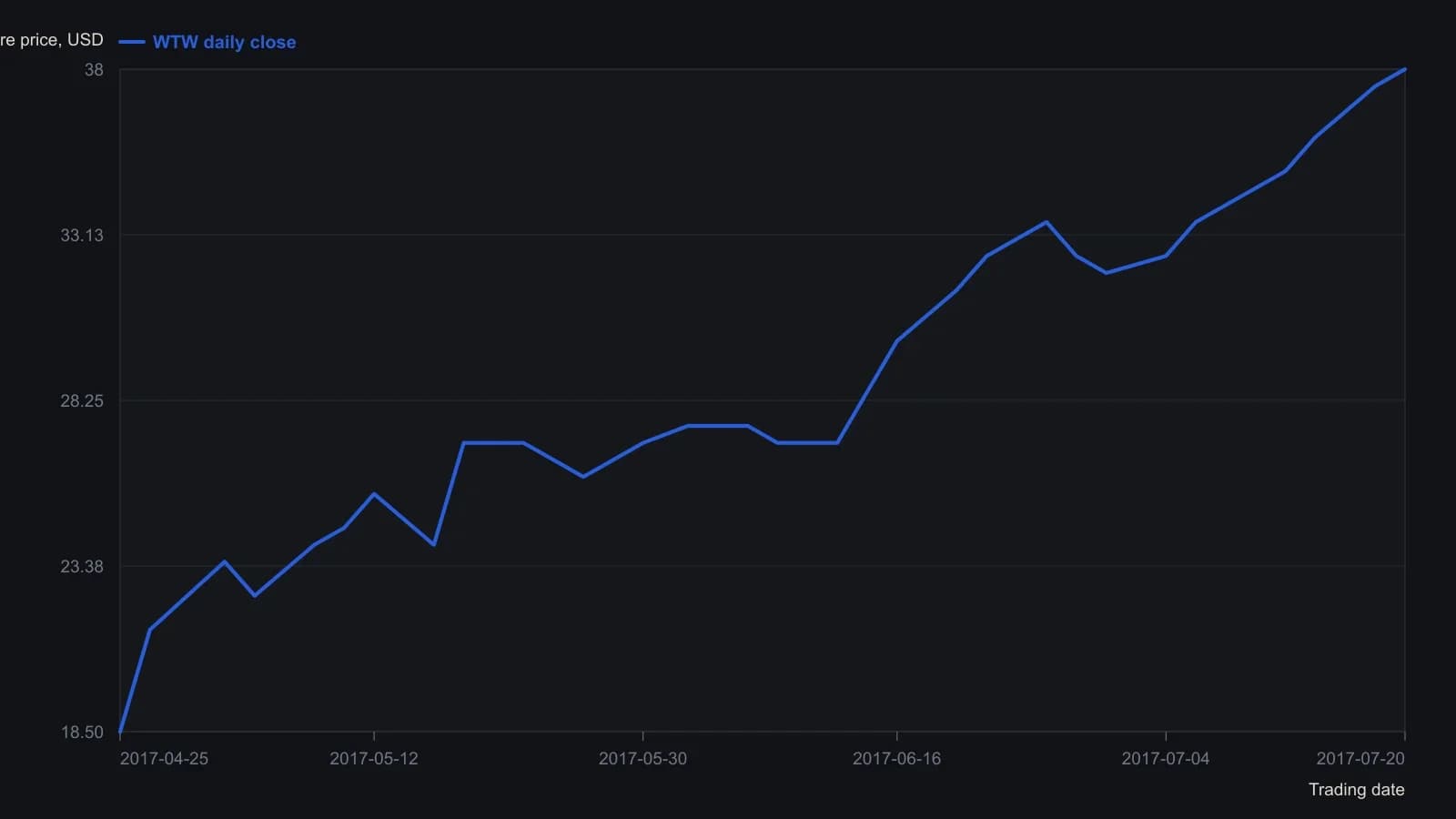
Closes are approximate to the nearest half-dollar because they were read from the candlestick raster against the printed dollar scale. The figure marks four-day green runs around mid-May, mid-June, and mid-July.
The offset buy-stop
Entry is specified as an offset-buy-stop: a resting buy placed 0.50 dollars above the highest high inside the qualifying candle streak.
The buy-stop is priced from the candles in that streak. The four-day-green-run is required before that order is armed.
The fixed-dollar trail
Every swing position in the procedure uses a fixed-dollar-trail. That is a 2-dollar initial stop that is then trailed.
The trailing-stop is set before entry and then moved with the open swing position. The same trail rule applies to each swing in the procedure.
When a later add is allowed
Additional size is allowed only as a later-run-add. That increase is permitted only after a later streak of four consecutive bullish daily candles appears on an already open winner.
No add is specified unless that later four-day-green-run appears on a position that is already open and ahead.
One entry, exit, and abstention procedure
The archive writes the scan, the four-day-green-run, the offset-buy-stop, the fixed-dollar-trail, and the later-run-add as a single breakout-system.
TradersWeek editorial reading: the same gate that arms the first offset-buy-stop also governs whether size may increase later. Names that fail the price-band-uptrend-scan or the four-day-green-run stay outside the procedure.
All readings on this track · 23 readings
- 1995Range breakout rules with an expansion filter and moving-average exits
- 1995Write a weekly breakout as one parameterized entry and exit
- 1995Combining a trend rule, a breakout trigger, and a seasonal filter
- 1996Constructing a two-bar clearance breakout from a twenty-session exponential average
- 1996Two-bar exponential-average breakout as setup, stop, and flatten
- 1998A noise-offset breakout judged after walk-forward re-estimation
- 1998Gating a weekly average crossover with stored support and resistance
- 1998Moving-average candidates gated by support and resistance
- 2000Constructing next-close envelope targets for breakout stops
- 2001February soybean high breakout and June trailing stop
- 2005Box-and-breakout states written as ordered entry and exit rules
- 2007Match trend and breakout rules to the market condition
- 2010How a JM internal band becomes long and short entry and exit rules
- 2013Constructing a three-average trend-aligned breakout system
- 2016Volume-confirmed breakout entry rules
- 2017How to construct exponential standard deviation bands
- 2017Four-day green candle breakout as one swing procedure
- 2018Constructing inverse ETF breakouts above a 200-day average
- 2018Evaluating trend, breakout, and regression rules by average robustness
- 2019A crypto pair breakout after a sideways range
- 2019Next-session breakout rules after a high-volume close
- 2020Altcoin dual-stop breakout with a timed exit
- 2020Critiquing required stops in mechanical breakout systems