1998issue C091-6
Gating a weekly average crossover with stored support and resistance
A one-parameter weekly close-versus-simple-moving-average rule can stay objective and backtestable when the lookback period is its only fitted input. A second, structure-based confirmation gate then decides whether that moving-average-crossover is a trade or an abstention.
- A moving-average-crossover is a weekly close crossing a simple moving average as the first, unambiguous trend signal, with the lookback period as its only fitted input.
- Support-resistance is the nearest prior swing high or low used to confirm or withhold that average-based signal.
- SMARS is a two-parameter weekly mutual-fund procedure: a breakout-system that commits only after a confirmed close through the average or through the stored support or resistance level, unless the confirmation factor already allows the crossover.
- On 1993-1997 weekly data for one emerging-markets fund, adding support-resistance confirmation cut trades per year by about half in the 10- to 14-week lookback band and matched or slightly exceeded the plain-average return except at very short lookbacks and confirmation factors above 1.08.
A one-parameter weekly signal
A one-parameter weekly close-versus-simple-moving-average rule is presented as objective and backtestable, with the lookback period as its only fitted input. A moving-average-crossover is a weekly close crossing a simple moving average as the first, unambiguous trend signal.
The weekly close is the Friday net asset value used as the only price trigger, with execution at the following Monday close. A weekly Friday close is used as the trigger so daily noise is filtered, with the next Monday closing net asset value as the execution price.
Intermediate swings and the lookback period
Intermediate stock-market swings are described as typical 10-30% peak-to-trough or trough-to-peak moves lasting about two to six months. The suggested lookback period for those intermediate swings is about half the swing duration, placing the working window in the four- to 13-week range.
Lengthening the average from 10 to 20 weeks removed four of six illustrated whipsaws but delayed 1995 entries and exits relative to the shorter average. A whipsaw is a short, costly sequence of opposing average-crossover signals inside a range.
How support and resistance are stored
Support-resistance is the nearest prior swing high or low used to confirm or withhold that average-based signal. SMARS is a two-parameter weekly mutual-fund procedure pairing a simple moving average with stored support and resistance.
The combined rules store resistance as the maximum weekly high since the last support event when a buy is still in force and price is below the average at the cross, and store support as the minimum weekly low since the last resistance event when a sell is still in force and price is above the average at the cross.
When the combined rules commit
The confirmation factor is the minimum ratio between the average and the stored support or resistance that allows an immediate crossover trade. A buy fires if weekly close exceeds stored resistance, or at the average cross if close is above the average and resistance divided by the average is at least the confirmation factor. A sell is the symmetric case using support.
A breakout-system is the combined procedure that only commits after a confirmed close through the average or through the stored support or resistance level.
A historical comparison
On 1993-1997 weekly data for one emerging-markets fund, with no transaction fees and a 5% money-market parking yield, the plain average (confirmation factor of 1) was relatively insensitive to lookback and beat a 7.7% buy-and-hold return, averaging about five trades a year near a 10- or 11-week lookback.
Over the same test, adding support-resistance confirmation cut trades per year by about half in the 10- to 14-week lookback band and matched or slightly exceeded the plain-average return except at very short lookbacks and confirmation factors above 1.08.
The same comparison found the unaided average needed a 19-week lookback to cut trades by half, while a two-average crossover with a two-week short average only reduced trades from five to four per year.
MNEMX average annual return versus weekly lookback, 1993–1997
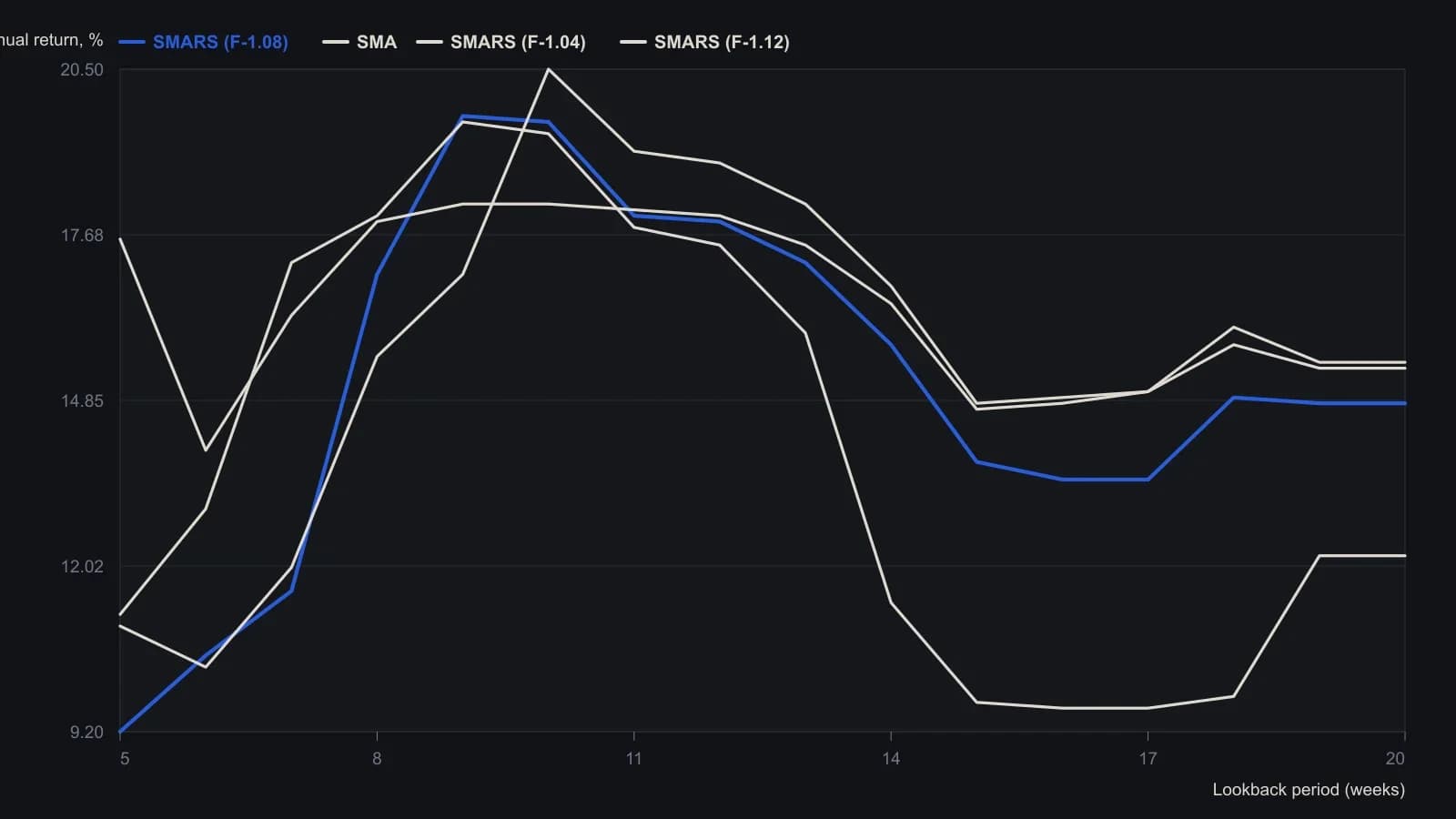
Digitized from the plotted curves; y-values are approximate to about half a percentage point. The source back-test assumes no transaction fees and parks idle cash in a money-market fund yielding 5%. F is one plus the fractional band that forces a wait for a stored support or resistance break.
All readings on this track · 23 readings
- 1995Range breakout rules with an expansion filter and moving-average exits
- 1995Write a weekly breakout as one parameterized entry and exit
- 1995Combining a trend rule, a breakout trigger, and a seasonal filter
- 1996Constructing a two-bar clearance breakout from a twenty-session exponential average
- 1996Two-bar exponential-average breakout as setup, stop, and flatten
- 1998A noise-offset breakout judged after walk-forward re-estimation
- 1998Gating a weekly average crossover with stored support and resistance
- 1998Moving-average candidates gated by support and resistance
- 2000Constructing next-close envelope targets for breakout stops
- 2001February soybean high breakout and June trailing stop
- 2005Box-and-breakout states written as ordered entry and exit rules
- 2007Match trend and breakout rules to the market condition
- 2010How a JM internal band becomes long and short entry and exit rules
- 2013Constructing a three-average trend-aligned breakout system
- 2016Volume-confirmed breakout entry rules
- 2017How to construct exponential standard deviation bands
- 2017Four-day green candle breakout as one swing procedure
- 2018Constructing inverse ETF breakouts above a 200-day average
- 2018Evaluating trend, breakout, and regression rules by average robustness
- 2019A crypto pair breakout after a sideways range
- 2019Next-session breakout rules after a high-volume close
- 2020Altcoin dual-stop breakout with a timed exit
- 2020Critiquing required stops in mechanical breakout systems