2000issue C061-5
Budget the loss before entry with stops and position limits
The archive workflow sets the stop-loss, the share count, and a position-concentration-limit before entry so a stop-out stays near a planned fraction of capital. Later stop raises can lock open profit, and single-idea exposure is capped so a losing stretch still leaves enough equity to continue.
- No trading idea is treated as certain enough to put all account capital at risk on that one idea.
- Share count is set from account size, a chosen risk fraction, and the dollar distance from entry to the stop-loss so a stop-out stays near a planned percentage of capital.
- A stop-loss is a planned exit, not a guaranteed fill, and it can later be raised under consolidation lows to lock open profit.
- A position-concentration-limit keeps enough equity after a large drop in a few holdings for trading to continue.
Budget the loss first
The archive workflow does not treat any trading idea as certain enough to justify putting all account capital at risk on that one idea. A stop-loss, the share count, and a position-concentration-limit are set before the position is opened.
A stop-loss is a pre-placed exit that caps the loss if price moves against the position. The risk-reward-ratio is the planned relationship between the amount risked to the stop and the room left for an open winner. A position-concentration-limit is a ceiling on how much account equity can be exposed to any single idea.
Place the stop-loss before the entry
A stop price is a planned exit, not a guaranteed fill. A fast drop can execute below the resting stop.
Stops can be raised under later consolidation lows after a move extends, converting an initial loss limit into a lock on open profit while still leaving room for the trend.
Set share count from the stop
Share count can be set from account size, a chosen risk fraction, and the dollar distance from entry to the stop so a stop-out stays near a planned percentage of capital.
In one worked example, a 100000 account risking 2 percent with entry 20 and stop 14.875 implied a 390-share position.
Manage the stop as the trade develops
The same 1 percent capital-risk rule and a stop just under a recent range low were applied on a second long, then the stop was ratcheted higher as the advance continued.
A third long used a tight initial stop under the breakout area and was closed when the expected follow-through failed, illustrating a bounded loss rather than an open-ended hold.
A 50 percent losing-trade rate can still leave the book ahead if losses stay small and winners are allowed to run. Equal-dollar holds of the same names produced a 3.62 percent result with much larger open risk than the risk-capped, stop-managed versions of those trades.
Startek (SRT) daily price from the $13 base to the $69 spike
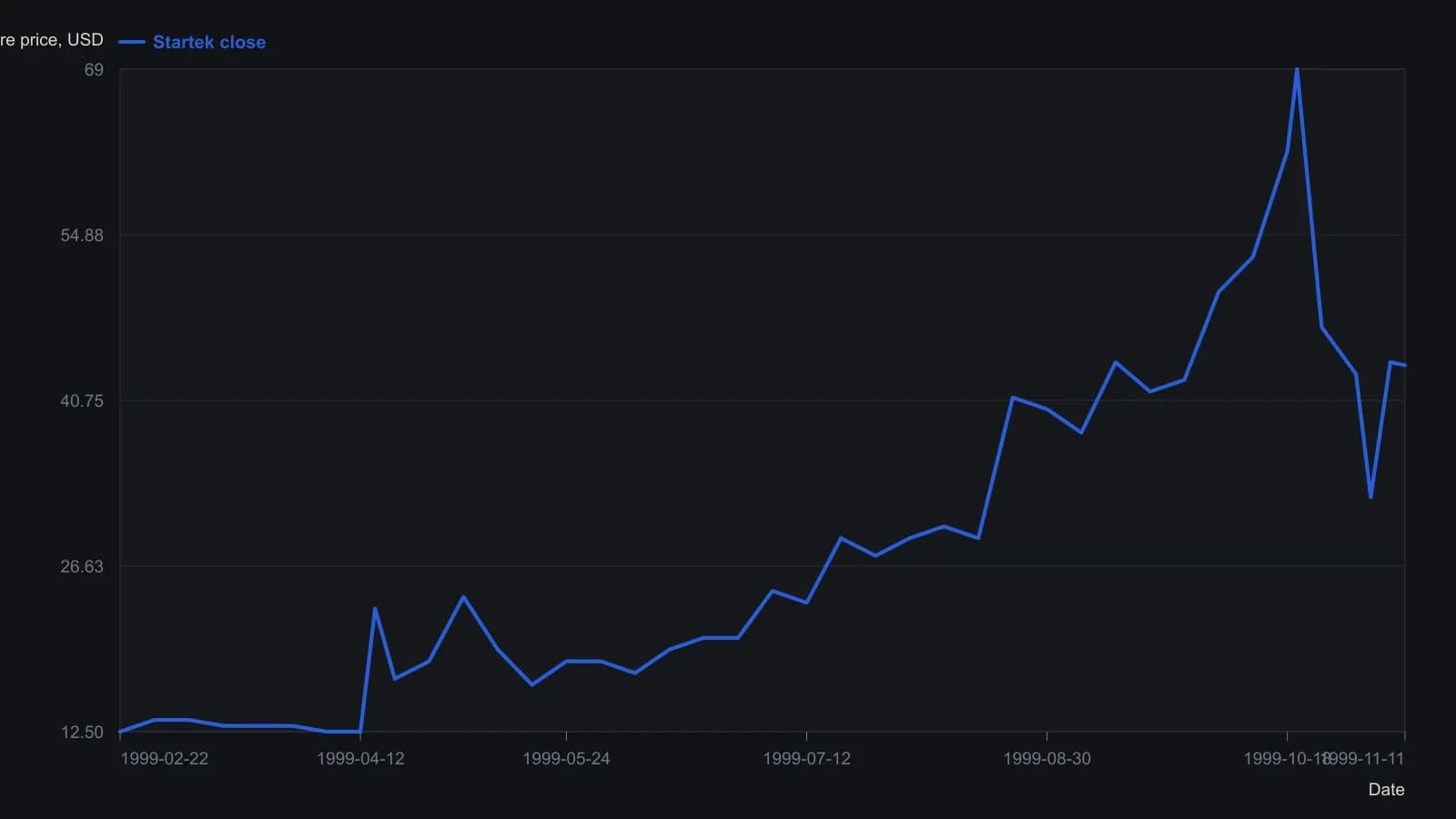
Sampled at the weekly date grid on the daily OHLC plot, with extra points only where the raster and the article both mark a swing: the mid-April $23 thrust, the $69 October high, and the early-November flush toward $32.50. Other prints are approximate to the nearest half-dollar. Intraweek highs and lows between samples are not shown.
Keep single-idea exposure limited
A 30 to 50 percent drop in a few concentrated holdings can shrink capital enough to force a trader out, so position size after each loss must leave enough equity to continue. The position-concentration-limit is the ceiling that keeps any one idea from taking that much of the book.
All readings on this track · 15 readings
- 1991Keep one risk ceiling after equity highs
- 1999Pre-trade size filters for expectancy and ruin
- 2000Budget the loss before entry with stops and position limits
- 2002Retest the entry before you exit
- 2002Option income after volatility and capital gates
- 2002Cap, scale, and delever when research buys late
- 2003Staying power starts as a planned-loser sizing rule
- 2006Leverage caps and concentration limits
- 2007A first-trade survival sequence for leveraged futures
- 2010Bound trend risk before the trade is placed
- 2011Event shocks, size caps, and second-order reweights
- 2014A copied scale-in ladder is not a personal risk plan
- 2018Worst-day caps for clustered system books
- 2019Pair-spread layer limits and event shocks
- 2020Pretrade quantity filters that bound account risk