2008issue C041-4
Speculative leaders and regime context for ten-bagger setups
Neither a fundamental screen nor a technical confirmation regimen identified ten-bagger launches without missing the start or giving back a large share of the later move. The archive classified each name as a leader, tracker, or laggard, looked for public strategic-clues, and used later sales, margins, and profit as a fundamental-overlay.
- Neither a purely fundamental screen nor a purely technical confirmation regimen identified ten-bagger launches without missing the start or giving back a large share of the subsequent move.
- Ten-bagger price advances often began six to twelve months before a visible change in company fundamentals, which the archive treats as speculative positioning rather than confirmed value.
- Most ten-baggers in the study began as leaders, with price running ahead of value, and later became trackers once post-launch growth caught up.
- Investing, trading, and speculation each failed as a standalone predictor, so the archive proposed combining elements of all three into one selection framework.
Neither screen nor confirmation was enough
A ten-bagger is a stock that eventually multiplies many times in price after an early speculative launch. The archive found that neither a purely fundamental screen nor a purely technical confirmation regimen identified those launches without missing the start or giving back a large share of the subsequent move.
Ten-bagger price advances often began six to twelve months before a visible change in company fundamentals. The archive treats that gap as speculative positioning rather than confirmed value.
Stock-types and speculator-types
The archive compares price to company value over time with three stock-types: leader, tracker, and laggard. Most ten-baggers in the study began as leaders, with price running ahead of value, and later became trackers once post-launch growth caught up. They were growth episodes rather than value-laggard catch-ups.
Early price moves are read through three speculator-types. Extrapolators project historical events. Visionaries bet on unproven innovation. Gamblers play sequence and odds without a systematic method.
Strategic-clues before confirmation
Strategic-clues are public company actions or environmental events reported before a price launch and later reflected in fundamentals. Examples include patents, new markets, product launches, or demand shocks. Unreported or unconfirmed signals are treated as insider information or mere tips.
A market-regime is a weeks-to-months context that places one trade among cross-market conditions, volatility, and portfolio weights. A later fundamental-overlay uses sales, margins, and profit confirmation to interpret an earlier speculative regime.
The Force Protection case
In the Force Protection case, sales were already growing before the large advance, but gross margins were negative in 2004 and only barely positive in 2005. Annual net profit arrived in February 2007 after the stock had already reached ten-bag status.
A purchase at the end of 2005, before year-end financials were released, sat in front of an 18-month twenty-bag move. Profitability was still the unresolved question at the time of that purchase.
A combined selection framework
The archive concludes that investing, trading, and speculation each fail as a standalone predictor. It proposes combining elements of all three into one selection framework.
Force Protection (FRPT) monthly stock price
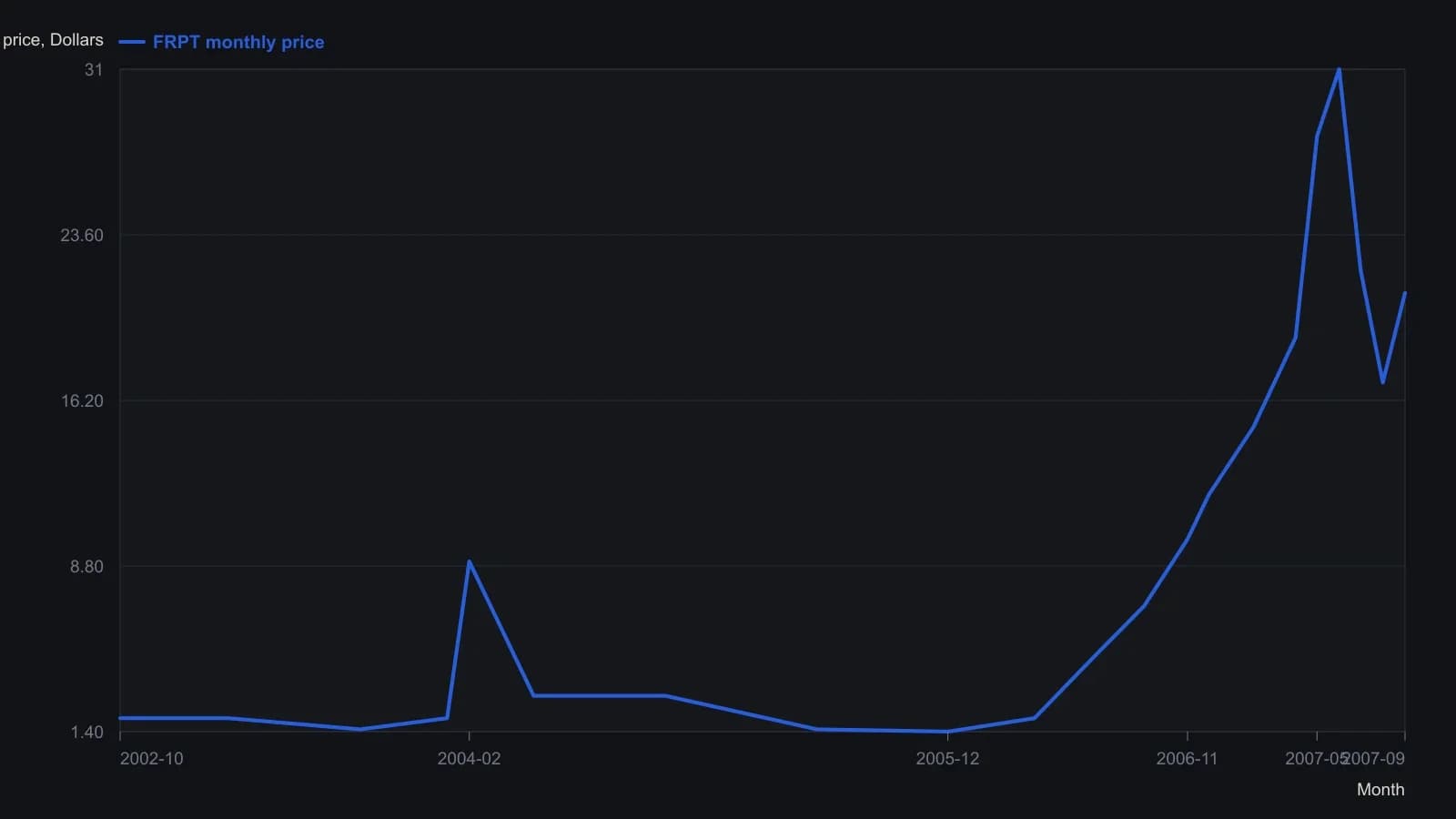
Closes are approximate raster readings. Pre-2006 bars sit in a tight band under five dollars, so those points are coarse except the early-2004 spike; the 2006–07 climb is readable against the five-dollar grid. The six-month average and volume panes were not digitized.
All readings on this track · 23 readings
- 1990The discount-rate path as an equity regime overlay
- 1991Evaluating successive policy hikes as equity regime warnings
- 2002Easing season meets commodity-bond reflation
- 2002Precious metals as portfolio insurance in uncertain regimes
- 2003Housing leverage after an equity crash
- 2003US rebound, capital-flow funding, and dollar translation
- 2003A three-path tape for recovery, inflation, or deflation
- 2006Disaster shocks, energy bottlenecks, and intermarket spillover
- 2008Speculative leaders and regime context for ten-bagger setups
- 2008A presidential transition as a dollar regime-timestamp
- 2009Check the regime before you hunt a setup
- 2009Withhold an equity regime label until credit-linked ratios agree
- 2010Energy futures, the dollar, inventory, and scenario risk
- 2011Official floors, sidelines, and scale-in after a telegraphed FX intervention
- 2014Scheduled prints as sector pair filters
- 2016Place a yuan devaluation inside peg, contract, and funding context
- 2017Quiet tape, seasonal soft edges, and event risks
- 2017A search-theme mood compass for regime-aware trade context
- 2018Bound headline trades with if-then paths
- 2019Election windows as testable regime filters
- 2020Climate capital rotation as a regime, then an event test
- 2020New listings as regime-aware portfolio events
- 2020One pre-trade checklist for event phase, pairs, and pattern outcomes