2008issue C101-2
A presidential transition as a dollar regime-timestamp
The archive treated each new US presidency as a possible turning point in the dollar path. This editorial case asks whether intermarket-dollar-context, the election-year-extreme-window, and a geopolitical-overlay agree before that single currency view sits in a broader book.
- A presidential transition is used here as a regime-timestamp on the dollar, not as a way to pick a winner.
- The compiled sample presented an alternating-administration-path, with start-to-end dollar-index changes flipping sign from one term to the next.
- Domestic economic policy and foreign military policy were listed as the main channels from a White House change to the dollar.
- Editorial filter: check intermarket-dollar-context, the election-year-extreme-window, and a geopolitical-overlay before placing the currency view in a broader book.
A calendar stamp, not a candidate call
This case study treats a US presidential transition as a regime-timestamp. The archive used that calendar mark to flag a possible shift in the dollar prevailing trend rather than to pick a winner.
Editorial reading: the useful question is whether intermarket-dollar-context, the election-year-extreme-window, and a geopolitical-overlay agree before that single currency view is placed inside a broader book.
Alternating paths after convertibility
After the end of gold convertibility, each new US presidency in the compiled sample was presented as coinciding with a major turning point in the dollar path. A presidency-by-presidency table showed start-to-end index changes that flipped sign from one term to the next. That pattern is the alternating-administration-path.
The long-run dollar series was described as oscillating around a long-run average. Domestic economic policy and foreign military policy were listed as the main structural channels through which a White House change can affect the dollar.
US dollar index change by president after the 1970s float
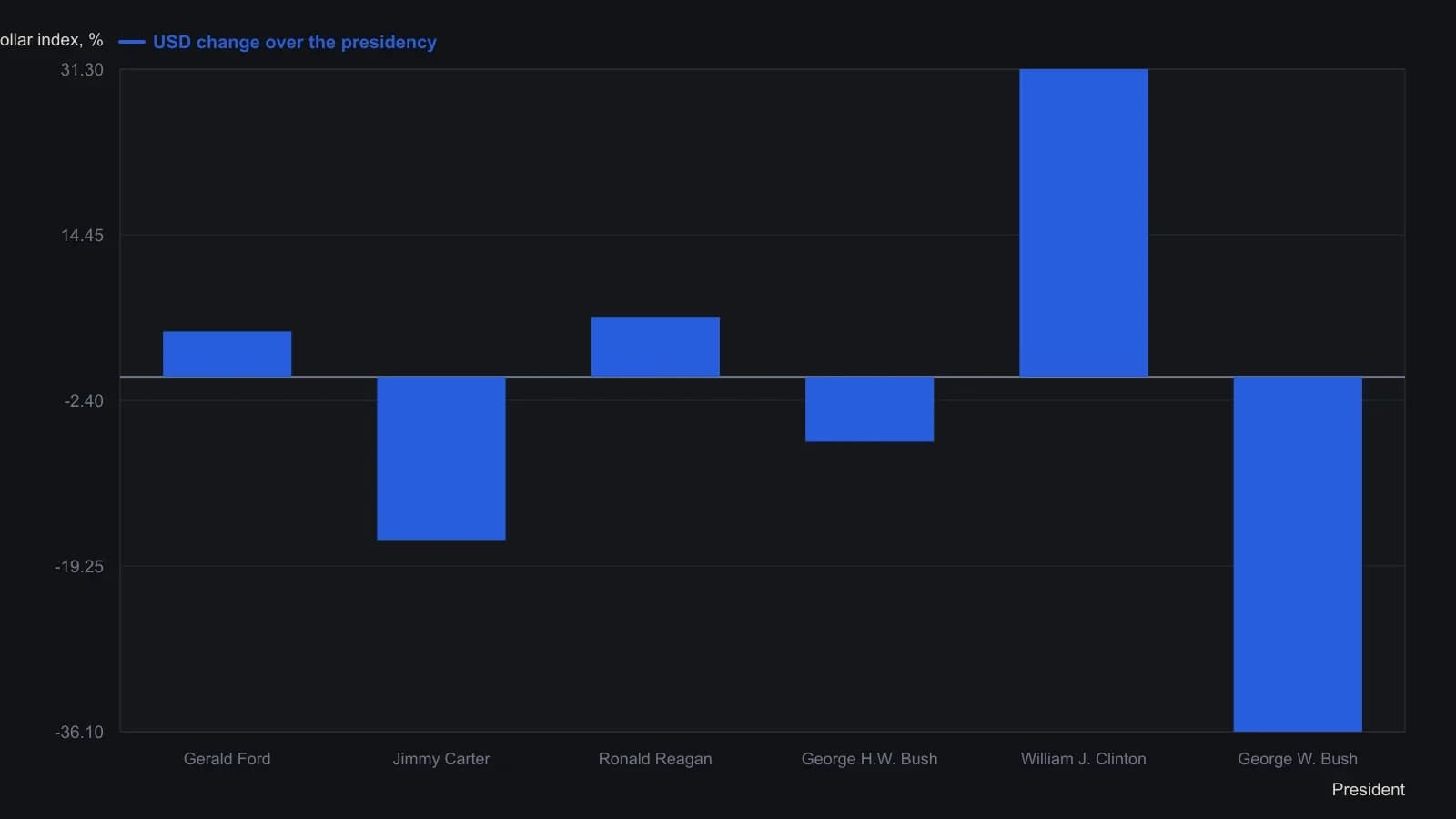
George W. Bush's -36.1% is measured to the 73.50 print in the October 2008 issue, before that presidency had ended.
The election-year window and intermarket checks
Across prior presidencies, the extreme of the then-prevailing dollar trend was described as typically arriving in the election-year-extreme-window, the late-spring to late-summer stretch of an election year.
The case mixed a fading credit-crisis impulse, market expectations of Federal Reserve rate increases before year-end, and a projected rebound in foreign-investor confidence around the vote, regardless of the winner. Those checks form intermarket-dollar-context. They sit beside the political calendar instead of replacing it.
A wartime overlay and an exit plan
A wartime overlay argued that the wars after the dollar free float each coincided with a negative impact on the currency. An expected Iraq exit plan under any incoming administration was treated as an additional event-driven overlay on that wartime dollar chart. That pairing is the geopolitical-overlay.
The overlay tests whether the political calendar looks dollar-supportive or dollar-draining. It does not replace the regime-timestamp. It asks whether the foreign-policy path lines up with the same dollar story.
One dollar view inside a broader book
Editorial close: the workflow is not to choose a candidate. It is to stamp the calendar, then ask whether intermarket-dollar-context, the election-year-extreme-window, and the geopolitical-overlay agree.
Only when those checks line up does the single currency view belong in a diversified, regime-aware book. That last step is editorial framing of the archive workflow, not a claim about present-day markets.
All readings on this track · 23 readings
- 1990The discount-rate path as an equity regime overlay
- 1991Evaluating successive policy hikes as equity regime warnings
- 2002Easing season meets commodity-bond reflation
- 2002Precious metals as portfolio insurance in uncertain regimes
- 2003Housing leverage after an equity crash
- 2003US rebound, capital-flow funding, and dollar translation
- 2003A three-path tape for recovery, inflation, or deflation
- 2006Disaster shocks, energy bottlenecks, and intermarket spillover
- 2008Speculative leaders and regime context for ten-bagger setups
- 2008A presidential transition as a dollar regime-timestamp
- 2009Check the regime before you hunt a setup
- 2009Withhold an equity regime label until credit-linked ratios agree
- 2010Energy futures, the dollar, inventory, and scenario risk
- 2011Official floors, sidelines, and scale-in after a telegraphed FX intervention
- 2014Scheduled prints as sector pair filters
- 2016Place a yuan devaluation inside peg, contract, and funding context
- 2017Quiet tape, seasonal soft edges, and event risks
- 2017A search-theme mood compass for regime-aware trade context
- 2018Bound headline trades with if-then paths
- 2019Election windows as testable regime filters
- 2020Climate capital rotation as a regime, then an event test
- 2020New listings as regime-aware portfolio events
- 2020One pre-trade checklist for event phase, pairs, and pattern outcomes